Skip to main content
Anatomy & Physiology
My Course
Learn
Exam Prep
AI Tutor
Study Guides
Textbook Solutions
Flashcards
Explore
Try the app
My Course
Learn
Exam Prep
AI Tutor
Study Guides
Textbook Solutions
Flashcards
Explore
Try the app
Back
Axial Skeleton: Spine & Rib Cage - Anatomy & Physiology
You can tap to flip the card.
What are the major functions of the vertebral column?
You can tap to flip the card.
👆
What are the major functions of the vertebral column?
Transmits body weight
from trunk to lower extremities,
protects the spinal cord
,
maintains upright posture
, and
provides mobility and flexibility
.
Track progress
Control buttons has been changed to "navigation" mode.
1/24
Recommended videos
Guided course
6:29
Spine (Vertebral Column)
10178
views
216
rank
Guided course
5:17
The Spine Example 1
7234
views
149
rank
Terms in this set (24)
Hide definitions
What are the major functions of the vertebral column?
Transmits body weight
from trunk to lower extremities,
protects the spinal cord
,
maintains upright posture
, and
provides mobility and flexibility
.
How many bones make up the vertebral column?
26 irregular bones: 24 vertebrae, 1 sacrum (fused), and 1 coccyx (fused).
Name the regions of the spine and their main functions.
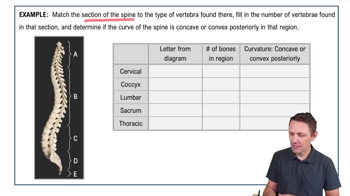
Cervical (7)
: supports skull;
Thoracic (12)
: rib attachment;
Lumbar (5)
: weight bearing;
Sacrum (1 fused)
: pelvic attachment;
Coccyx (1 fused)
: muscle attachment.
What is the purpose of spinal curves?
Allow
flexibility
,
shock absorption
,
proper weight transmission
, and
compression handling
.
Differentiate between kyphosis and lordosis curves.
Kyphosis
: posterior curve (backward C), primary, in thoracic and sacral regions;
Lordosis
: anterior curve (forward C), secondary, in cervical and lumbar regions.
When do secondary spinal curves develop?
Cervical lordosis develops when infant lifts head; lumbar lordosis develops when infant stands and walks.
What is scoliosis and how is it treated based on curve degree?
Abnormal lateral curvature of spine.
1–20°
: conservative care;
20–50°
: bracing;
>50°
: surgery.
What are the key structural parts of a vertebra and their functions?
Body
: weight bearing;
Vertebral foramen
: houses spinal cord;
Spinous & transverse processes
: muscle attachment;
Lamina & pedicle
: support vertebral arch;
Facets
: articulation surfaces.
How can you identify if a vertebra is viewed from superior or inferior?
Spinous process points downward; if process points down, viewing superior (top); if upward, viewing inferior (bottom).
What are the unique features of cervical vertebrae?
Small bodies, triangular vertebral foramen, bifid spinous process, and presence of transverse foramina containing vertebral arteries.
What is the function of the transverse foramen in cervical vertebrae?
Contains vertebral arteries that supply 15–20% of blood to the brain.
Describe the atlas (C1) vertebra and its function.
No body or spinous process, ring-shaped with anterior and posterior arches, largest vertebral foramen; supports skull and allows 'YES' nodding motion.
Describe the axis (C2) vertebra and its function.
Has dens (odontoid process) projecting upward into atlas; allows head rotation or 'NO' motion.
What are the key features of thoracic vertebrae?
Attach to ribs, have perfectly round vertebral foramen, long pointed spinous process, and heart-shaped body.
How do lumbar vertebrae differ from cervical vertebrae?
Lumbar have largest bodies, thick oval shape, short flat spinous process; both have triangular foramen but lumbar lack transverse foramina.
What are the functions of the sacrum and coccyx?
Sacrum attaches to pelvic bones; coccyx serves as muscle attachment and is tailbone; both are not weight-bearing.
What tissue type composes intervertebral discs and their function?
Fibrocartilage; acts as shock absorbers between vertebrae.
What are the components of an intervertebral disc and their roles?
Nucleus pulposus
: gel center for shock absorption;
Annulus fibrosus
: collagen outer ring containing the gel.
Differentiate between bulging and herniated discs.
Bulging disc: disc shifts without tear; herniated disc: tear in annulus fibrosus with nucleus pulposus leaking out.
What are the main components of the thoracic cage?
Thoracic vertebrae, sternum, ribs, and costal cartilage.
List the parts of the sternum and their functions.
Manubrium
: clavicle attachment;
Body
: rib attachment;
Xiphoid process
: CPR landmark and muscle attachment.
What are the three types of ribs and their anterior attachments?
True ribs
: attach directly to sternum;
False ribs
: attach to cartilage above;
Floating ribs
: no anterior attachment.
What is the mnemonic to remember rib attachments?
"T goes with T": Tubercle attaches to Transverse process; Head attaches to Vertebral body.
What are the clinical consequences of disrupted rib alignment?
Pain with breathing and difficulty expanding rib cage due to impaired rib movement needed for breathing.
 BackBack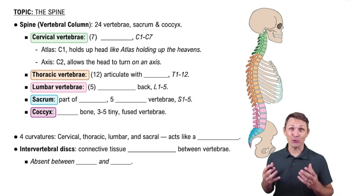
 6:29
6:29