Blood is classified as a connective tissue that develops from embryonic mesoderm.
What are the main components of blood?
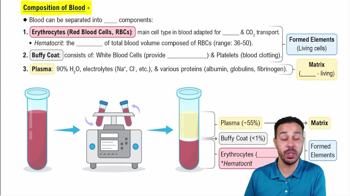
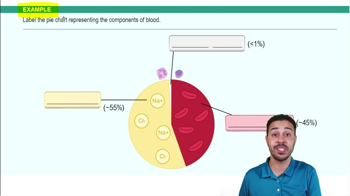
Blood consists of a matrix called blood plasma and various blood cells floating in this plasma.
Describe the appearance and smell of blood.
Blood is a liquid, opaque, salty, sticky fluid with a metallic smell due to its iron content and is slightly alkaline.
What is blood plasma and what does it contain?
Blood plasma is the liquid component of blood, yellowish in color, containing dissolved substances like water, salts, gases, proteins, glucose, fats, and waste products.
List the main functions of blood plasma.
Blood plasma transports blood components and other substances like medicines, helps with blood clotting via fibrinogen, recognizes foreign proteins via globulin, and maintains body temperature.
What are red blood corpuscles and their main function?
Red blood corpuscles or erythrocytes are flat, biconcave discs containing haemoglobin that transport oxygen and carbon dioxide.
Where are red blood cells produced and how many are there per cubic millimeter?
Red blood cells are produced in the red bone marrow with about 4-5 million per cubic millimeter.
What are white blood corpuscles and their role?
White blood corpuscles or leucocytes are colorless cells produced by bone marrow, spleen, and lymph glands that play an important role in the immune system.
Name the types of white blood cells classified by shape.
White blood cells include neutrophils, basophils, eosinophils, monocytes, and lymphocytes.
What are blood platelets and their function?
Blood platelets or thrombocytes are small discs without nuclei that help form blood clots to stop bleeding.
Explain the process of blood clotting.
Platelets gather at a wound, secrete substances to attract more platelets forming the first clot; fibrinogen converts to fibrin forming a network trapping cells for the second clot; Vitamin K is necessary for clotting.
What is haemophilia?
Haemophilia is a rare genetic disorder where a blood clotting factor is absent, causing blood not to clot naturally, often affecting males.
What is leukemia?
Leukemia is a cancer of blood-forming tissues causing excessive, dysfunctional white blood cells; it affects bone marrow and lymphatic system with no cure.
Define anemia and its effects.
Anemia is a lack of healthy red blood cells or haemoglobin, leading to reduced oxygen transport, causing weakness and tiredness.
Name some serious forms of anemia.
Serious forms include sickle cell anemia (abnormal RBC shape), aplastic anemia (reduced cell production), and iron-deficiency anemia (most common and treatable).
What color is blood flowing from arteries versus veins?
Blood is bright red when flowing from arteries and dark red when flowing from veins.
What proteins in plasma help with blood clotting and immune response?
Fibrinogen helps with blood clotting; globulin recognizes foreign proteins important for immune response and blood transfusions.
How does haemoglobin function in red blood cells?
Haemoglobin is a red pigment protein that binds iron to attract and transport oxygen molecules.
What percentage of blood do white blood cells make up?
White blood cells make up about 1% of blood, roughly 10,000-12,000 per cubic millimeter.
Why is Vitamin K important in blood clotting?
Vitamin K is necessary for the clotting process, helping convert fibrinogen to fibrin to form clots.
 Back
Back
 2:36
2:36