 Back
BackBlood Vessels & Circulation - Anatomy & Physiology
 3:38
3:38
Terms in this set (22)
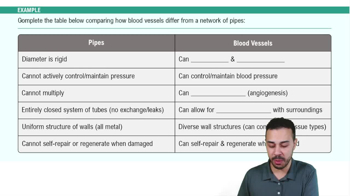
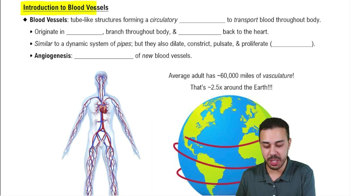
Arteries have thick walls, especially a thick tunica media with smooth muscle, allowing them to withstand high pressure and distribute blood from the heart.
Veins have thinner walls, larger lumens, and valves to prevent backflow. They return blood to the heart and act as blood reservoirs.
Capillaries consist only of the tunica intima (endothelium), allowing efficient exchange of gases, nutrients, and wastes.
Capillary beds are networks of capillaries with precapillary sphincters that regulate microcirculation by controlling blood flow to tissues.
Vasodilation is the widening of blood vessels due to relaxation of smooth muscle in the tunica media, which decreases resistance and increases blood flow.
Vasoconstriction is the narrowing of blood vessels due to contraction of smooth muscle, increasing resistance and decreasing blood flow.
Blood flow (\(Q\)) is directly proportional to pressure difference (\(\Delta P\)) and inversely proportional to resistance (\(R\)): \(Q=\frac{\Delta P}{R}\).
Baroreceptors and chemoreceptors in arteries send signals to the brain to adjust vessel diameter, controlling blood pressure and flow.
Hormones like epinephrine, ADH, and angiotensin II affect vessel tone and blood volume to regulate blood pressure and flow.
Local chemicals such as nitric oxide (NO) cause vasodilation, while endothelin causes vasoconstriction, regulating blood flow locally.
Key arteries include the aorta (main trunk), carotid (neck), subclavian (shoulder), renal (kidney), and femoral (thigh) arteries.
Key veins include the vena cavae (main trunks), jugular (neck), subclavian (shoulder), renal (kidney), and femoral (thigh) veins.
Includes hypovolemic (blood loss), vascular (abnormal vasodilation), cardiogenic (heart failure), and obstructive (blockage) shock.
Chronic condition characterized by high blood pressure in the arteries.
Condition involving plaque buildup inside arteries, leading to narrowed vessels and reduced blood flow.
Weakening and bulging of a blood vessel wall, which can rupture and cause serious complications.
Swollen, twisted veins caused by valve failure leading to blood pooling.
Formation of a blood clot inside a blood vessel, which can obstruct blood flow.
From inside out: tunica intima (smooth inner lining), tunica media (smooth muscle controlling diameter), and tunica externa (collagen fibers for support).
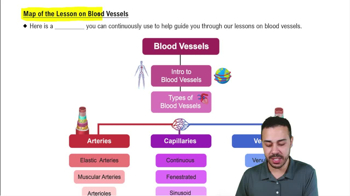
Includes elastic arteries (largest, buffer pressure), muscular arteries (distribute blood), and arterioles (smallest, regulate resistance).
Veins have thinner walls, larger lumens, and valves; arteries have thicker walls and higher pressure.
Anastomoses provide alternate routes for blood flow, ensuring tissue perfusion if one pathway is blocked.