 Back
BackBlood Vessels and Hemodynamics - Anatomy & Physiology
 3:38
3:38
Terms in this set (20)
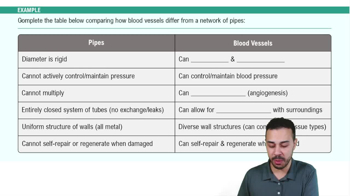
Tunica intima (endothelium & basement membrane), tunica media (smooth muscle), and tunica adventitia (collagen & elastic fibers with blood and nerve supply).
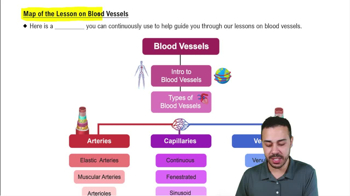
Elastic arteries have more elastic fibers in the tunica media for recoil and pressure maintenance; muscular arteries have thicker smooth muscle for vasoconstriction and vasodilation.
Arterioles control blood flow into capillaries via vasoconstriction or vasodilation and regulate systemic blood pressure.
Veins have thinner tunica intima and media, thicker tunica adventitia, larger lumen, and valves to prevent backflow; they return blood to the heart at lower pressure.
Weakened or damaged valves in veins cause blood to pool and veins to become enlarged and twisted, leading to varicose veins.
Connections between blood vessels (collateral vessels) that provide alternative pathways for blood flow, important in heart, brain, and joints.
BP is the force exerted by blood on vessel walls, measured in mm Hg using a sphygmomanometer and stethoscope detecting Korotkoff sounds.
MAP is the average arterial pressure during one cardiac cycle, calculated as \(\text{diastolic} + 0.33 \times (\text{systolic} - \text{diastolic})\).
Increased cardiac output, increased total blood volume, and increased systemic vascular resistance.
Resistance depends on vessel diameter, blood viscosity, vessel length, and presence of obstructions.
Velocity decreases as cross-sectional area increases in capillaries, allowing time for exchange, then increases again in veins.
Baroreceptors in carotid sinus and aorta detect BP changes and trigger reflexes to maintain stable blood pressure.
Sympathetic activation increases heart rate, contractility, and vasoconstriction, raising blood pressure.
Capillaries facilitate exchange of gases, nutrients, and wastes between blood and tissues.
Continuous (least leaky), fenestrated (moderately leaky), and sinusoidal (most leaky).
Diffusion, transcytosis, and bulk flow driven by hydrostatic and osmotic pressures.
They regulate blood flow into capillary beds by opening or closing in response to tissue needs.
Increased peripheral resistance raises blood pressure by opposing blood flow; decreased resistance lowers it.
Valves prevent backflow of blood, ensuring unidirectional flow toward the heart.
Over 60% of blood is found in veins at rest, acting as a blood reservoir.