 Back
BackCardiovascular System - Anatomy & Physiology
 6:13
6:13
Terms in this set (30)
Hemodynamics is the study of blood flow and the forces involved in circulation within the cardiovascular system.
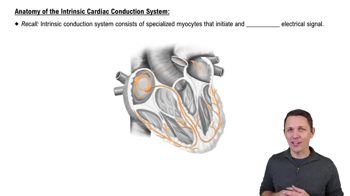
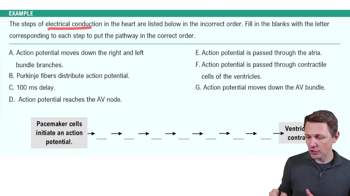
The main components are the sinoatrial (SA) node, atrioventricular (AV) node, bundle of His, bundle branches, and Purkinje fibers.
An ECG (electrocardiogram) records the electrical activity of the heart over time.
The main waves are P wave, QRS complex, and T wave. Key intervals include the PR interval and QT interval.
The cardiac cycle is the sequence of events in one heartbeat, including atrial and ventricular systole and diastole.
Heart sounds are caused by valve closures: S1 is the closing of AV valves, and S2 is the closing of semilunar valves.
A heart murmur is an abnormal sound caused by turbulent blood flow, often due to valve defects.
A pressure gradient drives blood flow from areas of higher pressure to lower pressure through vessels.
The two key factors are cardiac output and total peripheral resistance.
Cardiac output is the volume of blood the heart pumps per minute, calculated as stroke volume times heart rate.
Stroke volume is the amount of blood ejected by the left ventricle in one contraction.
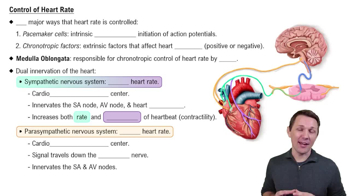
Heart rate is the number of heartbeats per minute.
Factors include preload (end-diastolic volume), contractility, and afterload (resistance).
Heart rate is influenced by autonomic nervous system input, hormones, temperature, and fitness level.
EDV is the volume of blood in the ventricles at the end of diastole, before contraction.
Ejection fraction is the percentage of EDV ejected during systole, calculated as stroke volume divided by EDV.
The baroreceptor reflex helps regulate blood pressure by adjusting heart rate and vessel diameter in response to pressure changes.
Peripheral resistance is the resistance to blood flow in vessels; increased resistance raises blood pressure.
TPR is the overall resistance to blood flow offered by all systemic blood vessels.
Venous return is the volume of blood returning to the heart via the veins.
Factors include skeletal muscle pump, respiratory pump, venous valves, and blood volume.
Total blood volume is most easily changed by adjusting fluid intake and renal function.
Starling’s law describes fluid exchange across capillaries based on hydrostatic and osmotic pressure differences.
Blood pressure is measured using a sphygmomanometer and listening for Korotkoff sounds during cuff deflation.
Korotkoff sounds are the sounds heard when blood flow resumes in an artery during blood pressure measurement.
Systolic pressure is the pressure in arteries during ventricular contraction.
Diastolic pressure is the pressure in arteries during ventricular relaxation.
MAP is the average arterial pressure during one cardiac cycle, important for tissue perfusion.
Pulse pressure is the difference between systolic and diastolic blood pressure.
Venous pressure is the blood pressure within the venous system, generally lower than arterial pressure.