 Back
BackCh. 9 Quiz Power Point A&P I
 8:11
8:11
Terms in this set (24)
What three things are skeletal muscles made up of?
Blood Vessels
Nerves
Connective Tissue
Each individual muscle cell is surrounded by _____ (thin connective tissue layer)
Endomysium
Most superficial connective tissue sheath
Fascia
Bundles of muscle cells
Fascicles
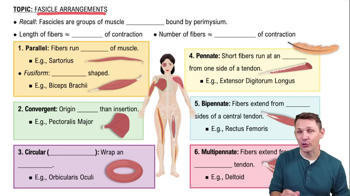
Strap like muscle; evenly spaced fascicles; muscle and tendon are same width
Parallel
Broad triangular-shaped muscle that tapers down into single tendon
Convergent
surround body openings; provide voluntary control over defecation and urination
Circular
muscle midsection is thicker than each tapered end
Fusiform
Pennate variation; fascicles attached to both sides of associated tendon
Bipennate
Pennate variation; fascicles only attached to one side of associated tendon
Unipennate
Fascicles attach to tendon at an angle; feather-like appearance
Pennate
groups of muscle fibers or fascicles that contract painfully and will not relax
Muscle knots
Provide most force for given muscle action
Agonists
Usually on opposite side of bones and joint where they meet
allows for modulation and control of agonist movement
Antagonists
Aid agonists by supplying supplemental force, minimizing unwanted movement; help stabilize joints; provide for efficient movement
Synergists
Provide stabilizing force that anchors bone; provides movement efficiency and protection from injury due to unnecessary movements
Fixators
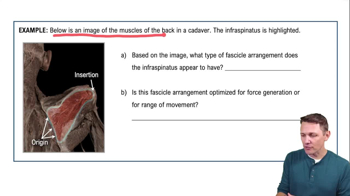
Anchoring Point on bone, attached at the non-movable bone
Origin
Moving end of muscle at the end that moves the bone
Insertion
What are the 3 components of the Lever System
Load (Resistance)
Force (moves the load)
Fulcrum (Pivot Point)
Fulcrum sits between load and applied force; load moves in opposite direction than applied force
First-class Lever (seesaw)
Fulcrum is at one end of the lever, applied force is near the other end; load is somewhere in-between; load moves in same direction as applied force
Second-class Lever (Dolly)
Fulcrum and applied force are close to one another at same end of lever; load is near other end; load moved in same direction as applied force
Third-class Lever (Tongs)
Placing the fulcrum close to the load allows a large load to be moved with a smaller force
Mechanical advantage
Placing the fulcrum farther from the load requires a greater force to move the load
Mechanical Disadvantage