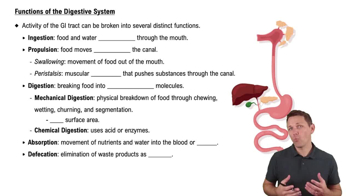
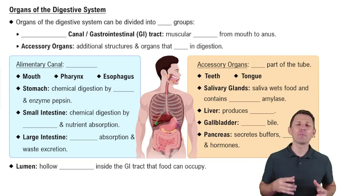
The large intestine is about 1.5 meters (5 feet) long and has a larger diameter than the small intestine.
Primary functions of the large intestine
Propulsion and defecation, absorption of water, minerals, electrolytes, maintaining acid-base homeostasis, and housing beneficial gut microbiota.
Location and role of the cecum
The cecum is the first portion of the large intestine, a blind pouch in the right lower abdomen; it connects to the appendix which plays a role in the immune system.
Cause and symptoms of appendicitis
Blockage of appendix by fecal matter causes bacterial infection and inflammation; symptoms include right lower quadrant abdominal pain, nausea, and vomiting.
Potential complications of untreated appendicitis
Appendix may rupture causing internal bleeding, peritonitis, and can be fatal if untreated.
Four portions of the colon
Ascending colon, transverse colon, descending colon, and sigmoid colon.
Function of the internal anal sphincter
Involuntary sphincter made of thickened circular muscularis externa, controlled by parasympathetic motor neurons.
Function of the external anal sphincter
Voluntary sphincter composed of skeletal muscle, controlled by somatic motor neurons from the cerebral cortex.
Histological features of the large intestine mucosa
Lacks villi and microvilli, contains numerous goblet cells that secrete mucus for protection and lubrication.
Role of gut flora in the large intestine
Produce vitamins like vitamin K, metabolize undigested carbohydrates into fatty acids, and inhibit growth of harmful bacteria.
Proximal large intestine functions
Consists of ascending and transverse colon; primary site for water and electrolyte absorption and bacterial activity.
Distal large intestine functions
Includes descending and sigmoid colon, rectum, and anal canal; stores fecal material and absorbs small amounts.
Haustral contractions in the large intestine
Occur every 30 minutes in ascending and transverse colon; aid water and electrolyte absorption; controlled by ENS.
Mass movements in the large intestine
Propulsive peristaltic waves moving fecal contents toward distal colon; occur 3-4 times daily, often triggered by food intake.
Defecation reflex mechanism
Rectal distension activates parasympathetic reflex causing sigmoid colon and rectum contraction, internal anal sphincter relaxation, and voluntary external sphincter control.
Effect of increased large intestine motility
Less water absorption, resulting in diarrhea; insoluble fiber speeds up motility.
Effect of decreased large intestine motility
Excess water absorption, causing hard feces and constipation; dehydration is a common cause.
Definition of digestion
A catabolic process breaking down large molecules into monomers via hydrolysis.
Barriers for nutrient absorption in the alimentary canal
Apical plasma membrane, cytosol, basal plasma membrane, and endothelial cells of capillaries.
Initial carbohydrate digestion
Begins in mouth with salivary amylase breaking starch into oligosaccharides.
Completion of carbohydrate digestion
Occurs in small intestine by pancreatic amylase and brush border enzymes producing monosaccharides.
Absorption of monosaccharides
Glucose and galactose use active transport; fructose uses facilitated diffusion; all exit enterocytes by facilitated diffusion into blood.
Start of protein digestion
Begins in stomach with pepsin activated from pepsinogen by chief cells.
Major site of protein digestion
Small intestine with pancreatic enzymes activated by trypsin and brush border enzymes producing free amino acids.
Protein absorption mechanism
Amino acids cotransported with sodium via active transport across apical membrane; exit by facilitated diffusion into capillaries.
Major dietary lipids and their digestion
Mostly triglycerides; mechanical digestion breaks globules; emulsification by bile salts increases surface area for pancreatic lipase.
Role of micelles in lipid absorption
Micelles formed by bile salts escort fatty acids and monoglycerides to enterocyte membrane for absorption.
Fate of absorbed lipids inside enterocytes
Reassembled into triglycerides, packaged into chylomicrons, released by exocytosis into lacteals (lymphatic system).
Lipid transport after absorption
Lipids enter lymph, then bloodstream; capillary enzymes break down chylomicrons into fatty acids and glycerol for energy or storage.
 Back
Back
 4:06
4:06