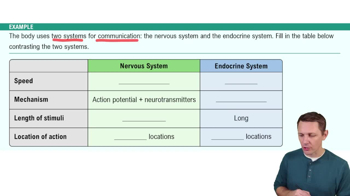
What are the two major regulatory systems of the body?
The nervous system and the endocrine system.
How do endocrine organs communicate with target cells?
Endocrine organs secrete hormones into the blood, which bind to specific receptors on target cells in target tissues.
Describe the pathway of hormone transport from secretion to target cell binding.
Hormones are secreted into interstitial fluid, diffuse into blood capillaries, transported via veins to the heart, then arteries distribute hormones to the body, where they diffuse out of capillaries to bind target cell receptors.
What are paracrine and autocrine signals?
Paracrine signals affect nearby cells via chemicals secreted into extracellular fluid; Autocrine signals affect the same cell that secreted the chemical.
What distinguishes endocrine glands from exocrine glands?
Endocrine glands are ductless and secrete hormones into interstitial fluid for blood transport; exocrine glands secrete products into ducts leading to body surfaces or cavities.
Name the seven primary endocrine organs.
Anterior pituitary, thyroid gland, parathyroid glands, adrenal cortices, endocrine pancreas, thymus, and ovaries or testes.
What are neuroendocrine organs?
Organs composed of nervous tissue that secrete hormones called neurohormones, including the hypothalamus, pineal gland, and adrenal medulla.
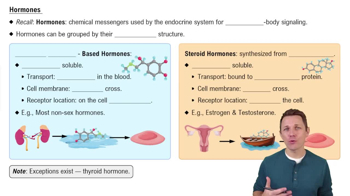
What are the three classes of hormones based on chemical structure?
Amino acid-based hormones, peptide/protein hormones, and steroid hormones.
How are hydrophilic and hydrophobic hormones transported in the blood?
Hydrophilic hormones travel freely in plasma; hydrophobic hormones bind to plasma proteins for transport.
What defines a target cell for a hormone?
A cell that has specific receptors that bind a hormone, triggering changes in cell function.
Explain upregulation and downregulation of hormone receptors.
Upregulation increases receptor numbers when hormone levels decline, increasing sensitivity; downregulation decreases receptor numbers after prolonged high hormone exposure.
Describe the second-messenger system for hydrophilic hormones.
Hormone binds plasma membrane receptor, activates G-protein, which activates adenylate cyclase to produce cAMP, activating protein kinase A to phosphorylate proteins and alter cell activity.
How do hydrophobic hormones like steroids act on target cells?
They diffuse into the cell, bind intracellular receptors, enter the nucleus, and interact with DNA to regulate gene transcription.
List some effects of hormone action on target cells.
Stimulating secretion, activating/inhibiting enzymes, regulating mitosis/meiosis, opening/closing ion channels, and altering gene expression.
What are complementary, synergistic, and antagonistic hormone interactions?
Complementary hormones affect different cells for a common goal; synergists act on the same cell with similar effects; antagonists act on the same cell with opposite effects.
What is hormone half-life and how does it vary?
The time for hormone plasma concentration to reduce by half; hydrophobic hormones have longer half-lives than hydrophilic hormones.
What are the three types of stimuli that regulate hormone secretion?
Hormonal stimuli (response to other hormones), humoral stimuli (response to blood ion or compound levels), and neural stimuli (response to nervous system signals).
Describe the negative feedback loop regulating hormone secretion.
A physiological variable deviates, detected by receptors, stimulating hormone secretion, which triggers a response to restore normal range, then secretion returns to baseline.
What is the functional relationship between the hypothalamus and anterior pituitary?
Hypothalamus secretes releasing/inhibiting hormones into portal veins, regulating anterior pituitary hormone secretion, which controls other endocrine glands.
Name the anterior pituitary hormones that affect other glands and their triggers.
TSH (triggered by TRH), ACTH (triggered by CRH), LH and FSH (triggered by GnRH), and Prolactin (stimulated by suckling, inhibited by dopamine).
What are the short-term and long-term effects of growth hormone (GH)?
Short-term: promotes fat breakdown, gluconeogenesis, and inhibits glucose uptake; Long-term: stimulates IGF production, protein synthesis, cell division, bone growth, and muscle development.
What causes gigantism, acromegaly, and pituitary dwarfism?
Gigantism: GH hypersecretion before epiphyseal closure; acromegaly: GH hypersecretion after closure; pituitary dwarfism: GH hyposecretion before closure.
What is the structure of the thyroid gland?
Two lobes connected by an isthmus, composed of thyroid follicles lined by follicle cells producing thyroid hormones, filled with colloid; parafollicular cells produce calcitonin.
What are the main thyroid hormones and their characteristics?
Triiodothyronine (T3) with 3 iodine atoms, more active; thyroxine (T4) with 4 iodine atoms, converted to T3 in target cells; both regulate metabolism and development.
How is thyroid hormone production regulated?
Negative feedback loop: hypothalamus secretes TRH, stimulating anterior pituitary to release TSH, which stimulates thyroid hormone production; low hormone levels or cold increase production.
What is the role of parathyroid hormone (PTH) in calcium homeostasis?
PTH increases blood calcium by stimulating osteoclasts to release calcium from bone, increasing intestinal absorption via vitamin D activation, and enhancing kidney calcium reabsorption.
What is the function of calcitonin?
Produced by thyroid parafollicular cells in response to high blood calcium; inhibits osteoclast activity to lower blood calcium.
Describe the adrenal cortex zones and their hormone products.
Zona glomerulosa produces mineralocorticoids (aldosterone); zona fasciculata produces glucocorticoids (cortisol); zona reticularis produces glucocorticoids and androgenic steroids.
What are the main effects of aldosterone?
Regulates sodium and potassium levels, increases extracellular fluid volume and blood pressure, and maintains acid-base balance by promoting hydrogen ion excretion.
What are the effects and regulation of cortisol?
Cortisol promotes gluconeogenesis, protein and fat breakdown, acts as an anti-inflammatory, and mediates stress response; regulated by the HPA axis via CRH and ACTH.
What are the adrenal medulla hormones and their effects?
Chromaffin cells secrete epinephrine and norepinephrine, which mediate the sympathetic nervous system's immediate stress response, increasing heart rate, dilating bronchioles, and redirecting blood flow.
What are the main endocrine cell types in the pancreas and their hormones?
Increases blood glucose by stimulating glycogenolysis, gluconeogenesis, protein breakdown, fat release, and ketone body formation.
What are the primary actions of insulin?
Promotes uptake and storage of glucose, lipids, and amino acids; lowers blood glucose; stimulates glycogen, fat, and protein synthesis; promotes satiety.
What causes type 1 and type 2 diabetes mellitus?
Type 1: autoimmune destruction of beta cells causing insulin deficiency; Type 2: insulin resistance and decreased beta cell responsiveness, often linked to heredity and obesity.
How is blood glucose regulated when levels rise?
Beta cells detect high glucose, increase insulin secretion, which promotes glucose uptake and storage, lowering blood glucose; glucagon secretion decreases.
 Back
Back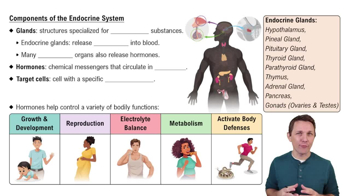
 7:06
7:06