What are the two main types of cells in nervous tissue?
Neurons for intercellular communication and Neuroglia (glial cells) that support and preserve nervous tissue structure.
What are the anatomical divisions of the nervous system?
The Central Nervous System (CNS) and the Peripheral Nervous System (PNS).
What are the main functions of the Central Nervous System (CNS)?
Processes sensory data, coordinates motor commands, and performs higher brain functions like intelligence, memory, learning, and emotion.
What does the Peripheral Nervous System (PNS) include and do?
Includes all nervous tissue outside CNS and ENS; delivers sensory info to CNS and carries motor commands to peripheral tissues.
What are the functional divisions of the PNS?
Afferent division carries sensory info to CNS; Efferent division carries motor commands from CNS to muscles, glands, and adipose tissue.
What are the two subdivisions of the efferent division of the PNS?
Somatic nervous system (SNS) controls skeletal muscles; Autonomic nervous system (ANS) controls smooth, cardiac muscle, and glands.
What is the Enteric Nervous System (ENS)?
A network of 100 million neurons in the digestive tract walls that coordinates visceral reflexes locally without CNS input.
What are the main parts of a typical neuron?
Dendrites, cell body (soma) with nucleus and perikaryon, and a single long axon with axon terminals.
What is the function of dendritic spines?
Fine processes on dendrites that receive information from other neurons, covering 80–90% of neuron surface area.
What is the axoplasm and axolemma?
Axoplasm is the cytoplasm inside the axon; axolemma is the plasma membrane covering the axoplasm.
What is axonal transport?
Movement of materials between the cell body and axon terminals along neurotubules, powered by mitochondria, kinesin, and dynein.
Name the four structural classifications of neurons.
Anaxonic, Bipolar, Unipolar (pseudounipolar), and Multipolar neurons.
What distinguishes unipolar neurons?
Axon and dendrites are fused with the cell body off to one side; most sensory neurons of the PNS.
What are the three functional classifications of neurons?
Sensory neurons, Motor neurons, and Interneurons.
What are the types of sensory receptors based on location and function?
Interoceptors (internal systems), Exteroceptors (external environment), and Proprioceptors (position and movement).
What are the main types of neuroglia in the CNS?
Astrocytes, Ependymal cells, Oligodendrocytes, and Microglia.
What are the functions of astrocytes?
Maintain blood-brain barrier, provide structural support, repair nervous tissue, guide neuron development, and control interstitial environment.
What do ependymal cells do?
Line ventricles and central canal, produce and circulate cerebrospinal fluid (CSF) with their cilia.
What is the role of oligodendrocytes?
Form myelin sheath around CNS axons to insulate and increase action potential speed.
What is the function of microglia?
Smallest neuroglia that migrate through nervous tissue to remove debris, wastes, and pathogens by phagocytosis.
What neuroglia are found in the PNS?
Satellite cells that surround ganglia and regulate interstitial fluid, and Schwann cells that form myelin sheaths around axons.
What is Wallerian degeneration?
Degeneration of the axon distal to an injury, followed by Schwann cells forming a path for new axon growth.
What is resting membrane potential?
The electrical potential of a resting cell, typically around −70 mV, established by ion concentration differences and membrane permeability.
What ions are most important in establishing resting membrane potential?
High extracellular sodium (Na+) and chloride (Cl−); high intracellular potassium (K+) and negatively charged proteins.
What is the sodium-potassium exchange pump's role?
Uses ATP to eject 3 Na+ ions and bring in 2 K+ ions, stabilizing resting membrane potential.
What are the three types of gated ion channels?
Chemically gated (ligand-gated), voltage-gated, and mechanically gated ion channels.
What is an action potential?
A propagated electrical impulse along an axon, triggered when membrane potential reaches threshold (−60 to −55 mV).
What is the all-or-none principle of action potentials?
An action potential either occurs fully when threshold is reached or not at all, regardless of stimulus strength.
What are the steps in generating an action potential?
1) Depolarization to threshold, 2) Activation of voltage-gated Na+ channels, 3) Inactivation of Na+ channels and activation of K+ channels, 4) Return to resting potential.
What is the difference between continuous and saltatory propagation?
Continuous occurs in unmyelinated axons with stepwise depolarization; saltatory occurs in myelinated axons with impulses jumping between nodes of Ranvier.
How does axon diameter affect action potential speed?
Larger diameter axons have lower resistance and conduct impulses faster.
What are the three types of axons based on diameter and myelination?
Type A (large, myelinated, fast), Type B (medium, myelinated, intermediate speed), Type C (small, unmyelinated, slow).
What is a synapse?
A specialized site where a neuron communicates with another cell, involving a presynaptic neuron and a postsynaptic neuron or effector.
What are the two types of synapses?
Electrical synapses with direct cell contact and chemical synapses using neurotransmitters across a synaptic cleft.
What is the function of acetylcholine (ACh) at cholinergic synapses?
ACh is released by presynaptic neurons, binds to postsynaptic receptors, causing depolarization, and is broken down by acetylcholinesterase.
What are excitatory and inhibitory neurotransmitters?
Excitatory neurotransmitters cause depolarization and promote action potentials; inhibitory neurotransmitters cause hyperpolarization and suppress action potentials.
What are neuromodulators?
Chemicals released by axon terminals that alter neurotransmitter release or postsynaptic response, with long-term and slow effects.
What are examples of neuromodulators?
Neuropeptides like opioids (enkephalins, endorphins, dynorphins) and dissolved gases like nitric oxide (NO) and carbon monoxide (CO).
What is temporal summation?
Rapid, repeated stimuli at a single synapse that combine to increase postsynaptic potential.
What is spatial summation?
Simultaneous stimuli at multiple synapses that combine to affect the postsynaptic neuron.
What is presynaptic inhibition and facilitation?
Presynaptic inhibition decreases neurotransmitter release; presynaptic facilitation increases neurotransmitter release at the presynaptic membrane.
 Back
Back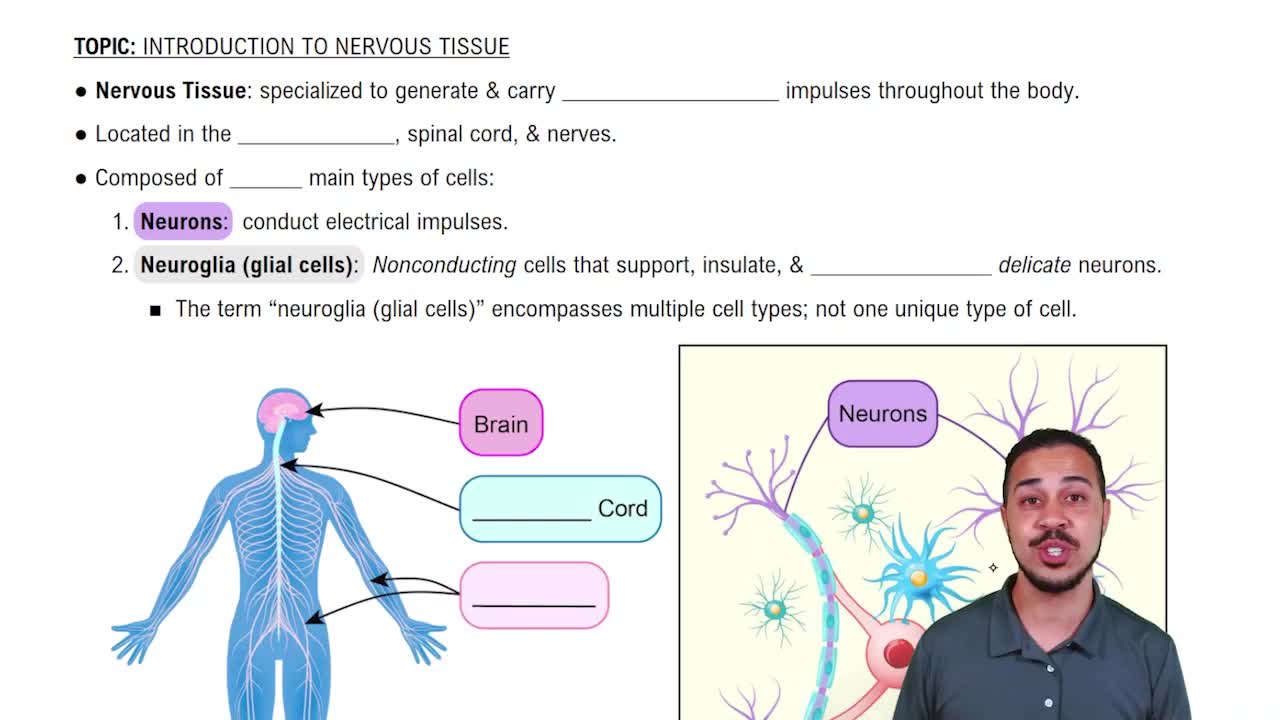
 04:36
04:36