 Back
BackFundamentals of Anatomy & Physiology: Tissue Level of Organization
 03:32
03:32
Terms in this set (31)
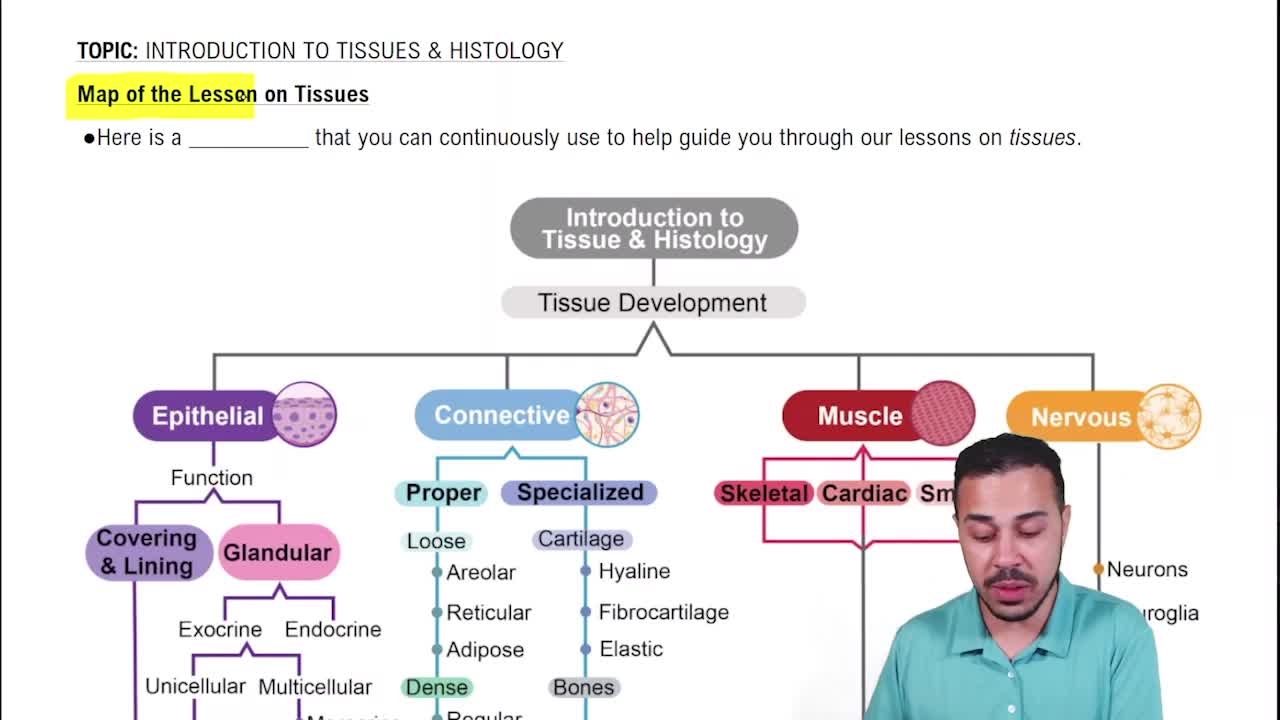
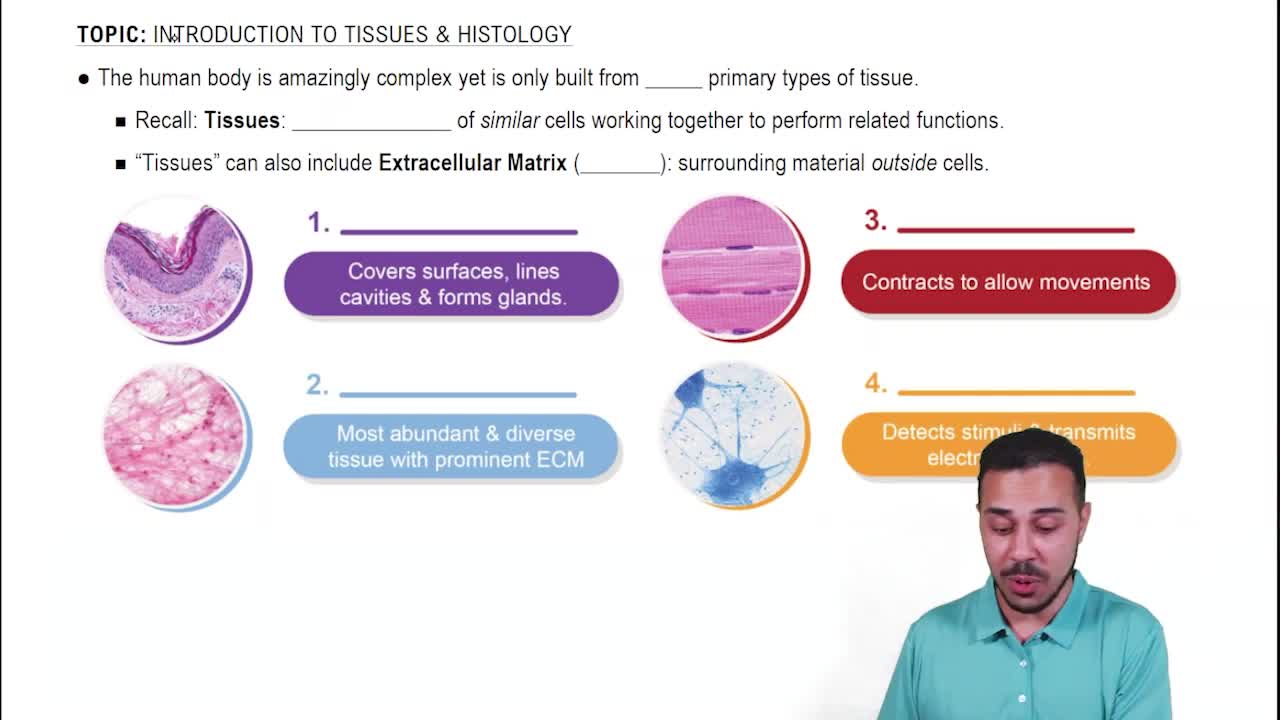
Epithelial, Connective, Muscle, and Nervous tissues.
Protection, control permeability, sensation, and production of specialized secretions.
Polarity, cellularity, attachment to basement membrane, avascularity, and regeneration.
Microvilli increase surface area for absorption or secretion; cilia move fluids over the epithelium.
Gap junctions, tight junctions, and desmosomes.
Allow passage of small molecules and ions between cells through interlocking connexons.
Prevent passage of water and solutes between cells, maintaining a barrier between lumen and underlying tissue.
Cell adhesion structures that link cytoskeletons of adjacent cells, providing mechanical stability.
Basal lamina (selective filter) and reticular lamina (strength layer with reticular fibers and ground substance).
By continual division of stem cells located near the basement membrane.
Squamous (flat), cuboidal (boxy), and columnar (tall and slender).
Simple (single layer) and stratified (multiple layers).
Absorption and diffusion; found in lung alveoli, mesothelium, and endothelium.
Keratinized has a layer of dead cells with keratin for water resistance; non-keratinized does not.
Secretion and absorption; found in glands and kidney tubules.
Cells change from cuboidal to squamous when stretched; allows repeated stretching without damage; found in urinary bladder.
Appears layered but is a single layer; often ciliated; found in respiratory tract.
Endocrine glands (hormone secretion into blood) and exocrine glands (secretion onto epithelial surfaces).
Merocrine (exocytosis), apocrine (shedding cytoplasm), and holocrine (cell bursting).
Connective tissue proper, fluid connective tissues, and supporting connective tissues.
Structural framework, transport, protection, support, energy storage, and defense against microorganisms.
Most abundant fixed cells; secrete ground substance and protein fibers.
Collagen (strength), reticular (support network), and elastic (stretch and recoil).
Loose connective tissue that cushions and stabilizes cells and supports epithelia.
Parallel collagen fibers providing strength; found in tendons and ligaments.
Connective tissue wrapping organs; includes superficial, deep, and subserous fascia.
Plasma (fluid matrix), red blood cells, white blood cells, and platelets.
Hyaline (common, flexible), elastic (flexible with elastic fibers), fibrocartilage (tough, collagen-rich).
By interstitial growth (from within) and appositional growth (adding to surface).
Skeletal (voluntary, striated), cardiac (involuntary, striated), and smooth (involuntary, nonstriated).
Neurons (conduct electrical impulses) and neuroglia (supporting cells).