 Back
BackGross Anatomy of the Nervous System - Anatomy & Physiology
 0:50
0:50
Terms in this set (24)
The CNS consists of the brain and spinal cord, responsible for processing and integrating information.
The PNS includes all nerves outside the CNS, subdivided into cranial and spinal nerves.
Neurons that carry information toward the CNS from sensory receptors.
Neurons that transmit impulses away from the CNS to effector organs like muscles.
Controls voluntary movements by innervating skeletal muscles.
Regulates involuntary functions by controlling heart, glands, and viscera. Divided into sympathetic and parasympathetic divisions.
Known as the "fight, flight, freeze" system; activates energy-expending responses during stress.
Known as the "rest and digest" system; conserves and replenishes energy.
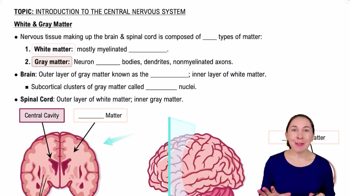
Inner region shaped like an "H" containing neuronal cell bodies and involved in processing.
Outer region composed of myelinated axons organized into columns and tracts for fast signal conduction.
31 pairs of nerves emerging from the spinal cord, each with an anterior (motor) root and a posterior (sensory) root.
Three protective layers around the brain and spinal cord: dura mater, arachnoid mater, and pia mater.
Fluid in the subarachnoid space that cushions the CNS and maintains its environment.
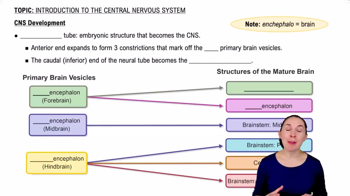
The largest brain region, divided into two hemispheres and four lobes: frontal, parietal, temporal, occipital.
Located posterior to the cerebrum, it regulates muscle coordination, balance, and posture.
Contains the thalamus and hypothalamus, which process sensory information and regulate homeostasis.
Relay center that directs sensory and motor signals to the cerebral cortex.
Regulates circadian rhythm, hunger, thirst, body temperature, and controls the pituitary gland.
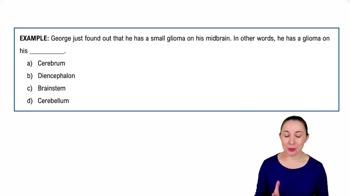
Includes the midbrain, pons, and medulla oblongata; controls vital functions like heart rate and breathing.
Twelve pairs of nerves emerging from the brain, numbered I to XII, with sensory, motor, or mixed functions.
Sensory nerve for smell, originating in the nasal mucosa and terminating in the olfactory bulb.
Sensory nerve for vision, originating in the retina and passing through the optic chiasma.
Motor nerve controlling eye movement, eyelid opening, pupil constriction, and lens shape.
Mixed nerve for facial sensation and motor control of mastication and swallowing.