What is the primary function of the respiratory system?
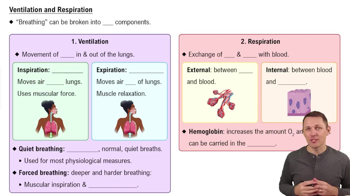
To move oxygen into body tissues for cellular respiration and remove carbon dioxide, a waste product, from cells.
Name the main parts of the human respiratory system.
Trachea, bronchi, bronchioles, alveoli, and diaphragm.
What happens during inhalation?
The diaphragm and intercostal muscles contract, causing the rib cage to expand and air to move into the lungs.
What happens during exhalation?
The diaphragm and intercostal muscles relax, the diaphragm domes upward, rib cage contracts, and air is pushed out of the lungs.
What is the role of alveoli in the respiratory system?
Alveoli are moist, thin-walled pockets where gas exchange occurs between air and blood.
Why is surfactant important in the alveoli?
Surfactant is a slightly oily substance that prevents alveolar walls from collapsing and sticking together.
How does gas exchange occur in the lungs?
Oxygen diffuses from alveoli into blood in capillaries, and carbon dioxide diffuses from blood into alveoli to be exhaled.
What is the relationship between the respiratory and circulatory systems in gas exchange?
The respiratory system supplies oxygen to the blood, and the circulatory system transports oxygen to body cells and carries carbon dioxide back to the lungs.
How does hemoglobin assist in oxygen transport?
Hemoglobin binds oxygen molecules, increasing oxygen transport efficiency in the blood.
In what forms is carbon dioxide transported in the blood?
Dissolved in plasma, bound to hemoglobin, and mostly as bicarbonate ions (about 70%).
What creates the diffusion gradient for oxygen and carbon dioxide at the cells?
Cells use oxygen quickly and produce carbon dioxide, making oxygen concentration lower and CO2 concentration higher inside cells than in blood.
What harmful effects does smoking have on the respiratory system?
Smoking introduces CO2, carcinogens, and nicotine, which paralyzes cilia, damages lung tissue, and increases risk of tumors and emphysema.
What is emphysema and how is it related to smoking?
Emphysema is a lung disease where alveoli become brittle and rupture, often caused by smoking or exposure to smoke.
What causes cystic fibrosis (CF)?
A mutation in the CFTR gene that controls chloride ion balance in lung cells, leading to thick, sticky mucus.
How does the CFTR mutation affect lung mucus in cystic fibrosis?
Faulty CFTR causes excess salt inside cells, drawing water out of mucus by osmosis, making it thick and sticky.
Why do people with cystic fibrosis have trouble with lung infections?
Thick, sticky mucus traps bacteria and impairs cilia function, reducing lung cleaning and increasing infection risk.
What role do cilia and mucus play in lung health?
Mucus traps dust and microbes; cilia move mucus out of the lungs to keep airways clean.
Can lungs recover after quitting smoking?
Yes, if lungs are not severely damaged, cilia can recover and help clean the lungs again.
What is cellular respiration?
The breakdown of glucose in mitochondria to produce ATP, using oxygen and producing carbon dioxide as a waste.
How does oxygen move from alveoli to body cells?
Oxygen diffuses from alveoli into blood, binds hemoglobin, is transported to tissues, and diffuses into cells following concentration gradients.
 Back
Back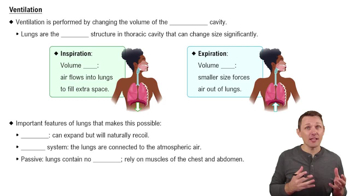
 4:28
4:28