What are the main components of the integumentary system?
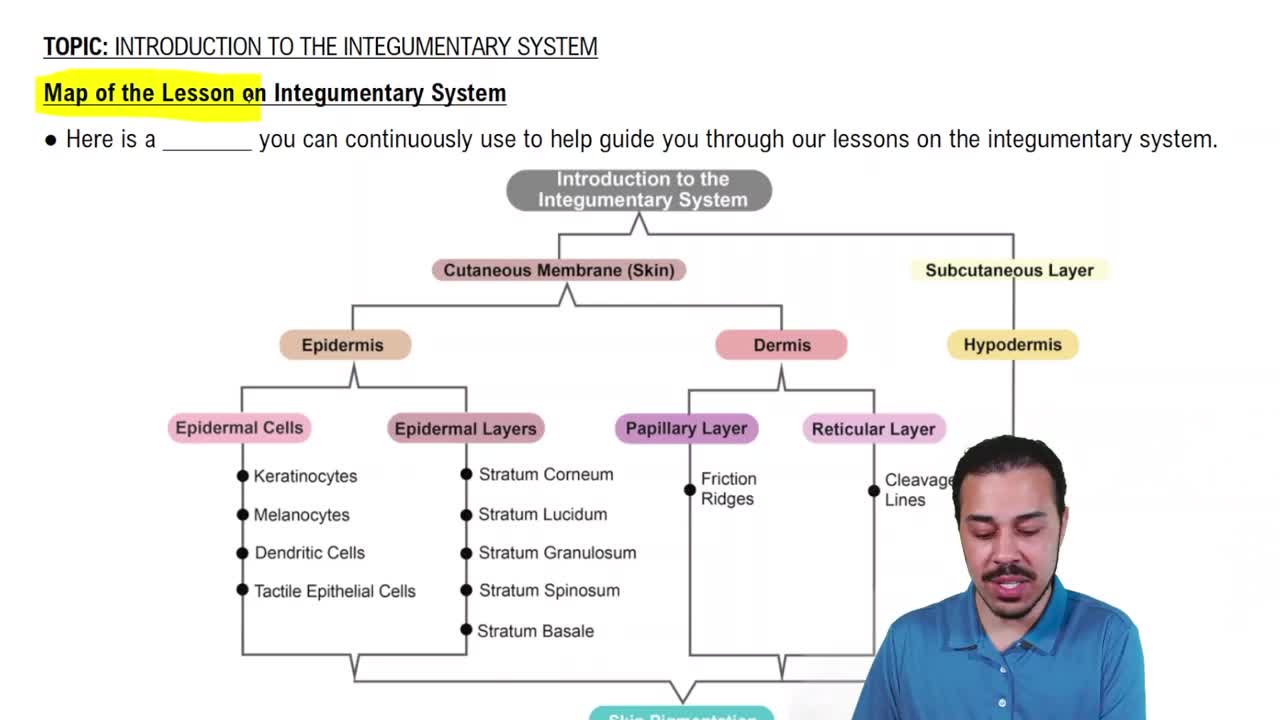
The integumentary system includes the cutaneous membrane (skin), hair, nails, glands, and sensory receptors.
What are the three main layers of the cutaneous membrane (skin)?
The skin consists of the epidermis (outer epithelial layer), dermis (connective tissue layer beneath epidermis), and the hypodermis (subcutaneous layer beneath dermis).
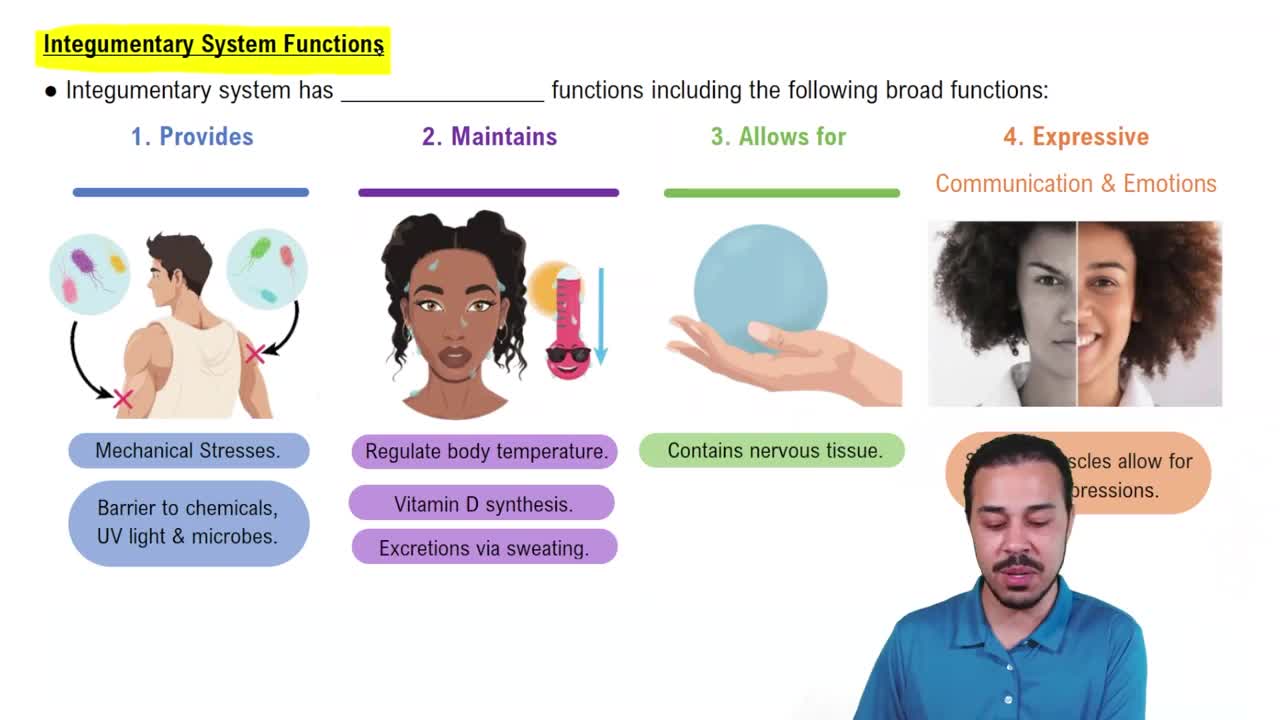
List four broad functions of the integumentary system.
Functions include: 1) Providing a protective barrier, 2) Maintaining homeostasis, 3) Allowing for sensation, and 4) Expressing communication and emotions.
What is thermoregulation and how does the integumentary system contribute?
Thermoregulation is maintaining stable internal body temperature. The skin regulates temperature via vasoconstriction/vasodilation of blood vessels and sweating.
What happens during vasoconstriction?
Blood vessels constrict (decrease diameter) to reduce blood flow to the skin, conserving body heat when cold.
What happens during vasodilation?
Blood vessels dilate (increase diameter) to increase blood flow to the skin, promoting heat loss when hot.
How does sweating help cool the body?
Sweat glands secrete water-based sweat onto the skin surface, which cools the body as it evaporates.
What are keratinocytes and their role in the epidermis?
Keratinocytes are the most abundant epidermal cells responsible for producing keratin, a tough, water-resistant protein that strengthens the skin.
Name the four main types of cells in the epidermis.
Melanocytes produce melanin, a pigment that protects skin from UV damage.
What role do dendritic cells play in the epidermis?
Dendritic cells help initiate immune responses to prevent infection.
What is the function of tactile epithelial (Merkel) cells?
They work with nerves to detect touch sensations.
How many layers does the epidermis have and what are they called?
The epidermis has five layers: 1) Stratum basale, 2) Stratum spinosum, 3) Stratum granulosum, 4) Stratum lucidum (only in thick skin), 5) Stratum corneum.
What is the difference between thick and thin skin?
Thick skin contains the stratum lucidum, has more sweat glands, and no hair follicles or oil glands. Thin skin lacks stratum lucidum and contains hair follicles and oil glands.
Where do keratinocytes originate and how do they mature?
Keratinocytes originate in the stratum basale and move upward, becoming more keratinized and dying as they reach the surface.
What is the papillary layer of the dermis?
The papillary layer is the superficial dermis made of loose connective tissue containing capillaries, lymphatic vessels, and touch receptors called Meissner corpuscles.
What are dermal papillae and their function?
Dermal papillae are projections that indent the epidermis, forming ridges that enhance grip and create fingerprints.
What is the reticular layer of the dermis?
The reticular layer is the deeper dermis made of dense irregular connective tissue containing sweat and oil glands, hair roots, and pressure receptors called Pacinian corpuscles.
What are cleavage (tension) lines in the skin?
Cleavage lines are parallel orientations of collagen fibers in the dermis; incisions along these lines heal faster.
What is the hypodermis and its functions?
The hypodermis is a subcutaneous layer of mostly adipose tissue that anchors skin, acts as a shock absorber, and reduces heat loss.
 Back
Back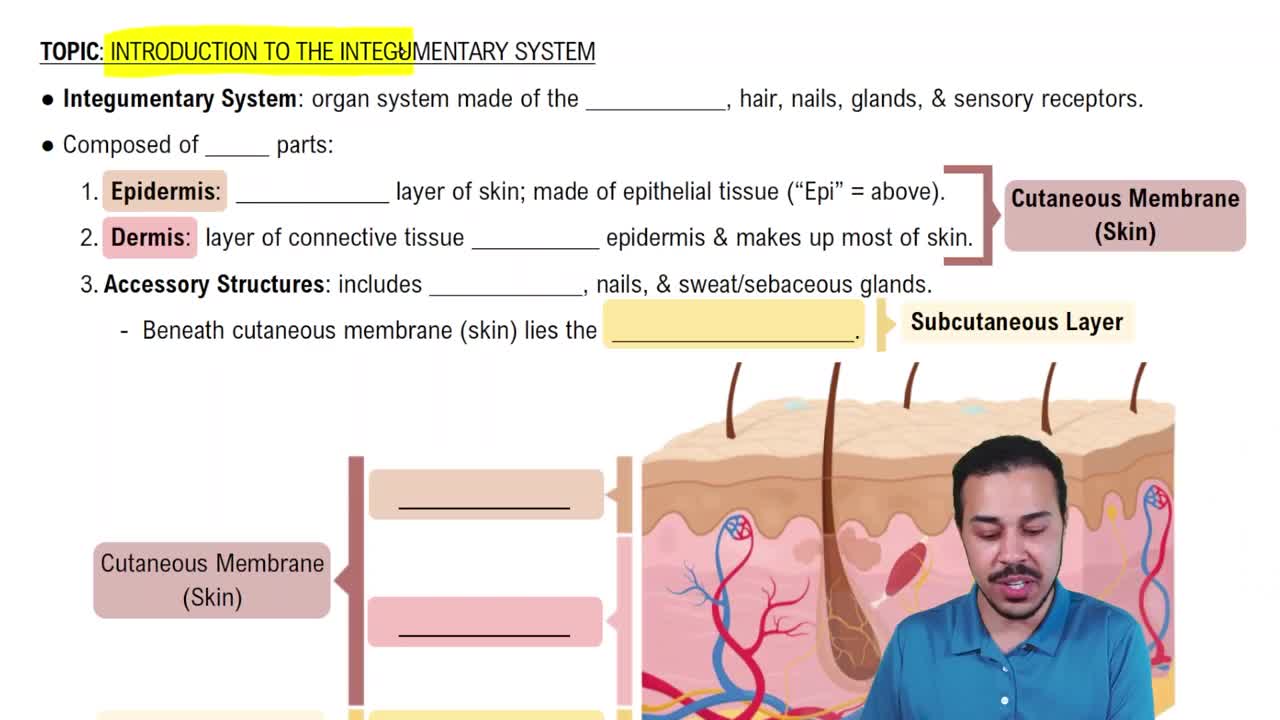
 06:54
06:54