How long does it take for keratinocytes to migrate from the stratum basale to the stratum corneum?
Between 40–50 days.
What are melanocytes and their function?
Cells that produce melanin, the pigment responsible for skin color.
What distinguishes thick skin from thin skin?
Thick skin has a thicker epidermis with a stratum lucidum and is found on palms and soles; thin skin lacks stratum lucidum and covers most of the body.
What are the two layers of the dermis?
Papillary layer and reticular layer.
What sensory receptors are found in the papillary layer?
Tactile (Meissner) corpuscles.
What sensory receptors are found in the reticular layer?
Lamellated (Pacinian) corpuscles.
What causes fingerprints?
Epidermal ridges formed by dermal papillae enhance grip and produce fingerprints.
Name two minor pigments affecting skin color besides melanin.
Carotene and hemoglobin.
What are the four types of sweat glands?
Eccrine, apocrine, ceruminous, and mammary glands.
What is the function of sebaceous glands?
Produce oily sebum that lubricates and waterproofs the skin and hair.
What is piloerection and what causes it?
Contraction of arrector pili muscles causes hair to stand up, producing 'goosebumps.'
Where does nail growth occur?
At the nail matrix, where actively dividing cells push keratinocytes distally.
What are the three types of skin cancer linked to UV exposure?
Basal cell carcinoma, squamous cell carcinoma, and malignant melanoma.
What are the ABCDE signs of malignant melanoma?
Asymmetry, Border irregularity, Color variation, Diameter > 6 mm, and Evolving shape/size.
 Back
Back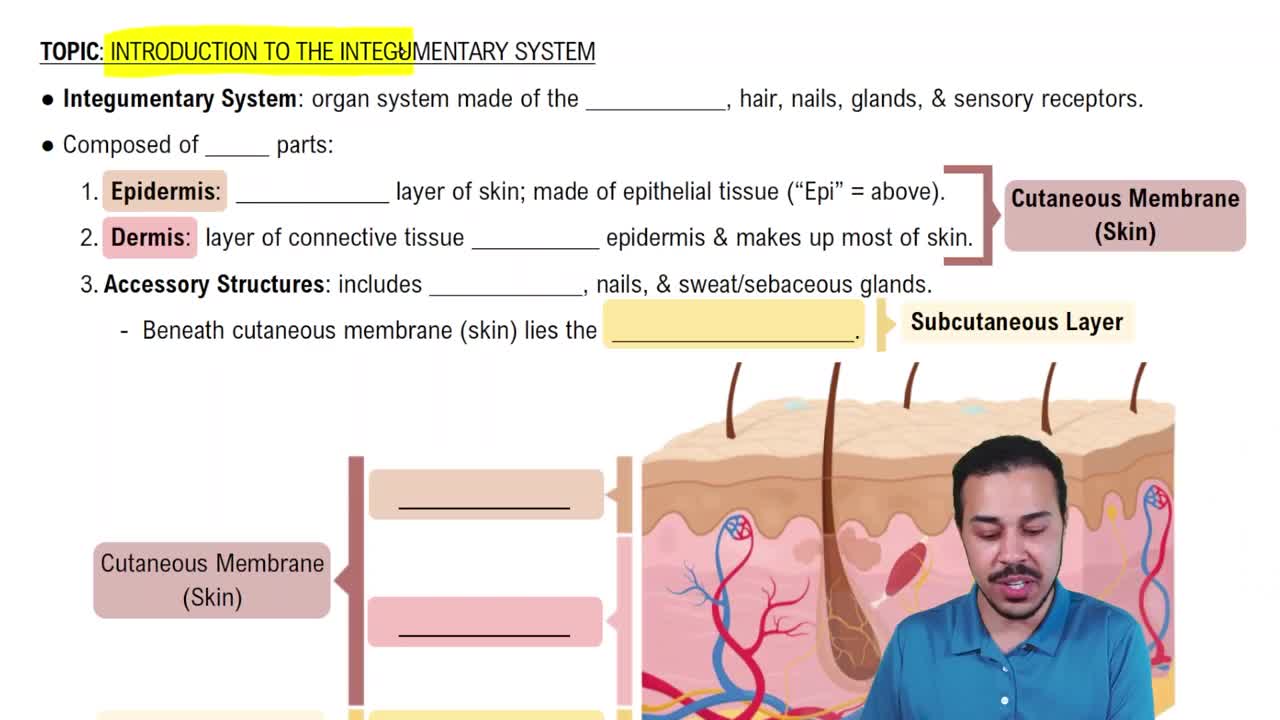
 06:54
06:54