 Back
BackIntegumentary System - Anatomy & Physiology
 06:54
06:54


Terms in this set (29)
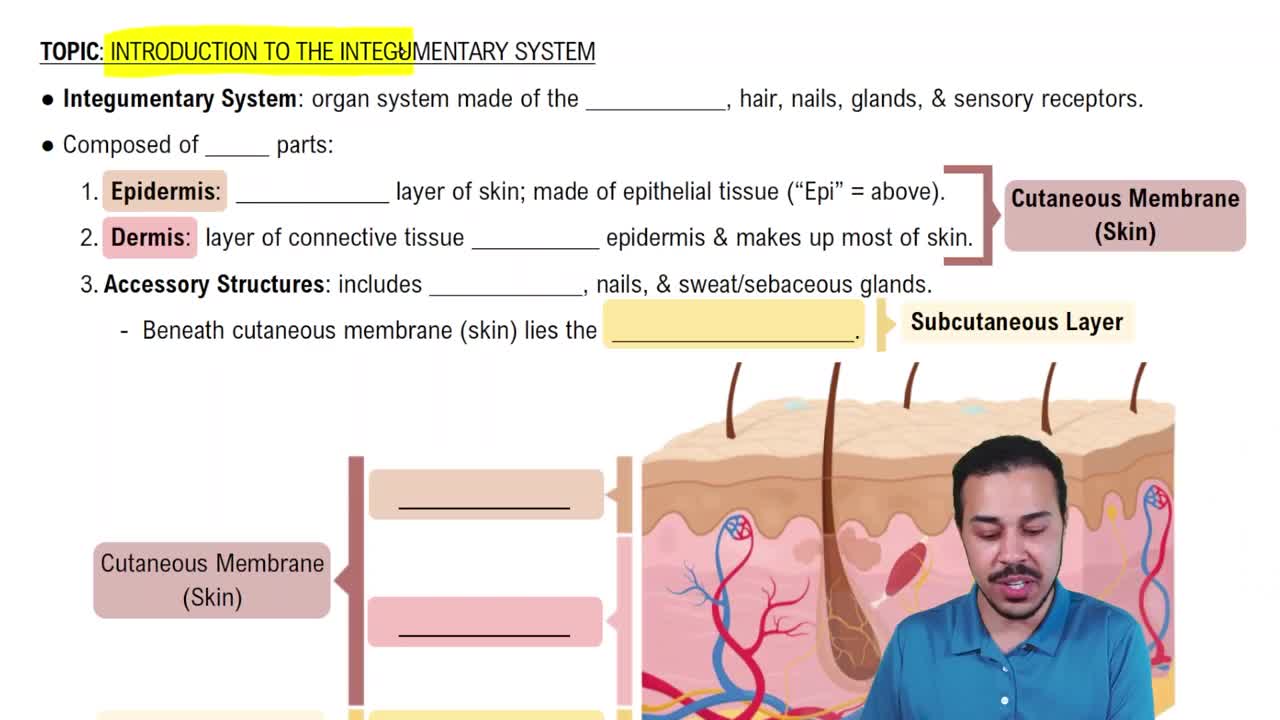
The integumentary system consists of skin, hair, nails, sweat glands, and sebaceous (oil) glands.
The skin has three layers: epidermis (superficial, epithelial, avascular), dermis (underlying connective tissue, vascular), and hypodermis (subcutaneous layer, mostly adipose tissue, not part of skin).
The epidermis is made mostly of keratinized stratified squamous epithelium.
1. Keratinocytes (produce keratin)
2. Melanocytes (produce melanin)
3. Dendritic (Langerhans) cells (immune cells)
4. Tactile (Merkel) cells (touch receptors)
1. Stratum basale
2. Stratum spinosum
3. Stratum granulosum
4. Stratum lucidum (only in thick skin)
5. Stratum corneum
It is the deepest epidermal layer with mitotically active stem cells producing new keratinocytes; also contains melanocytes (~10-25%).
Several layers thick with keratinocytes connected by desmosomes; contains melanosomes and dendritic cells; cells appear spiky (prickle cells).
Cells flatten, nuclei and organelles disintegrate, keratinization begins, and cells accumulate keratohyaline and lamellar granules to form keratin fibers and slow water loss.
Found only in thick skin (palms, soles); thin, translucent layer of dead keratinocytes above stratum granulosum.
20-30 layers of flat, dead, keratinized cells that protect deeper layers, prevent water loss, and act as a barrier against abrasion and pathogens.
Papillary layer: superficial areolar connective tissue with dermal papillae.
Reticular layer: deeper dense irregular connective tissue with collagen and elastic fibers.
Fingerlike projections of the papillary dermis that contain capillaries and sensory receptors; they increase surface area for nutrient exchange and contribute to fingerprints.
Ridges formed by dermal papillae and epidermal ridges that enhance grip and create unique fingerprint patterns.
Lines in the reticular dermis where collagen fibers run parallel; important for surgeons because incisions made parallel to these lines heal better.
Dermal folds near joints where the dermis is tightly secured to underlying structures, causing deep creases visible on hands and fingers.
Hair consists of dead, keratinized cells with hard keratin; functions include protection from trauma, heat loss, sunlight, and sensory input.
Medulla: central core
Cortex: surrounding layers
Cuticle: outer overlapping layer of cells
Extends from epidermis to dermis; includes hair bulb (growth area), hair matrix (dividing cells), hair papilla (capillaries), and arrector pili muscle (causes goosebumps).
Vellus hair: fine, pale body hair
Terminal hair: coarse, long hair on scalp, eyebrows, and after puberty in axillary and pubic regions.
Scale-like modifications of epidermis with hard keratin; main parts include free edge, nail plate, root, nail bed, nail matrix, eponychium (cuticle), and hyponychium.
Eccrine (merocrine) glands: abundant, thermoregulation, secrete watery sweat.
Apocrine glands: found in axillary and anogenital areas, secrete milky sweat, begin functioning at puberty.
Oil glands associated with hair follicles; secrete sebum, an oily holocrine secretion that softens skin and hair and has bactericidal properties.
Protection, body temperature regulation, cutaneous sensations, metabolic functions, blood reservoir, and excretion of wastes.
Chemical barrier (acid mantle, antimicrobial secretions), physical barrier (keratinized cells and glycolipids), and biological barrier (immune cells like dendritic cells and macrophages).
By producing sweat (insensible and sensible perspiration) and adjusting blood flow through dermal vessels (vasodilation and vasoconstriction).
Synthesizes vitamin D for calcium absorption, disarms carcinogens, activates hormones, and produces collagenase to prevent wrinkles.
It can hold up to 5% of the body's blood volume and constrict vessels to shunt blood to other organs when needed.
Limited amounts of nitrogenous wastes such as ammonia, urea, and uric acid, along with salt and water loss through sweating.
Fetal skin develops by 4th month; lanugo and vernix caseosa protect fetus; skin thickens and gland activity increases through adulthood; aging causes thinning, dryness, wrinkles, and hair thinning.