 Back
BackMetabolism and Energy Balance in Anatomy & Physiology
 02:17
02:17
Terms in this set (29)
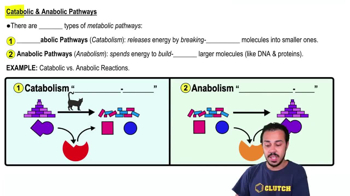
Anabolism is the synthesis of large molecules from small ones, such as the formation of proteins from amino acids.
Catabolism is the hydrolysis of complex structures into simpler ones, like the breakdown of proteins into amino acids.
The goal of cellular respiration is to trap chemical energy from food in the form of ATP.
Stage 1: Digestion, absorption, and transport to tissues.
Stage 2: Cellular processing (synthesis or glycolysis).
Stage 3: Oxidative breakdown into CO2, water, and ATP in mitochondria.
Redox reactions involve the loss of electrons (oxidation) and gain of electrons (reduction), catalyzed by enzymes requiring B vitamin coenzymes like NAD+ and FAD.
A process where a high-energy phosphate group is directly transferred from a substrate to ADP to form ATP, occurring in glycolysis and Krebs cycle.
A chemiosmotic process where energy from electron transport pumps H+ across the mitochondrial membrane, and ATP synthase uses this gradient to produce ATP.
Glucose is phosphorylated to glucose-6-phosphate, trapping it inside the cell and maintaining a low intracellular glucose concentration to ensure continued glucose entry.
Phase 1: Sugar activation (energy investment).
Phase 2: Sugar cleavage.
Phase 3: Sugar oxidation and ATP formation.
2 pyruvic acid molecules, 2 NADH + H+, and a net gain of 2 ATP molecules.
NADH donates hydrogen atoms back to pyruvic acid, reducing it to lactic acid to regenerate NAD+ for glycolysis to continue anaerobically.
A mitochondrial cycle where acetyl CoA is oxidized, producing CO2, NADH + H+, FADH2, and ATP through substrate-level phosphorylation.
6 CO2, 8 NADH + H+, 2 FADH2, and 2 ATP molecules.
ETC uses high-energy electrons from NADH and FADH2 to pump H+ across the mitochondrial membrane, creating a proton gradient used to synthesize ATP.
Movement of H+ back into the mitochondrial matrix through ATP synthase, driving the phosphorylation of ADP to ATP.
Approximately 30 ATP molecules after accounting for energy used to transport NADH from glycolysis into mitochondria.
The synthesis of glycogen from excess glucose, primarily in liver and skeletal muscle cells.
The formation of new glucose from noncarbohydrate sources like glycerol and amino acids, mainly in the liver.
Fatty acid breakdown in mitochondria where fatty acid chains are split into two-carbon acetic acid fragments that form acetyl CoA for the citric acid cycle.
The synthesis of triglycerides from acetyl CoA and glyceraldehyde 3-phosphate when ATP and glucose levels are high.
Transfer of an amine group from an amino acid to α-ketoglutaric acid, forming glutamic acid, an intermediate in the citric acid cycle.
Removal of an amine group from glutamic acid as ammonia, which combines with CO2 to form urea for excretion.
The fed state lasting about 4 hours after eating, where anabolism exceeds catabolism and excess nutrients are stored as fats.
Insulin, which promotes glucose uptake, glycogen and triglyceride formation, and protein synthesis.
The fasting state when the GI tract is empty and energy is supplied by breakdown of body reserves like glycogen, fat, and protein.
Glucagon, a hyperglycemic hormone released in response to low blood glucose and rising amino acid levels.
During prolonged fasting, body cells use fats and proteins for energy to conserve glucose for the brain, which may also use ketone bodies after several days.
Processing nutrients, regulating plasma cholesterol, storing vitamins and minerals, and metabolizing alcohol, drugs, hormones, and bilirubin.
HDLs transport excess cholesterol to liver; LDLs deliver cholesterol to tissues; VLDLs transport triglycerides from liver to tissues; chylomicrons transport dietary fats.