 Back
BackMuscle Structure and Function in Anatomy & Physiology
 6:31
6:31
Terms in this set (28)
Fascicles are bundles of muscle fibers grouped together within a muscle, surrounded by the perimysium connective tissue.
Sarcoplasm is the cytoplasm of a muscle fiber, containing glycogen, myoglobin, and organelles.
The sarcoplasmic reticulum stores and releases calcium ions essential for muscle contraction.
Thin filaments are primarily actin, while thick filaments are primarily myosin; both interact to cause muscle contraction.
A sarcomere is the basic contractile unit of a muscle fiber, defined by Z discs and containing overlapping thin and thick filaments.
The neuromuscular junction is where a motor neuron releases acetylcholine to stimulate muscle fiber depolarization and contraction.
The cycle includes calcium binding, cross-bridge formation, power stroke, ATP binding for release, and resetting of myosin heads.
Muscle fibers include slow oxidative, fast oxidative, and fast glycolytic types, differing in contraction speed and fatigue resistance.
Synergistic contractions occur when muscles work together to produce a movement or stabilize joints.
Muscle shapes include parallel, pennate, convergent, circular, and fusiform, affecting force and range of motion.
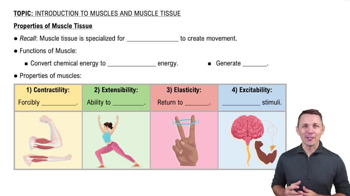
Muscle tissue properties include excitability, contractility, extensibility, and elasticity.
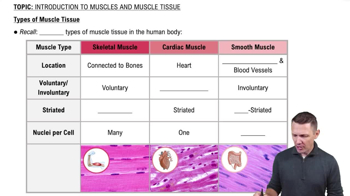
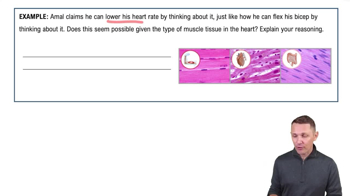
Skeletal is voluntary and striated, cardiac is involuntary and striated with intercalated discs, smooth is involuntary and non-striated.
Connective tissue layers: endomysium surrounds fibers, perimysium surrounds fascicles, epimysium surrounds the entire muscle.
Depolarization is the influx of Na+ causing a positive shift; repolarization restores resting potential by K+ efflux.
Muscle tone is the state of partial contraction that maintains muscle firmness and readiness.
The sliding filament theory states that thin filaments slide past thick filaments, shortening the sarcomere during contraction.
The H zone and I band shorten, while the A band remains constant during contraction.
Calcium binds to troponin, causing tropomyosin to move and expose myosin-binding sites on actin.
Muscles restore energy using creatine phosphate, aerobic respiration, and anaerobic glycolysis.
A motor unit consists of a motor neuron and all the muscle fibers it innervates.
Aponeurosis is a broad, flat tendon that connects muscles to bones or other muscles.
Muscles are named by location, shape, size, direction of fibers, number of origins, and action.
Calcium is stored in the sarcoplasmic reticulum of muscle fibers.
Muscle fatigue results from ATP depletion, lactic acid buildup, and ionic imbalances.
Acetylcholine triggers muscle fiber depolarization by binding to receptors at the neuromuscular junction.
Myoglobin stores oxygen in muscle cells to support aerobic respiration.
Smooth muscle contracts involuntarily using calcium-calmodulin activation of myosin light chain kinase, not troponin.
Fulcrum is the pivot point, lever is the bone, load is the resistance, and effort is the force applied by muscle.