Back

Muscular System - Anatomy & Physiology

Control buttons has been changed to "navigation" mode.
1/24
  • Functions of muscle tissue

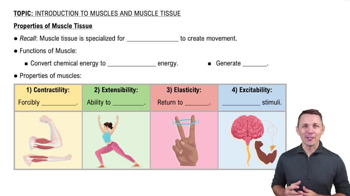
    Excitability: responds to stimuli
    Contractility: ability to shorten
    Extensibility: ability to stretch beyond resting length
    Elasticity: ability to return to original length after stretching
  • Types of muscle tissue

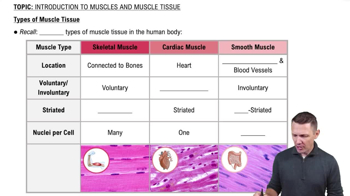
    Skeletal: voluntary, striated, attached to bones
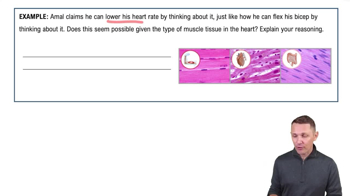
    Cardiac: involuntary, striated, heart walls
    Smooth: involuntary, non-striated, walls of hollow organs
  • Connective tissue sheaths of skeletal muscle

    Epimysium: surrounds whole muscle
    Perimysium: surrounds fascicles
    Endomysium: surrounds individual muscle fibers
  • Difference between origin and insertion

    Origin: attachment to bone that does not move during contraction
    Insertion: attachment to bone that moves during contraction
  • Microscopic anatomy of skeletal muscle fiber

    Long cylindrical cells called muscle fibers, containing sarcoplasm, myofibrils, sarcoplasmic reticulum, and sarcolemma with T-tubules
  • Role of sarcoplasmic reticulum and T-tubules

    Sarcoplasmic reticulum stores Ca2+; T-tubules transmit action potentials deep into muscle fiber to trigger Ca2+ release
  • Structure and function of myofibrils

    Rod-like structures containing contractile proteins organized into sarcomeres, the functional units of muscle contraction
  • Composition of thick filaments

    Made of myosin molecules with heads containing actin binding sites, ATP binding sites, and ATPase enzyme
  • Composition of thin filaments

    Made of actin strands with myosin binding sites, tropomyosin (blocks binding sites), and troponin (binds calcium)
  • Steps of muscle contraction (sliding filament theory)

    1. ATP hydrolysis energizes myosin
    2. Myosin binds actin forming crossbridge
    3. Power stroke slides actin
    4. ATP binds myosin to detach and repeat
  • Role of calcium in muscle contraction

    Ca2+ binds to troponin, causing tropomyosin to move and expose myosin binding sites on actin, enabling contraction
  • Neuromuscular junction components

    Axon terminal with ACh vesicles, synaptic cleft, and motor end plate with ACh receptors on muscle fiber
  • Process of excitation at neuromuscular junction

    Nerve impulse triggers ACh release, ACh binds receptors, Na+ influx depolarizes sarcolemma, generating action potential
  • Action potential phases in muscle fiber

    Depolarization: Na+ channels open, Na+ enters
    Repolarization: K+ channels open, K+ exits restoring resting potential
  • Muscle relaxation mechanism

    Ca2+ reabsorbed into sarcoplasmic reticulum, troponin-tropomyosin complex blocks myosin binding sites, sarcomeres lengthen
  • Motor unit definition

    A motor neuron and all the muscle fibers it innervates; smaller units allow finer control
  • Types of muscle contraction

    Isotonic: muscle length changes
    Concentric: muscle shortens
    Eccentric: muscle lengthens
    Isometric: tension increases, length unchanged
  • Characteristics of smooth muscle

    Spindle-shaped cells, single nucleus, no T-tubules, gap junctions, uses actin and myosin but no sarcomeres
  • Energy sources for muscle contraction

    ATP stores (4-6 sec), creatine phosphate (10-15 sec), anaerobic glycolysis (up to 45 sec), aerobic respiration (hours)
  • Muscle fatigue causes

    Low ATP, lactic acid buildup, phosphate binding Ca2+, and ion imbalances reduce contraction ability
  • Types of muscle fibers

    Slow oxidative: endurance, aerobic
    Fast glycolytic: powerful, anaerobic
    Fast oxidative: intermediate power and fatigue resistance
  • Effects of aerobic and resistance exercise on muscles

    Aerobic: increases capillaries, mitochondria, converts fibers to fast oxidative
    Resistance: increases fiber size, glycogen, converts fibers to fast glycolytic
  • Rigor mortis explanation

    After death, Ca2+ leaks in causing myosin-actin binding; lack of ATP prevents detachment, causing muscle stiffness
  • Diseases affecting muscle contraction

    Botulism blocks ACh release; Curare blocks ACh receptors; Myasthenia gravis is autoimmune against ACh receptors; Muscular dystrophy lacks dystrophin