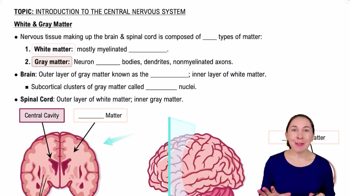
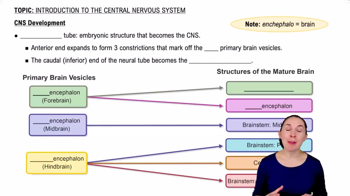
The nervous system is divided into the central nervous system (CNS), consisting of the brain and spinal cord, and the peripheral nervous system (PNS), which includes cranial and spinal nerves.
Functional divisions of the PNS
The PNS has a sensory (afferent) division with somatic and visceral branches, and a motor (efferent) division with somatic motor and autonomic nervous system branches.
Main cell types in nervous tissue
Nervous tissue consists of neurons, which send and receive action potentials, and neuroglial cells, which support and protect neurons.
Parts of a neuron
A neuron has a cell body, one or more dendrites (receptive), and a single axon (transmits signals).
Structural classes of neurons
Neurons are classified as multipolar, bipolar, or pseudounipolar based on the number and arrangement of their processes.
Functional classes of neurons
Neurons are sensory (afferent), interneurons, or motor (efferent) based on their role in signal transmission.
Neuroglia of the CNS and their functions
Astrocytes anchor neurons and blood vessels; oligodendrocytes form myelin sheaths; microglia act as phagocytes; ependymal cells produce and circulate cerebrospinal fluid.
Neuroglia of the PNS and their functions
Neurolemmocytes (Schwann cells) form myelin sheaths; satellite cells surround neuron cell bodies in the PNS.
Myelin sheath formation
Oligodendrocytes in the CNS and neurolemmocytes in the PNS wrap around axons multiple times to form the myelin sheath, speeding up action potential conduction.
Resting membrane potential of neurons
An unstimulated neuron is polarized with a resting membrane potential of about -70 mV due to charge separation across its membrane.
Types of ion channels in neurons
Neurons have leak channels (always open) and gated channels that open or close in response to stimuli.
Key ion concentration gradients in neurons
Sodium (Na+) concentration is higher outside the cell; potassium (K+) concentration is higher inside the cytosol.
Local potentials characteristics
Local potentials are small, graded, reversible changes in membrane potential that can depolarize or hyperpolarize a neuron and are decremental with distance.
Voltage-gated Na+ and K+ channel states
Voltage-gated Na+ channels have resting and activated states; voltage-gated K+ channels have resting, activated, and inactivated states.
Phases of an action potential
Depolarization occurs as Na+ floods in, raising membrane potential; repolarization follows as K+ flows out, restoring negativity; often followed by hyperpolarization.
Properties of action potentials
Action potentials are nondecremental, follow the all-or-none principle, are irreversible, and serve as long-distance signals.
Refractory period
The refractory period is the time during which a neuron cannot or is less likely to fire another action potential.
Propagation speed increases with larger axon diameter and presence of a myelin sheath.
Saltatory vs continuous conduction
Saltatory conduction occurs rapidly by jumping between myelin sheath gaps; continuous conduction is slower, depolarizing every membrane segment.
Electrical vs chemical synapses
Electrical synapses use gap junctions for fast, bidirectional transmission; chemical synapses use neurotransmitters for slower, unidirectional signaling.
Synaptic transmission at chemical synapses
An action potential triggers neurotransmitter release from presynaptic vesicles, which bind postsynaptic receptors causing excitatory or inhibitory postsynaptic potentials.
Excitatory and inhibitory postsynaptic potentials
EPSPs depolarize the postsynaptic neuron; IPSPs hyperpolarize it, influencing whether an action potential will fire.
Neural integration and summation
Neural integration combines excitatory and inhibitory inputs; temporal summation is rapid firing by one neuron, spatial summation is simultaneous firing by multiple neurons.
Types of neurotransmitter receptors
Ionotropic receptors directly open ion channels; metabotropic receptors activate signaling pathways to influence ion channels.
Major neurotransmitters and their effects
Acetylcholine is mostly excitatory; biogenic amines include norepinephrine, dopamine, epinephrine, serotonin, histamine; amino acids include glutamate (excitatory), GABA and glycine (inhibitory).
Neuronal pools and neural circuits
Interneurons form pools for specialized CNS functions; diverging circuits spread signals to many neurons; converging circuits focus signals onto fewer neurons.
 Back
Back
 0:50
0:50