What are the two main types of cells in nervous tissue?
Neurons for intercellular communication and Neuroglia (glial cells) which support and preserve the structure and function of neurons.
What are the anatomical divisions of the nervous system?
The Central Nervous System (CNS) consisting of the brain and spinal cord, and the Peripheral Nervous System (PNS) which includes all nervous tissue outside the CNS.
What are the functional divisions of the Peripheral Nervous System (PNS)?
The Afferent division carries sensory information to the CNS, and the Efferent division carries motor commands from the CNS to muscles, glands, and adipose tissue.
What are the two subdivisions of the efferent division of the PNS?
The Somatic Nervous System (SNS) controls skeletal muscle contractions, and the Autonomic Nervous System (ANS) controls subconscious actions like smooth and cardiac muscle contractions and gland secretions.
What is the Enteric Nervous System (ENS)?
A network of about 100 million neurons in the walls of the digestive tract that can initiate and coordinate visceral reflexes locally without CNS input.
What are the main parts of a neuron?
The cell body (soma) containing the nucleus, dendrites which receive signals, and a single axon that propagates electrical signals.
What is the function of Nissl bodies in neurons?
They are dense areas of rough endoplasmic reticulum and ribosomes that synthesize proteins and give nervous tissue its gray color.
Describe the structural classification of neurons.
Neurons are classified as Anaxonic (no obvious axon), Bipolar (one dendrite, one axon), Unipolar (axon and dendrites fused), and Multipolar (one axon, multiple dendrites).
What are the functional classifications of neurons?
Neurons are classified as Sensory neurons (afferent), Motor neurons (efferent), and Interneurons which connect sensory and motor neurons.
What are the main types of neuroglia in the CNS?
Astrocytes, Ependymal cells, Oligodendrocytes, and Microglia.
What is the role of astrocytes in the CNS?
They maintain the blood-brain barrier, provide structural support, regulate ion and nutrient concentrations, absorb neurotransmitters, and form scar tissue after injury.
What is the function of oligodendrocytes?
They myelinate CNS axons, increasing the speed of action potentials and providing structural framework.
What are the two types of neuroglia in the PNS?
Satellite cells, which surround neuron cell bodies in ganglia, and Schwann cells, which myelinate peripheral axons.
What is Wallerian degeneration?
The process where the distal portion of an injured axon degenerates, and Schwann cells form a path for new growth to regenerate the axon.
What is resting membrane potential and its typical value in neurons?
The electrical potential of a resting cell membrane, typically about \(-70\,mV\), with the inside negatively charged relative to the outside.
What ions primarily determine the resting membrane potential?
Potassium (K+) and Sodium (Na+) ions, with high K+ inside the cell and high Na+ outside, maintained by selective permeability and the sodium-potassium pump.
What are the three types of gated ion channels?
Chemically gated (ligand-gated), voltage-gated, and mechanically gated ion channels.
What is a graded potential?
A temporary, localized change in membrane potential caused by opening gated ion channels, which can be depolarizing or hyperpolarizing.
What is an action potential?
A propagated electrical impulse along an axon that occurs when a graded potential depolarizes the membrane to threshold, triggering voltage-gated ion channels.
What is the all-or-none principle of action potentials?
An action potential either occurs fully when threshold is reached or not at all, regardless of stimulus strength above threshold.
Describe the steps of action potential generation.
1) Depolarization to threshold, 2) Activation of voltage-gated Na+ channels and rapid depolarization, 3) Inactivation of Na+ channels and activation of K+ channels causing repolarization, 4) Return to resting potential with possible hyperpolarization.
What is the refractory period in neurons?
The time during and after an action potential when the membrane cannot respond normally to new stimuli, including absolute and relative refractory periods.
What is the difference between continuous and saltatory propagation?
Continuous propagation occurs in unmyelinated axons with action potentials along every segment; saltatory propagation occurs in myelinated axons where the action potential jumps between nodes of Ranvier.
How does axon diameter affect action potential propagation speed?
Larger diameter axons have lower resistance and conduct action potentials faster.
What are the three types of axons based on diameter and myelination?
Type A fibers: large, myelinated, fast; Type B fibers: medium diameter, myelinated, intermediate speed; Type C fibers: small, unmyelinated, slow.
What is a synapse?
A specialized site where a neuron communicates with another cell, either electrical (direct contact) or chemical (neurotransmitter release).
What are the main types of chemical synapses?
Neuron-to-neuron, neuromuscular junction (neuron to muscle), and neuroglandular junction (neuron to gland).
What is the sequence of events at a cholinergic synapse?
1) Action potential depolarizes axon terminal, 2) Ca2+ enters and triggers ACh release, 3) ACh binds postsynaptic receptors causing depolarization, 4) ACh is broken down by acetylcholinesterase and recycled.
What is synaptic delay?
A brief delay (0.2–0.5 msec) between arrival of an action potential at the axon terminal and the effect on the postsynaptic membrane, mainly due to calcium influx and neurotransmitter release.
What are excitatory and inhibitory neurotransmitters?
Excitatory neurotransmitters cause depolarization and promote action potentials; inhibitory neurotransmitters cause hyperpolarization and suppress action potentials.
What are neuromodulators?
Chemicals released by axon terminals that alter neurotransmitter release or postsynaptic response, producing long-term and slow effects.
 Back
Back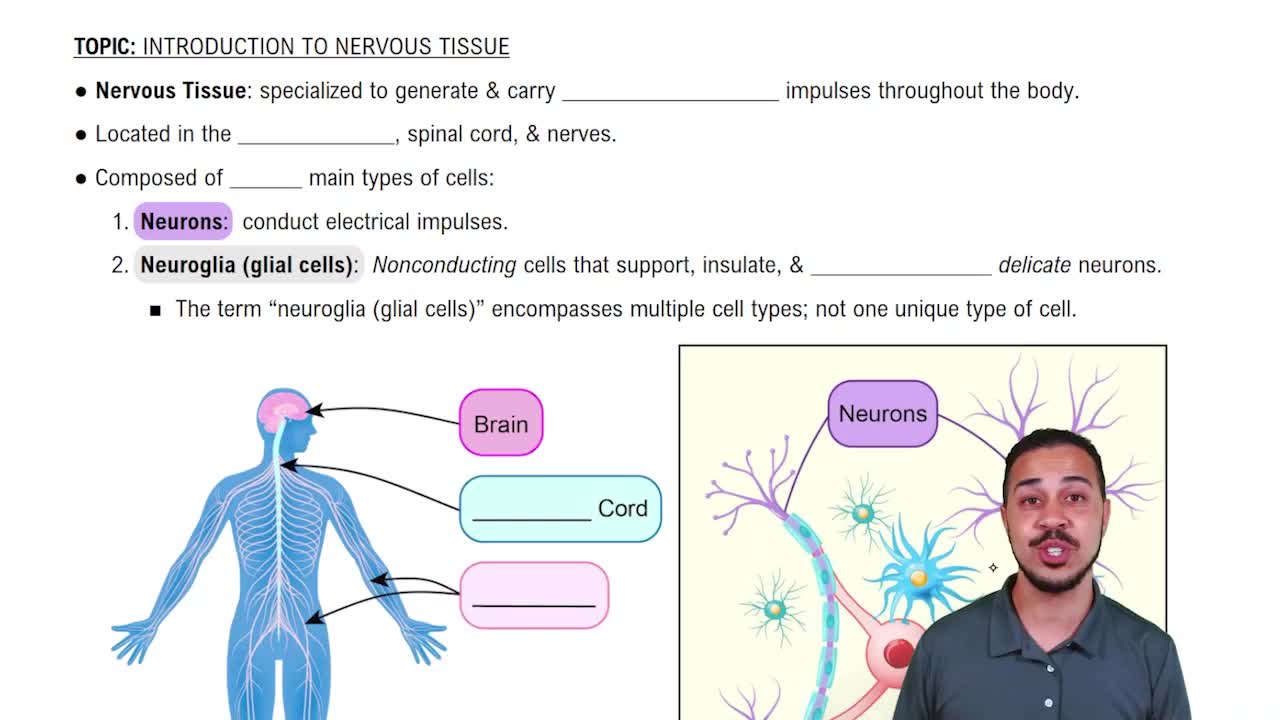
 04:36
04:36