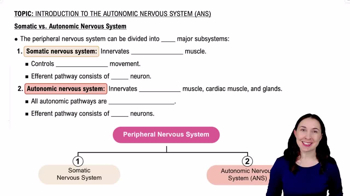
Peripheral Nervous System (PNS) functional divisions
The PNS is divided into sensory and motor divisions, which are further subdivided into somatic and visceral, and general and special categories.
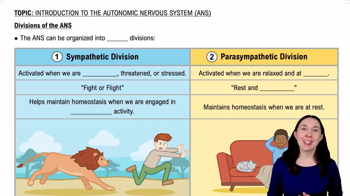
Autonomic Nervous System (ANS) divisions
The ANS, part of the general visceral motor PNS, has two divisions: parasympathetic and sympathetic.
Components of the Peripheral Nervous System
The PNS includes sensory receptors, nerves (bundles of peripheral axons), ganglia (clusters of neuronal cell bodies), and motor endings that innervate muscles and glands.
Function of sensory receptors
Sensory receptors pick up stimuli from inside or outside the body and initiate signals in sensory axons.
Two main categories of sensory receptors
Free nerve endings of sensory neurons monitor general sensory information, while complete receptor cells are specialized epithelial cells or small neurons monitoring special sensory information.
Classification of sensory receptors by location
Exteroceptors detect external stimuli; interoceptors detect internal stimuli; proprioceptors monitor body position and movement.
Exteroceptors
Located at or near body surfaces, exteroceptors respond to stimuli like touch, pressure, pain, and temperature from outside the body.
Interoceptors
Located in internal organs like the digestive tube and lungs, interoceptors monitor chemical changes, tissue stretch, temperature, and taste stimuli.
Proprioceptors
Found in skeletal muscles, tendons, joints, and ligaments, proprioceptors monitor stretch and send information about body movement to the CNS.
Classification of sensory receptors by stimulus detected
Includes mechanoreceptors (touch, pressure), thermoreceptors (temperature), chemoreceptors (chemicals), photoreceptors (light), and nociceptors (pain).
Mechanoreceptors
Respond to mechanical forces such as touch, pressure, stretch, vibration, and itch; baroreceptors monitor blood pressure.
Thermoreceptors
Sensory receptors that respond to changes in temperature.
Chemoreceptors
Detect chemicals in solution, important for taste and internal chemical monitoring.
Photoreceptors
Located in the eye, photoreceptors respond to light stimuli.
Nociceptors
Respond to harmful stimuli that cause pain.
General sensory receptors structure
Widely distributed nerve endings of sensory neurons that monitor touch, pressure, vibration, stretch, pain, temperature, and proprioception.
Two groups of general sensory receptors
Free nerve endings and encapsulated nerve endings.
Free nerve endings
Abundant in epithelia and connective tissue; respond mainly to pain and temperature.
Specialized free nerve endings
Include epithelial tactile complexes (Merkel discs) for light touch and hair follicle receptors that rapidly adapt to touch.
Encapsulated nerve endings
Sensory neuron end fibers enclosed in connective tissue; mainly mechanoreceptors including tactile, lamellar, bulbous corpuscles, and proprioceptors.
Tactile (Meissner’s) corpuscles
Located in dermal papillae of hairless skin; rapidly adapting receptors for discriminative touch.
Lamellar (Pacinian) corpuscles
Found in the hypodermis; sensitive to deep pressure and vibration; rapidly adapting.
Bulbous corpuscles (Ruffini endings)
Located in the dermis; respond to continuous pressure and stretch; slowly adapting.
Proprioceptors types
Include muscle spindles, tendon organs, and joint kinesthetic receptors.
Muscle spindles
Measure changing muscle length; embedded in perimysium; contain intrafusal muscle fibers with anulospiral endings sensitive to stretch.
Tendon organs
Located near muscle-tendon junctions; monitor tension within tendons.
Joint kinesthetic receptors
Sensory nerve endings in joint capsules; include lamellar corpuscles, bulbous corpuscles, free nerve endings, and receptors like tendon organs.
 Back
Back
 1:10
1:10