Skip to main content
Anatomy & Physiology
My Course
Learn
Exam Prep
AI Tutor
Study Guides
Textbook Solutions
Flashcards
Explore
Try the app
My Course
Learn
Exam Prep
AI Tutor
Study Guides
Textbook Solutions
Flashcards
Explore
Try the app
Back
Reflex Arcs in Anatomy & Physiology
You can tap to flip the card.
What is a reflex?
You can tap to flip the card.
👆
What is a reflex?
A reflex is a rapid, involuntary response to a stimulus.
Track progress
Control buttons has been changed to "navigation" mode.
1/23
Recommended videos
0:41
Introduction to Reflex Arcs Example 2
5158
views
160
rank
4:03
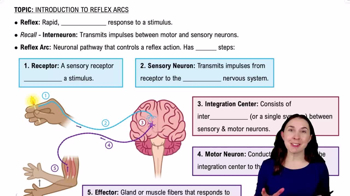
Introduction to Reflex Arcs
7862
views
156
rank
1
comments
5:15
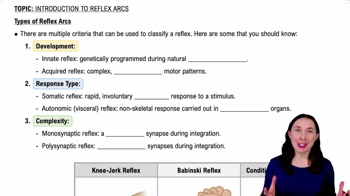
Types of Reflex Arcs
6364
views
107
rank
Terms in this set (23)
Hide definitions
What is a reflex?
A reflex is a rapid, involuntary response to a stimulus.
What is the function of an interneuron in a reflex arc?
An interneuron transmits impulses between motor and sensory neurons.
How many steps are in a reflex arc?
A reflex arc has 5 steps.
What is the first step in a reflex arc?
The receptor detects a stimulus.
What does the sensory neuron do in a reflex arc?
The sensory neuron transmits impulses from the receptor to the central nervous system.
What is the role of the integration center in a reflex arc?
The integration center consists of interneurons (or a single synapse) between sensory and motor neurons.
What does the motor neuron do in a reflex arc?
The motor neuron conducts impulses from the integration center to the effector.
What is the effector in a reflex arc?
The effector is a gland or muscle fiber that responds to the stimulus by secreting or contracting.
What are the two types of reflex development?
Innate reflexes are genetically programmed during natural development; acquired reflexes are complex, learned motor patterns.
What are the two response types of reflexes?
Somatic reflexes cause rapid, involuntary skeletal muscle responses; autonomic (visceral) reflexes control non-skeletal organs.
What distinguishes monosynaptic from polysynaptic reflexes?
Monosynaptic reflexes have one synapse during integration; polysynaptic reflexes have multiple synapses.
What is the purpose of the stretch reflex?
The stretch reflex prevents muscle strain and tear injuries.
What initiates the stretch reflex?
Muscle spindles initiate the stretch reflex in response to being stretched.
What happens to the muscle during the stretch reflex?
The stretched muscle contracts.
What is reciprocal inhibition in the stretch reflex?
Neurons inhibit the antagonistic muscle during the stretch reflex, allowing smooth movement.
What is the purpose of the tendon reflex?
The tendon reflex prevents tendon injury by responding to excessive tension.
What initiates the tendon reflex?
Golgi tendon organs initiate the tendon reflex in response to tendon tension.
What happens to the muscle during the tendon reflex?
The muscle relaxes to prevent damage.
What is reciprocal activation in the tendon reflex?
Neurons activate the antagonistic muscle during the tendon reflex to balance muscle activity.
What is the flexor (withdrawal) reflex?
A rapid withdrawal of a body part from a painful or harmful stimulus.
What side of the body does the flexor reflex affect?
The flexor reflex is ipsilateral; motor activity occurs on the same side as the stimulus.
What is the crossed-extensor reflex?
It causes extension of the opposite limb to maintain balance during the flexor reflex.
What side of the body does the crossed-extensor reflex affect?
The crossed-extensor reflex is contralateral; motor activity occurs on the opposite side of the stimulus.
 BackBack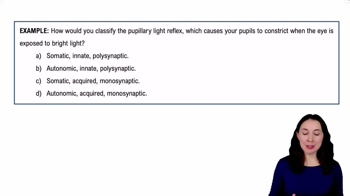
 0:41
0:41