 Back
BackSet #2 Anatomy & Physiology: Deep Skull, Trunk, & Shoulder Structures
 2:12
2:12
Terms in this set (35)
Smaller, horn-like superior projections from the sphenoid body forming the posterior border of the anterior cranial fossa floor.
A saddle-like depression in the middle of the sphenoid bone body; houses the pituitary gland.
A jagged, slit-like opening between the greater and lesser wings at the back of the eye orbit; permits passage of cranial nerves.
An opening through the lesser wing of the sphenoid bone just anterior to the sella turcica; transmits the optic nerve (CN II).
A round opening in the greater wing of the sphenoid bone; transmits the maxillary branch of the trigeminal nerve (CN V).
An oval-shaped opening in the greater wing of the sphenoid bone posterior to the foramen rotundum; transmits the mandibular branch of the trigeminal nerve (CN V).
A tiny opening located just posterolateral to the foramen ovale; transmits the middle meningeal artery.
An irregularly shaped bone located in the anterior skull base between the eye orbits, forming the roof of the nasal cavity.
A thin, vertical plate projecting downward from the ethmoid midline; forms the superior part of the nasal septum.
The horizontal plate of the ethmoid bone containing tiny holes, forming the roof of the nasal cavity.
Small perforations within the cribriform plate through which olfactory nerve fibers travel from the nasal cavity to the brain.
A sharp vertical ridge projecting superiorly from the cribriform plate; serves as an attachment point for brain membranes.
Thin, scroll-like extensions from the lateral masses of the ethmoid bone; located high inside the nasal cavity.
Scroll-like bony shelves directly below the superior conchae; part of the lateral masses of the ethmoid bone.
Small, rectangular paired bones meeting at the midline to form the bridge of the nose.
Paired bones that fuse at the midline to form the upper jaw and most of the hard palate.
The horizontal projection of each maxilla bone that forms the anterior two-thirds of the hard palate.
The largest paranasal sinus cavity, located inside the body of each maxilla below the eye orbits.
The thickened ridge containing deep sockets (alveoli) that hold the teeth.
Paired facial bones forming the prominences of the cheeks and the lateral margins of the eye orbits.
A backward-directed projection that articulates with the zygomatic process of the temporal bone to finish the zygomatic arch.
Independent, thin scroll-shaped bones attached to the lateral walls of the nasal cavity, below the middle conchae.
L-shaped paired facial bones forming the posterior portion of the hard palate and parts of the nasal cavity floor.
Tiny, fingernail-sized paired bones forming part of the anterior medial wall of each eye orbit.
A vertical groove on the lacrimal bone that houses the lacrimal sac, draining tears into the nasal cavity.
A thin, plow-shaped bone along the midline of the nasal cavity floor; forms the inferior part of the nasal septum.
The single, U-shaped bone forming the lower jaw; the only movable bone of the skull.
The vertical, upward-projecting branch on each side of the mandible bone.
The horizontal, tooth-bearing anterior portion of the mandible bone.
The posterior upward projection of the ramus topped with an articular condyle; articulates with the temporal bone.
The flat, triangular anterior upward projection of the mandibular ramus; acts as a muscle attachment site.
An opening on the lateral, anterior side of the mandibular body below the premolar teeth for blood vessels and nerves.
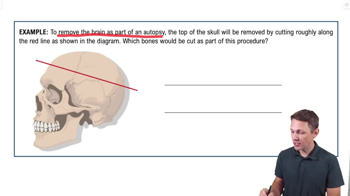
The skullcap or upper domed part of the cranium composed of the frontal, parietal, and occipital bones.
Three distinct tiered depressions in the internal cranial floor that accommodate the frontal lobes, temporal lobes, and cerebellum/brainstem.
A large, irregular opening located at the junction of the temporal and occipital bones; transmits the internal jugular vein.