 Back
BackThe Skeleton - Anatomy & Physiology
 4:50
4:50
Terms in this set (20)
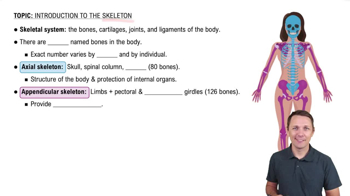
The axial skeleton and the appendicular skeleton.
The skull, vertebral column, and rib cage.
To provide support, protection, movement, mineral storage, and blood cell production.
Osseous tissue, a type of connective tissue.
Compact bone is dense and forms the outer layer; spongy bone is porous and found inside bones.
Bone marrow produces blood cells and stores fat.
Long, short, flat, and irregular bones.
The femur (thigh bone).
The sternum and skull bones.
A dense layer of connective tissue covering the outer surface of bones.
Osteocytes maintain bone tissue.
Osteoblasts build new bone.
Osteoclasts resorb bone.
Individual bones called vertebrae stacked together.
Typically 33, including cervical, thoracic, lumbar, sacral, and coccygeal vertebrae.
Protects the heart and lungs and supports breathing.
The clavicle and scapula.
The hip bones (ilium, ischium, and pubis).
Allow movement and provide flexibility between bones.
Fibrous (immovable), cartilaginous (slightly movable), and synovial (freely movable) joints.