
Paola is a 3-year-old girl with a disease that reduces the ability of her mitochondria to generate ATP. Explain the specific effects of this disease on the ability of Paola's muscles to function properly. What other tissues and organs are likely to be especially affected by her disease, and why?
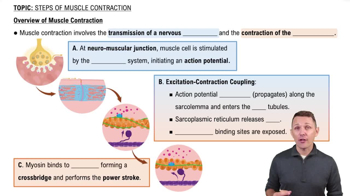
Mr. Nasheed has cerebral palsy and suffers severe skeletal muscle spasms as a result of his condition. He is prescribed the drug dantrolene, which prevents the release of Ca2+ from the SR. Explain how this will treat his muscle spasms.
Verified step by step guidance
Verified video answer for a similar problem:
Key Concepts
Cerebral Palsy
Calcium Release in Muscle Contraction
Dantrolene Mechanism of Action
Order the following events of excitation and excitation-contraction coupling. Put 1 by the first event, 2 by the second, and so on.
____ The motor end plate generates an end-plate potential.
____ The action potential spreads along the T-tubules, SR Ca2+ channels are pulled open, and Ca2+ floods the cytosol.
____ Acetylcholine binds to receptors on the motor end plate, and ligand-gated ion channels open.
____ Ca2+ bind troponin, which allows tropomyosin to move away from the actin active site, initiating a contraction cycle.
____ The action potential propagates through the sarcolemma and dives deeply into the cell along the T-tubules.
Match the following terms with the correct definition.
____Z-disc
____Sarcomere
____A band
____H zone
____I band
____M line
a. The dark band containing the entire length of the thick filament
b. The band of proteins in the middle of the H zone
c. The boundary between sarcomeres
d. The functional unit of contraction
e. The middle region of the A band containing only thick filaments
f. The light band containing only thin filaments
Some athletes will consume only protein for several days before a competition, which reduces the amount of glycogen in both the muscle fibers and the liver. What effect would this have on their ability to perform activities that require short, powerful bursts of activity? How would it affect their ability to perform endurance activities?
What is the basic mechanism of contraction at the level of myofilaments?
Jesse is a 2-year-old boy who presents with difficulty in walking and poor control of movements. When the doctor examines Jesse, she notices that when his muscles contract, they are very slow to relax and remain contracted well after the movement has been performed. She sends a sample of his tissue for genetic analysis, and the lab reports a genetic defect that causes the pumps in the SR to operate much more slowly than normal. How does a defect in DNA lead to a malfunctioning protein? How does this finding explain Jesse's symptoms?
