Ch. 10 Muscle Tissue and Physiology
Amerman - Human Anatomy & Physiology 2nd Edition
Amerman2nd EditionHuman Anatomy & PhysiologyISBN: 9780136873822Not the one you use?Change textbook
Chapter 10, Problem 9

Which of the following statements accurately describes the role of ATP in a muscle contraction?
a. ATP is directly responsible for the power stroke.
b. ATP moves troponin and tropomyosin away from actin.
c. ATP breaks the actin/myosin attachment and 'cocks' the myosin head.
d. ATP causes the myofilaments to shorten.

Verified step by step guidance
1
Understand the role of ATP in muscle contraction: ATP is essential for several steps in the contraction and relaxation cycle of muscle fibers. It provides the energy required for specific processes during the interaction of actin and myosin filaments.
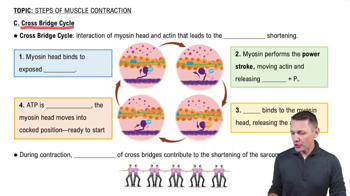
Recall the cross-bridge cycle: During muscle contraction, myosin heads bind to actin filaments to form cross-bridges. The cycle involves attachment, power stroke, detachment, and re-cocking of the myosin head.
Focus on the detachment and re-cocking step: ATP binds to the myosin head after the power stroke, causing the myosin to release actin (breaking the actin/myosin attachment). ATP is then hydrolyzed into ADP and inorganic phosphate, which provides the energy to 'cock' the myosin head into its high-energy position for the next cycle.
Eliminate incorrect options: a) ATP is not directly responsible for the power stroke; the power stroke occurs when ADP and phosphate are released. b) ATP does not move troponin and tropomyosin; calcium ions are responsible for this. d) ATP does not directly cause the myofilaments to shorten; shortening occurs due to the sliding filament mechanism.
Identify the correct answer: Based on the above analysis, the correct statement is c) ATP breaks the actin/myosin attachment and 'cocks' the myosin head.

Verified video answer for a similar problem:

This video solution was recommended by our tutors as helpful for the problem above.
Was this helpful?

Key Concepts

Here are the essential concepts you must grasp in order to answer the question correctly.

Role of ATP in Muscle Contraction

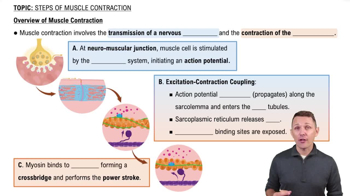
Adenosine triphosphate (ATP) is the primary energy carrier in cells, crucial for muscle contraction. During contraction, ATP provides the energy needed for myosin heads to attach to actin filaments and perform the power stroke. Without ATP, muscle fibers cannot contract effectively, as the energy required for the mechanical work of muscle contraction is not available.
Recommended video:
Guided course
4:53
Overview of Muscle Contraction

Cross-Bridge Cycle

The cross-bridge cycle describes the process by which myosin heads interact with actin filaments to produce muscle contraction. This cycle involves the binding of ATP to myosin, which causes the release of myosin from actin, followed by hydrolysis of ATP that 'cocks' the myosin head into a high-energy state, allowing it to bind to actin again and perform the power stroke.
Recommended video:
Guided course
7:39
C. Cross Bridge Cycle

Troponin and Tropomyosin Regulation

Troponin and tropomyosin are regulatory proteins that control the interaction between actin and myosin. When calcium ions bind to troponin, it causes a conformational change that moves tropomyosin away from actin's binding sites, allowing myosin heads to attach and initiate contraction. ATP is not directly involved in this process but is essential for muscle contraction to occur after the regulatory proteins are activated.
Recommended video:
03:31
Cell Cycle Regulation
Related Practice
Textbook Question

Mark the following statements as true or false. If a statement is false, correct it to make a true statement.

Muscle fibers generate more tension if the starting length of their sarcomeres is very short.

724
views

Textbook Question

Which of the following energy sources would provide the majority of the ATP for a person running a 26-mile marathon?

a. Stored ATP

b. Glycolytic catabolism

c. Oxidative catabolism

d. Creatine phosphate

790
views
Textbook Question

Order the following events of excitation and excitation-contraction coupling. Put 1 by the first event, 2 by the second, and so on.

____ The motor end plate generates an end-plate potential.

____ The action potential spreads along the T-tubules, SR Ca2+ channels are pulled open, and Ca2+ floods the cytosol.

____ Acetylcholine binds to receptors on the motor end plate, and ligand-gated ion channels open.

____ Ca2+ bind troponin, which allows tropomyosin to move away from the actin active site, initiating a contraction cycle.

____ The action potential propagates through the sarcolemma and dives deeply into the cell along the T-tubules.

1396
views
Textbook Question

A muscle fiber relaxes when:

a. The concentration of Ca2+ in the cytosol returns to resting levels.

b. The supply of ATP is exhausted.

c. Ca2+ flood the cytosol.

d. Acetylcholine is released from the axon terminal and the sarcolemma depolarizes.

814
views
Textbook Question

Match the following terms with the correct definition.      


____Z-disc     

____Sarcomere     

____A band     

____H zone     

____I band     

____M line


a. The dark band containing the entire length of the thick filament

b. The band of proteins in the middle of the H zone

c. The boundary between sarcomeres

d. The functional unit of contraction

e. The middle region of the A band containing only thick filaments

f. The light band containing only thin filaments

729
views
Textbook Question

What is the basic mechanism of contraction at the level of myofilaments?

851
views