
Ch. 11 Introduction to the Nervous System and Nervous Tissue
Amerman - Human Anatomy & Physiology 2nd Edition
Amerman2nd EditionHuman Anatomy & PhysiologyISBN: 9780136873822Not the one you use?Change textbook
Chapter 11, Problem 7

Describe the three components of the neuromuscular junction.

Verified step by step guidance
1
The first component of the neuromuscular junction is the **axon terminal** of the motor neuron. This is the end of the motor neuron where synaptic vesicles containing the neurotransmitter acetylcholine (ACh) are stored. These vesicles release ACh into the synaptic cleft when an action potential arrives.
The second component is the **synaptic cleft**, which is the small gap between the axon terminal of the motor neuron and the muscle fiber's membrane. This space allows for the diffusion of acetylcholine from the neuron to the muscle fiber.
The third component is the **motor end plate**, which is a specialized region of the muscle fiber's sarcolemma (cell membrane). It contains receptors for acetylcholine, specifically nicotinic acetylcholine receptors, which bind to ACh and initiate a response in the muscle fiber.
When acetylcholine binds to its receptors on the motor end plate, it triggers the opening of ion channels, leading to an influx of sodium ions (Na⁺) into the muscle fiber. This depolarizes the membrane and generates an action potential in the muscle fiber.
The action potential travels along the sarcolemma and into the muscle fiber via the T-tubules, ultimately leading to muscle contraction through the excitation-contraction coupling process.

Verified video answer for a similar problem:

This video solution was recommended by our tutors as helpful for the problem above.
Was this helpful?

Key Concepts

Here are the essential concepts you must grasp in order to answer the question correctly.

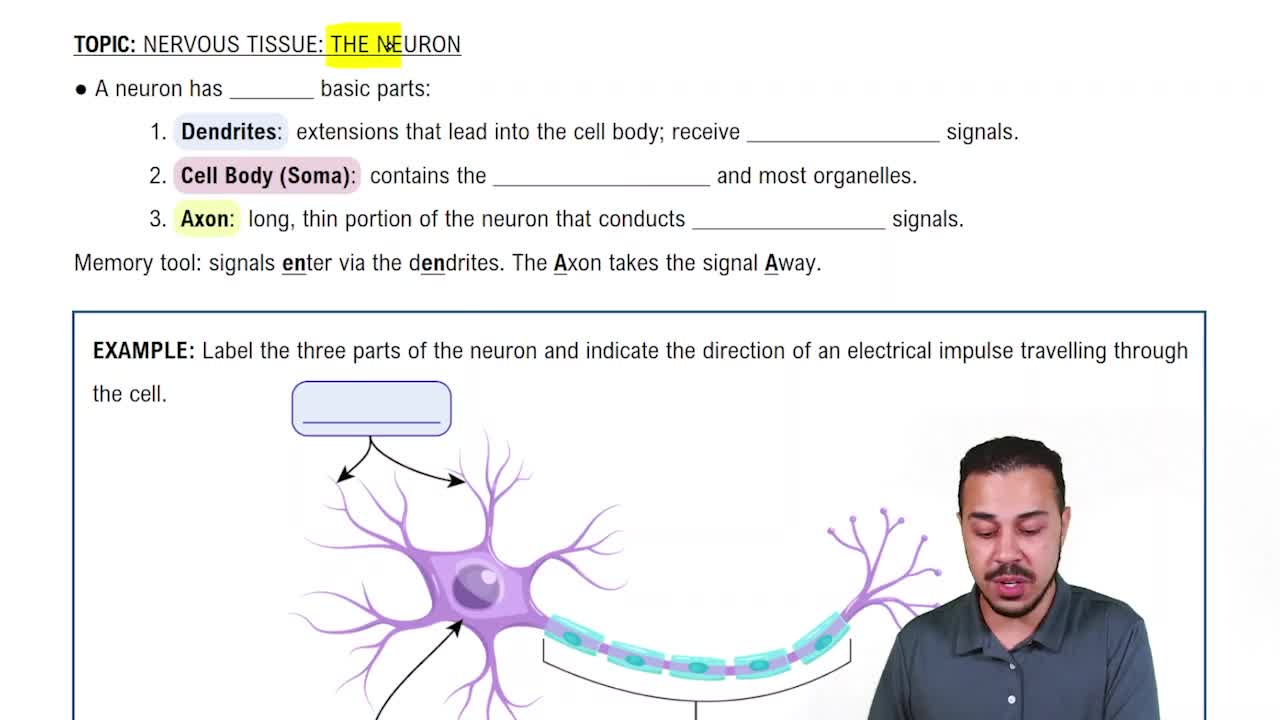
Motor Neuron

The motor neuron is a type of nerve cell that transmits signals from the central nervous system to the muscles. At the neuromuscular junction, the axon terminal of the motor neuron releases neurotransmitters, specifically acetylcholine, which initiates muscle contraction. Understanding the role of motor neurons is crucial for comprehending how signals are communicated to muscles.
Recommended video:

Synaptic Cleft

The synaptic cleft is the small gap between the motor neuron and the muscle fiber at the neuromuscular junction. This space is where neurotransmitters are released and diffuse to bind with receptors on the muscle cell membrane. The synaptic cleft is essential for the transmission of signals, as it allows for the chemical communication necessary for muscle activation.
Recommended video:
Guided course
1:46
The Skull Example 2

Muscle Fiber Receptors

Muscle fiber receptors, specifically nicotinic acetylcholine receptors, are located on the postsynaptic membrane of the muscle cell at the neuromuscular junction. When acetylcholine binds to these receptors, it triggers a series of events that lead to muscle contraction. Understanding these receptors is vital for grasping how neuromuscular transmission results in movement.
Recommended video:
Guided course
7:47
The Muscle Fiber
Related Practice
Textbook Question

Identify the following as properties of electrical synapses (ES), chemical synapses (CS), or both (B).           

a. ______ The plasma membranes of presynaptic and postsynaptic neurons are joined by gap junctions.          

b. ______ Transmission is unidirectional and delayed.          

c. ______ A presynaptic neuron and a postsynaptic neuron are involved.          

d. ______ The use of neurotransmitters packaged into synaptic vesicles is required.          

e. ______ Transmission is nearly instantaneous and bidirectional.

918
views
Textbook Question

Mark the following statements as true or false. If a statement is false, correct it to make a true statement.

The concentration of Na+ is highest in the cytosol, and the concentration of K+ is highest in the extracellular fluid.

738
views
Textbook Question

The ________ is the period of time during which it is impossible to stimulate a neuron to have an action potential, whereas the ________ is the period of time during which a larger-than-normal stimulus is required to elicit an action potential.

1081
views
Textbook Question

Mark the following statements as true or false. If a statement is false, correct it to make a true statement.

The Na+/K+ pumps and gated channels maintain the Na+ and K+ gradients necessary for action potentials to occur.

677
views
Textbook Question

Mark the following statements as true or false. If a statement is false, correct it to make a true statement.

A depolarization is a change in membrane potential that makes the potential less negative.

739
views
Textbook Question

Which of the following statements best describes saltatory conduction?

a. Every section of the axolemma must be depolarized and triggered to generate an action potential.

b. The internodes must generate action potentials.

c. The dendrites and cell bodies propagate EPSPs toward the trigger zone.

d. Only the nodes of Ranvier must generate action potentials.

924
views