
Textbook Question
Define each of the following terms in your own words, using 20 or fewer words.
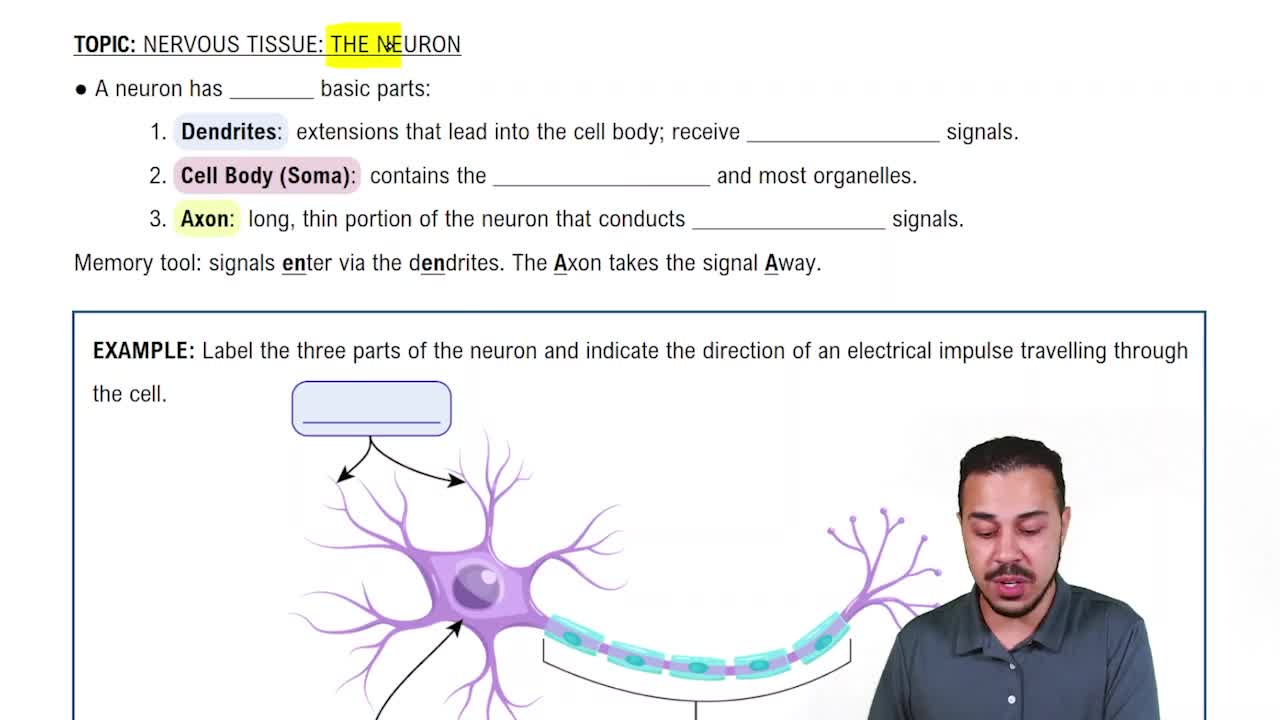
a. Peripheral nerve
618
views
 Verified step by step guidance
 02:31
02:31
 04:20
04:20 2:25
2:25Define each of the following terms in your own words, using 20 or fewer words.
a. Peripheral nerve
When Mr. Williams goes to the emergency department with pain in the area along the midline of the diaphragm, he worries he is having a heart attack. Could the pain be related to his heart? Could it be related to any other organ(s)? Explain.
First, write the Roman numeral that corresponds to each named cranial nerve (after the abbreviation CN). Second, match the cranial nerve with its correct function from the column on the right.
CN____
______Vestibulocochlear nerve
CN____
______Trigeminal nerve
CN____
_______Hypoglossal nerve
CN____
_______Abducens nerve
CN____
_______Vagus nerve
CN____
_______Olfactory nerve
CN____
_______Accessory nerve
CN____
_______Oculomotor nerve
CN____
_______Facial nerve
CN____
_______Optic nerve
CN____
_______Glossopharyngeal nerve
CN____
_______Trochlear nerve
a. Motor to the lateral rectus muscle
b. Motor to the muscles of facial expression; lacrimation; salivation; taste to the anterior two-thirds of the tongue
c. Sense of smell
d. Motor to the muscles for swallowing; salivation; taste to the posterior one-third of the tongue; somatic sensation from the throat
e. Senses of hearing and equilibrium
f. Motor to the superior oblique muscle
g. Motor to the tongue
h. Motor to the sternocleidomastoid and trapezius muscles
i. Sense of vision
j. Motor to muscles of swallowing and speaking; parasympathetic innervation to thoracic and abdominal viscera; sense of taste from the throat
k. Sensory to the face; motor to the muscles of mastication
l. Motor to four of six extrinsic eye muscles; constricts the pupil; changes the shape of the lens; opens the eyelid
Define each of the following terms in your own words, using 20 or fewer words.
b. Nerve plexus
Which cranial nerves are sensory only, primarily motor, and mixed?
Match the following nerves with the structures they innervate.
____Phrenic nerve
____Median nerve
____Femoral nerve
____Tibial nerve
____Radial nerve
____Intercostal nerves
____Common fibular nerve
____Musculocutaneous nerve
a. Motor to the triceps brachii muscle and muscles in the forearm that extend the hand; sensory from the posterior hand
b. Motor to the muscles in the anterior arm that flex the forearm; sensory from skin over the lateral forearm
c. Motor to the muscles in the anterior and lateral leg that evert and dorsiflex the foot; sensory from the skin of the anteroinferior leg
d. Motor to the diaphragm muscle
e. Motor to the muscles in the anterior thigh extend the knee; sensory from the skin over the anterior thigh and leg
f. Motor to the hamstring muscles that extend the thigh and flex the leg, muscles of the leg that plantarflex the foot, and muscles of the foot; sensory from the skin over the posterior and lateral leg and foot
g. Motor to the muscles between the ribs and the abdominal muscles; sensory from the skin over the abdomen
h. Motor to the muscles in the forearm that flex the hand, certain intrinsic hand muscles; sensory from the skin of the anterior hand