Ch. 13 The Peripheral Nervous System
Amerman - Human Anatomy & Physiology 2nd Edition
Amerman2nd EditionHuman Anatomy & PhysiologyISBN: 9780136873822Not the one you use?Change textbook
Chapter 13, Problem L3.2

Jason presents for evaluation after a severe shoulder injury during which his entire brachial plexus suffered damage. What effects would you expect Jason to have from this injury?

Verified step by step guidance
1
Understand the anatomy of the brachial plexus: The brachial plexus is a network of nerves originating from the spinal cord (C5-T1) that provides motor and sensory innervation to the upper limb, including the shoulder, arm, forearm, and hand.
Identify the functions of the brachial plexus: The brachial plexus is responsible for controlling muscle movements (motor function) and transmitting sensory information (touch, pain, temperature) from the upper limb to the brain.
Analyze the effects of damage to the entire brachial plexus: Damage to the entire brachial plexus would result in both motor and sensory deficits in the affected limb. This includes paralysis or weakness of the muscles in the shoulder, arm, forearm, and hand, as well as loss of sensation in these areas.
Consider specific motor impairments: Jason would likely experience an inability to move the shoulder (e.g., deltoid muscle paralysis), elbow (e.g., biceps and triceps paralysis), wrist, and fingers due to the loss of motor input from the brachial plexus.
Consider specific sensory impairments: Jason would also experience numbness or loss of sensation in the skin of the shoulder, arm, forearm, and hand, as the sensory nerves from the brachial plexus are no longer functional.

Verified video answer for a similar problem:

This video solution was recommended by our tutors as helpful for the problem above.
Was this helpful?

Key Concepts

Here are the essential concepts you must grasp in order to answer the question correctly.

Brachial Plexus Anatomy

The brachial plexus is a network of nerves that originates from the spinal cord in the neck and extends into the arm. It is responsible for motor and sensory innervation of the upper limb. Damage to this plexus can lead to significant loss of function and sensation in the shoulder, arm, and hand, depending on the severity and location of the injury.
Recommended video:
4:14
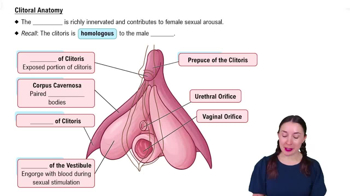
Clitoral Anatomy

Neurological Deficits

Neurological deficits refer to impairments in the nervous system's ability to function properly. In the context of a brachial plexus injury, this can manifest as weakness or paralysis of the arm muscles, loss of sensation, and impaired reflexes. The specific deficits depend on which nerves are affected, leading to conditions such as Erb's palsy or Klumpke's palsy.

Rehabilitation and Recovery

Rehabilitation is a critical process following a brachial plexus injury, focusing on restoring function and mobility. This may include physical therapy to strengthen muscles, occupational therapy to improve daily living skills, and sometimes surgical interventions to repair nerve damage. The extent of recovery can vary widely based on the severity of the injury and the timeliness of treatment.
Related Practice
Textbook Question

Complaining of muscle weakness, Delia goes to the doctor. Devise a series of physical examination tests that would help to determine if her problem involves upper or lower motor neurons.

556
views

Textbook Question

Match each type of neuroglial cell with its correct function.

____ Schwann cells    

____ Ependymal cells     

____ Microglial cells    

____ Oligodendrocytes     

____ Satellite cells    

____ Astrocytes

a. Phagocytic cells of the CNS

b. Surround the cell bodies of neurons in the PNS

c. Create the myelin sheath in the PNS

d. Anchor neurons and blood vessels, maintain extracellular environment around neurons, assist in repair of damaged brain tissue

e. Create the myelin sheath in the CNS

f. Ciliated cells in the CNS that produce and circulate the fluid around the brain and spinal cord

1186
views
1
rank
Textbook Question

Maria is a 3-year-old who has been diagnosed with CIPA, or congenital insensitivity to pain with anhidrosis. This disease results from a genetic mutation that causes essentially all general sensory neurons to not function properly. What types of sensations will Maria be unable to detect (be specific)? Predict what problems she might face from her condition.

751
views
Textbook Question

Define each of the following terms in your own words, using 20 or fewer words.

a. Peripheral nerve

618
views
Textbook Question

When Mr. Williams goes to the emergency department with pain in the area along the midline of the diaphragm, he worries he is having a heart attack. Could the pain be related to his heart? Could it be related to any other organ(s)? Explain.

525
views
Textbook Question

Define each of the following terms in your own words, using 20 or fewer words.

b. Nerve plexus

630
views