Ch. 13 The Peripheral Nervous System
Amerman - Human Anatomy & Physiology 2nd Edition
Amerman2nd EditionHuman Anatomy & PhysiologyISBN: 9780136873822Not the one you use?Change textbook
Chapter 13, Problem 16

Which of the following is the correct order of events of a reflex arc?


a. Stimulus detection and delivery → motor response → integration in the CNS
b. Motor response → stimulus detection and delivery → integration in the CNS
c. Stimulus detection and delivery → integration in the CNS → delivery of motor response
d. Integration in the CNS → motor response → stimulus detection and delivery

Verified step by step guidance
1
Understand the components of a reflex arc: A reflex arc is the neural pathway that controls a reflex. It typically involves five main components: (1) a sensory receptor, (2) a sensory neuron, (3) integration in the central nervous system (CNS), (4) a motor neuron, and (5) an effector (muscle or gland).
Identify the sequence of events: The reflex arc begins with the detection of a stimulus by sensory receptors. This information is then transmitted via sensory neurons to the CNS for processing and integration.
Recognize the role of the CNS: In the CNS (spinal cord or brain), the sensory input is processed, and an appropriate motor response is determined. This step is crucial for coordinating the reflex action.
Understand the motor response: After integration, the CNS sends signals through motor neurons to the effector organs (muscles or glands) to produce a response, such as muscle contraction or gland secretion.
Compare the options: Based on the above understanding, the correct sequence is 'stimulus detection and delivery → integration in the CNS → delivery of motor response,' which matches option c.

Verified video answer for a similar problem:

This video solution was recommended by our tutors as helpful for the problem above.
Was this helpful?

Key Concepts

Here are the essential concepts you must grasp in order to answer the question correctly.

Reflex Arc

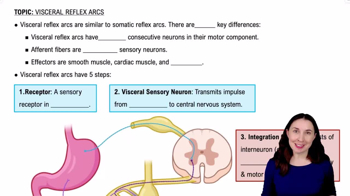
A reflex arc is a neural pathway that controls a reflex action. It typically involves a sensory neuron that detects a stimulus, an integration center in the central nervous system (CNS) that processes the information, and a motor neuron that triggers a response. This pathway allows for quick reactions to stimuli without the need for conscious thought.
Recommended video:
2:12
Visceral Reflex Arcs

Sensory Input

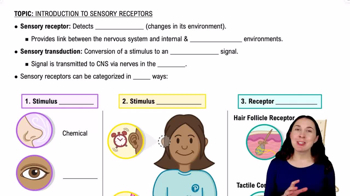
Sensory input refers to the information received by sensory receptors in response to external stimuli. In the context of a reflex arc, this is the initial step where a stimulus, such as heat or pain, is detected and converted into an electrical signal that travels along sensory neurons to the CNS for processing.
Recommended video:
2:47
Sensory Receptors

Motor Response

A motor response is the action taken by the body in reaction to a stimulus, initiated by the CNS after processing the sensory input. In a reflex arc, this response is typically executed by motor neurons that activate muscles or glands, resulting in a quick and involuntary action, such as pulling away from a hot surface.
Recommended video:
9:59
Steps of the Interferon Response
Related Practice
Textbook Question

The lower motor neurons that innervate contractile skeletal muscle fibers are called:

a. α-motor neurons

b. β-motor neurons

c. upper motor neurons

d. γ-motor neurons

809
views
Textbook Question

Mark the following statements as true or false. If a statement is false, correct it to make a true statement.

b. The Golgi tendon organs detect stretch in a simple stretch reflex.

790
views
Textbook Question

______detect the degree to which a muscle is stretched, whereas______detect the force of a muscle contraction.

581
views
Textbook Question

Mark the following statements as true or false. If a statement is false, correct it to make a true statement.

a. The simple stretch reflex is a monosynaptic reflex with only a single synapse in the spinal cord between the sensory and motor neurons.

834
views
Textbook Question

The cell bodies of upper motor neurons reside in the ________ and function to ________, whereas the cell bodies of lower motor neurons reside in the ________ and function to ________.

921
views
Textbook Question

Label the following components of the corticospinal tracts with numbers 1 through 6, with 1 being the origin of the tracts and 6 their destination.     

_____ Medullary pyramids where most fibers decussate.     

_____ Anterior horn of the spinal gray matter.     

_____ Midbrain and pons.      

_____ Upper motor neurons in the primary motor and premotor cortices.     

_____ Corona radiata and internal capsule.        

_____ Lateral funiculus of the spinal cord.

589
views