Ch. 17 The Cardiovascular System I: The Heart
Amerman - Human Anatomy & Physiology 2nd Edition
Amerman2nd EditionHuman Anatomy & PhysiologyISBN: 9780136873822Not the one you use?Change textbook
Chapter 17, Problem 15

The first heart sound is called ________ and it is caused by the closing of the ________ valves. It occurs at the beginning of the ________ phase of the cardiac cycle. The second heart sound is called ________ and it is caused by the closing of the ________ valves. It occurs at the beginning of the ________ phase of the cardiac cycle.

Verified step by step guidance
1
Step 1: Understand the cardiac cycle phases. The cardiac cycle consists of systole (contraction phase) and diastole (relaxation phase). These phases are crucial for understanding when the heart sounds occur.
Step 2: Identify the first heart sound (S1). The first heart sound is caused by the closing of the atrioventricular (AV) valves, which include the mitral and tricuspid valves. This occurs at the beginning of systole, when the ventricles start contracting.
Step 3: Identify the second heart sound (S2). The second heart sound is caused by the closing of the semilunar valves, which include the aortic and pulmonary valves. This occurs at the beginning of diastole, when the ventricles start relaxing.
Step 4: Recall the names of the heart sounds. The first heart sound is commonly referred to as 'lub,' and the second heart sound is referred to as 'dub.' These terms are used to describe the characteristic sounds heard during auscultation.
Step 5: Summarize the sequence. The first heart sound (S1) occurs at the beginning of systole due to the closing of the AV valves, while the second heart sound (S2) occurs at the beginning of diastole due to the closing of the semilunar valves.

Verified video answer for a similar problem:

This video solution was recommended by our tutors as helpful for the problem above.
Was this helpful?

Key Concepts

Here are the essential concepts you must grasp in order to answer the question correctly.

Heart Sounds

Heart sounds are the noises produced by the heart during the cardiac cycle, primarily due to the closing of heart valves. The first heart sound (S1) is associated with the closure of the atrioventricular (AV) valves, while the second heart sound (S2) corresponds to the closure of the semilunar valves. These sounds are crucial for assessing heart function and can indicate various cardiac conditions.
Recommended video:
Guided course
6:13
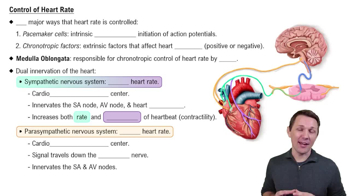
Control of Heart Rate

Cardiac Cycle Phases

The cardiac cycle consists of a series of phases that describe the sequence of events in one heartbeat. The two main phases are systole, when the heart contracts and pumps blood, and diastole, when the heart relaxes and fills with blood. Understanding these phases is essential for interpreting heart sounds and their timing within the cycle.
Recommended video:
Guided course
3:55
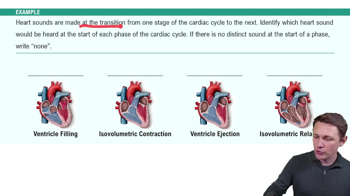
Cardiac Cycle Example 3

Valves of the Heart

The heart contains four main valves: the atrioventricular (AV) valves (tricuspid and mitral) and the semilunar valves (pulmonary and aortic). These valves ensure unidirectional blood flow through the heart and prevent backflow. Their closure is responsible for the heart sounds, making knowledge of their function vital for understanding cardiac physiology.
Recommended video:
Guided course
7:13
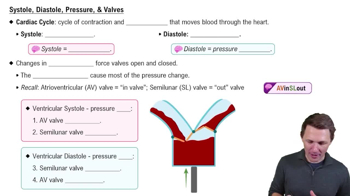
Systole, Diastole, Pressure, & Valves
Related Practice
Textbook Question

An increase in preload causes a/an ________ in stroke volume in accordance with the ________ law. An increase in afterload causes a/an ________ in stroke volume. An increase in contractility causes a/an ________ in stroke volume.

1030
views
Textbook Question

Mark the following statements as true or false. If a statement is false, correct it to make a true statement.

Tissue perfusion to the heart decreases during systole and increases during diastole.

803
views
Textbook Question

Which of the following statements is false?

a. The sympathetic nervous system releases epinephrine and norepinephrine, which are positive chronotropic and inotropic agents.

b. The endocrine system regulates cardiac output through chronotropic and inotropic hormones and through hormones that regulate water balance.

c. The parasympathetic nervous system releases acetylcholine and epinephrine, which are strongly negative inotropic agents.

d. Factors such as electrolyte concentrations, body temperature, and age all affect cardiac output.

933
views
Textbook Question

Mark the following statements as true or false. If a statement is false, correct it to make a true statement.

The ventricular ejection phase generally correlates with the S-T segment and the T wave on the ECG.

878
views
Textbook Question

Cardiac output is equal to:

a. End-diastolic volume minus end-systolic volume.

b. Heart rate multiplied by stroke volume.

c. Stroke volume divided by end-diastolic volume.

d. Heart rate multiplied by preload.

904
views
Textbook Question

Which chamber generates the highest pressure during systole?

a. Right atrium

b. Right ventricle

c. Left atrium

d. Left ventricle

1350
views