Ch. 19 Blood
Amerman - Human Anatomy & Physiology 2nd Edition
Amerman2nd EditionHuman Anatomy & PhysiologyISBN: 9780136873822Not the one you use?Change textbook
Chapter 19, Problem 6

Erythrocytes are derived from stem cells called____, circulate in the blood for approximately _______ days, and are destroyed by an organ called the _______.

Verified step by step guidance
1
Step 1: Understand that erythrocytes (red blood cells) are derived from stem cells in the bone marrow. These stem cells are specifically called hematopoietic stem cells (HSCs).
Step 2: Recall that erythrocytes have a lifespan of approximately 120 days in the bloodstream before they are removed from circulation.
Step 3: Identify the organ responsible for destroying old or damaged erythrocytes. This organ is the spleen, which acts as a 'red blood cell graveyard' and filters out aged cells.
Step 4: Connect the concepts: hematopoietic stem cells give rise to erythrocytes, which circulate for about 120 days, and are then destroyed by the spleen.
Step 5: Review the process of erythrocyte destruction in the spleen, where macrophages break down hemoglobin into its components, such as iron and bilirubin, for recycling or excretion.

Verified video answer for a similar problem:

This video solution was recommended by our tutors as helpful for the problem above.
Was this helpful?

Key Concepts

Here are the essential concepts you must grasp in order to answer the question correctly.

Hematopoietic Stem Cells

Hematopoietic stem cells are multipotent stem cells located primarily in the bone marrow. They are responsible for the production of all blood cells, including erythrocytes (red blood cells). These stem cells undergo a process of differentiation and maturation to give rise to various blood cell lineages.
Recommended video:
05:33
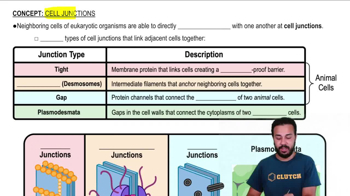
Cell Junctions

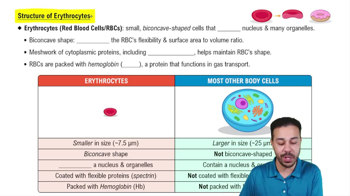
Erythrocyte Lifespan

Erythrocytes typically have a lifespan of about 120 days in the human body. During this time, they circulate through the bloodstream, transporting oxygen from the lungs to tissues and returning carbon dioxide for exhalation. After their lifespan, they are removed from circulation and broken down.
Recommended video:
6:31
Structure of Erythrocytes

Spleen Function

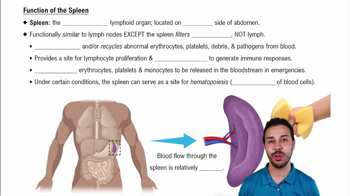
The spleen is an organ that plays a crucial role in filtering blood and recycling components of erythrocytes. It is responsible for the destruction of old or damaged red blood cells, breaking them down into their constituent parts, which can be reused or excreted. This process is vital for maintaining healthy blood composition.
Recommended video:
7:11
Function of the Spleen
Related Practice
Textbook Question

Leukocytes are:

a. Nucleated cells that function in blood clotting

b. Nucleated cells that function in immunity

c. Anucleate cells that function in blood clotting

d. Anucleate cells that function in immunity

1138
views

Textbook Question

Match the following leukocytes with the correct definition. 

__Basophil      

__B lymphocyte      

__Neutrophil      

__Monocyte       

__T lymphocyte      

__Eosinophil 

a. Destroys bacteria; directly phagocytoses bacteria

b. Responds to parasitic worm infection and mediates the allergic response

c. Activates all parts of the immune response; directly kills cancer or virally infected cells

d. Secretes inflammatory mediators

e. Agranulocyte that matures into macrophage

f. Agranulocyte that secretes antibodies

1348
views
Textbook Question

Mark the following statements as true or false. If a statement is false, correct it to make a true statement.

Hemoglobin forms oxyhemoglobin when it binds to oxygen.

980
views
Textbook Question

Erythropoiesis requires stimulation from the hormone:

a. Thrombin

b. Thrombopoietin

c. Thymosin

d. Erythropoietin

917
views
Textbook Question

Anemia is defined as:

a. A decreased oxygen-carrying capacity of the blood.

b. A decreased iron content of the blood.

c. Decreased bone marrow function.

d. Abnormalities in hemoglobin.

1220
views
Textbook Question

Mark the following statements as true or false. If a statement is false, correct it to make a true statement.

Hemoglobin consists of two polypeptide chains bound to a heme group.

1035
views