Ch. 2 The Chemistry of Life
Amerman - Human Anatomy & Physiology 2nd Edition
Amerman2nd EditionHuman Anatomy & PhysiologyISBN: 9780136873822Not the one you use?Change textbook
Chapter 2, Problem 7

Describe what takes place during a chemical reaction.

Verified step by step guidance
1
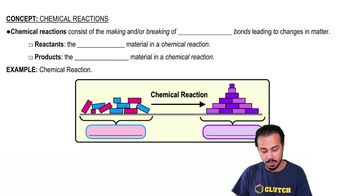
A chemical reaction begins when reactants interact with one another. Reactants are the starting substances in a chemical reaction, and they undergo changes to form new substances called products.
During the reaction, chemical bonds in the reactants are broken. This requires energy, which is often referred to as the activation energy of the reaction.
Once the bonds in the reactants are broken, atoms are rearranged to form new chemical bonds, resulting in the creation of products. This rearrangement follows the principle of conservation of mass, meaning no atoms are lost or gained, only rearranged.
Energy is either absorbed or released during the reaction. If the reaction releases energy, it is exothermic (e.g., heat is given off). If it absorbs energy, it is endothermic (e.g., heat is taken in).
The reaction reaches completion when all reactants are converted into products, or when the system reaches equilibrium, where the forward and reverse reactions occur at the same rate.

Verified video answer for a similar problem:

This video solution was recommended by our tutors as helpful for the problem above.
Was this helpful?

Key Concepts

Here are the essential concepts you must grasp in order to answer the question correctly.

Reactants and Products

In a chemical reaction, reactants are the starting substances that undergo transformation, while products are the substances formed as a result of the reaction. The conversion of reactants to products involves breaking and forming chemical bonds, which alters the molecular structure and properties of the substances involved.
Recommended video:
07:25
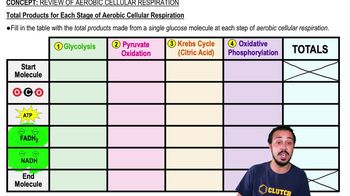
Total Products for Each Stage of Aerobic Cellular Respiration

Energy Changes

Chemical reactions often involve changes in energy, which can be either exothermic or endothermic. Exothermic reactions release energy, usually in the form of heat, while endothermic reactions absorb energy from their surroundings. Understanding these energy changes is crucial for predicting the behavior of reactions and their feasibility.
Recommended video:
4:58
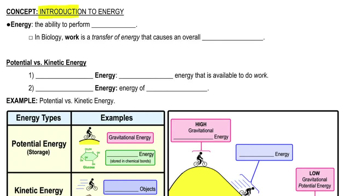
Introduction to Energy

Reaction Mechanism

The reaction mechanism describes the step-by-step sequence of elementary reactions that occur during a chemical reaction. It provides insight into how reactants are converted into products, including the formation of intermediates and the transition states. Analyzing the mechanism helps chemists understand the kinetics and dynamics of the reaction.
Recommended video:
01:56
Chemical Reactions
Related Practice
Textbook Question

Explain the difference between an ionic and a covalent bond.

1395
views

Textbook Question

Identify each of the following molecules or compounds as ionic, polar covalent, or nonpolar covalent.

a. H2O _________

b. LiI _________

c. C10H22 _________

d. N2 _________

e. MgBr2 _________

f. H2S _________

833
views
Textbook Question

An enzyme is a:

a. biological catalyst that increases the concentration of the products.

b. biological catalyst that increases the concentration of the reactants.

c. chemical that is used in a reaction, after which it can no longer be used by the cell.

d. biological catalyst that works by bringing its substrates closer to their transition states.

950
views
Textbook Question

Which of the following would not result in an increase in reaction rate?

a. Increase in temperature

b. Particles in the solid phase

c. Presence of a catalyst

d. Smaller particle size

867
views
Textbook Question

What are hydrogen bonds, and how do they form?

1477
views
Textbook Question

Match the following terms with the correct definition:

      Endergonic reaction

      Potential energy

      Electrical energy

      Anabolic reaction

      Oxidation-reduction reaction

      Chemical energy

      Catabolic reaction

      Kinetic energy

a. Energy in motion

b. Energy stored in chemical bonds

c. Reaction that consumes energy

d. A decomposition reaction

e. The energy of moving charged particles

f. Stored energy

g. Synthesis reaction

h. Reaction where electrons are transferred between reactants  

724
views