
Ch. 2 The Chemistry of Life
Amerman - Human Anatomy & Physiology 2nd Edition
Amerman2nd EditionHuman Anatomy & PhysiologyISBN: 9780136873822Not the one you use?Change textbook
Chapter 2, Problem 16d

Mark the following statements as true or false. If a statement is false, correct it to make a true statement.
Proteins are composed of strings of fatty acids linked by glycosidic bonds.

Verified step by step guidance
1
Step 1: Analyze the statement: 'Proteins are composed of strings of fatty acids linked by glycosidic bonds.' Proteins are macromolecules, so we need to identify their correct building blocks and bonds.
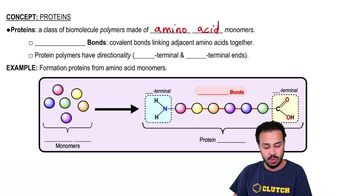
Step 2: Recall that proteins are composed of amino acids, not fatty acids. Amino acids are the monomers that form proteins.
Step 3: Understand the type of bond that links amino acids together. Amino acids are linked by peptide bonds, not glycosidic bonds. Glycosidic bonds are found in carbohydrates, linking monosaccharides.
Step 4: Determine whether the statement is true or false. Based on the above information, the statement is false because it incorrectly identifies the building blocks and bonds of proteins.
Step 5: Correct the statement to make it true: 'Proteins are composed of strings of amino acids linked by peptide bonds.'

Verified video answer for a similar problem:

This video solution was recommended by our tutors as helpful for the problem above.
Was this helpful?

Key Concepts

Here are the essential concepts you must grasp in order to answer the question correctly.

Proteins

Proteins are large, complex molecules made up of long chains of amino acids. They play critical roles in the body, including catalyzing biochemical reactions, providing structural support, and regulating cellular processes. Unlike fats, proteins are not composed of fatty acids, but rather of amino acids linked by peptide bonds.
Recommended video:
02:50
Proteins

Fatty Acids

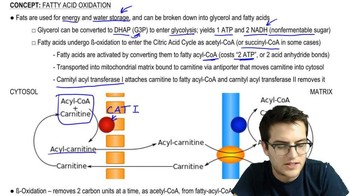
Fatty acids are carboxylic acids with long hydrocarbon chains, which are key components of lipids, including fats and oils. They are not involved in the structure of proteins. Instead, they serve as energy sources and are important for cell membrane structure. The linkage of fatty acids occurs through ester bonds, not glycosidic bonds.
Recommended video:
11:34
Fatty Acid Oxidation 1

Glycosidic Bonds

Glycosidic bonds are covalent bonds that link carbohydrates (sugars) together to form disaccharides and polysaccharides. They are formed between the hydroxyl group of one sugar and the anomeric carbon of another. This type of bond is not relevant to proteins, which are linked by peptide bonds, highlighting the distinction between carbohydrates and proteins.
Recommended video:
05:03
Hydrogen Bonding