Ch. 20 The Lymphatic System and Immunity
Amerman - Human Anatomy & Physiology 2nd Edition
Amerman2nd EditionHuman Anatomy & PhysiologyISBN: 9780136873822Not the one you use?Change textbook
Chapter 20, Problem 5

Which of the following make up the body's first line of defense?
a. Surface barriers
b. Cells and proteins of adaptive immunity
c. Cells and proteins of innate immunity
d. All of the above

Verified step by step guidance
1
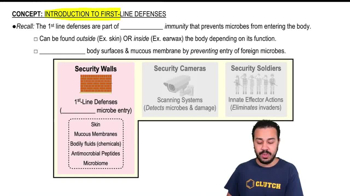
Understand the concept of the body's first line of defense: The first line of defense refers to physical and chemical barriers that prevent pathogens from entering the body. These are nonspecific defenses and are part of innate immunity.
Identify surface barriers as part of the first line of defense: Surface barriers include the skin and mucous membranes, which act as physical barriers to block pathogen entry. Additionally, secretions like mucus, sweat, and tears contain antimicrobial substances.
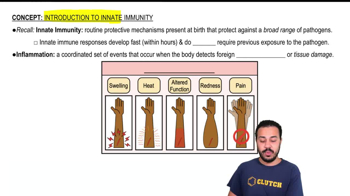
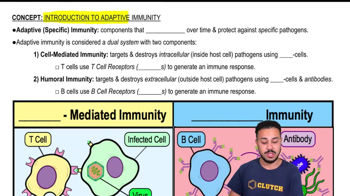
Differentiate between innate and adaptive immunity: Innate immunity is the body's immediate, nonspecific response to pathogens, while adaptive immunity involves a specific response and memory of pathogens. The first line of defense is part of innate immunity, not adaptive immunity.
Evaluate the options provided: Surface barriers (option a) are part of the first line of defense. Cells and proteins of innate immunity (option c) are part of the second line of defense, which responds after pathogens bypass the first line. Adaptive immunity (option b) is the third line of defense and is not part of the first line.
Conclude which option is correct: Based on the explanation, the correct answer is surface barriers (option a), as they exclusively make up the body's first line of defense.

Verified video answer for a similar problem:

This video solution was recommended by our tutors as helpful for the problem above.
Was this helpful?

Key Concepts

Here are the essential concepts you must grasp in order to answer the question correctly.

First Line of Defense

The first line of defense refers to the body's initial protective mechanisms against pathogens. This includes physical and chemical barriers such as skin, mucous membranes, and secretions like saliva and tears, which prevent the entry of harmful microorganisms.
Recommended video:
1:56
First-Line Defenses

Innate Immunity

Innate immunity is the body's immediate and non-specific response to pathogens. It includes various cells and proteins, such as phagocytes and natural killer cells, that act quickly to eliminate invaders and is considered a crucial part of the first line of defense.
Recommended video:
2:30
Innate Immunity

Adaptive Immunity

Adaptive immunity is a specific immune response that develops over time, involving lymphocytes such as B cells and T cells. While it is essential for long-term protection and memory against specific pathogens, it is not part of the first line of defense, which acts more rapidly.
Recommended video:
5:47
Adaptive Immunity
Related Practice
Textbook Question

The chemotherapeutic drugs Mr. White is taking affect all cells that undergo rapid mitosis, such as those of the skin. What effect would this have on the functions of the skin? How could this affect his immunity?

768
views

Textbook Question

Which of the following does not describe the relationship between the lymphatic and immune systems?

a. Lymphoid organs and tissues house cells of the immune system.

b. Lymphoid organs and tissues trap pathogens for the immune system.

c. Lymphoid organs activate cells of the immune system.

d. Lymphoid organs and tissues create the surface barriers of the immune system.

709
views
Textbook Question

Nonspecific immunity is also known as_____. Specific immunity is also known as_____. Specific immunity has the capacity for immunological ______ .

875
views
Textbook Question

Your friend tests her snake-wrangling skills on an eastern diamondback rattlesnake, and is bitten and envenomated (injected with the snake's venom). In the emergency department, doctors administer the antivenin CroFab, which contains antibodies to the toxins in snake venom. Is this an example of active or passive immunity? Will this confer any lasting protection to your friend?

1111
views
Textbook Question

Mark the following statements as true or false. If a statement is false, correct it to make a true statement.

Surface barriers contain substances in their secretions that kill pathogens and deter their growth.

773
views
Textbook Question

Mark the following statements as true or false. If a statement is false, correct it to make a true statement.

Phagocytic cells of innate immunity include NK cells and basophils.

1080
views