Ch. 21 The Respiratory System
Amerman - Human Anatomy & Physiology 2nd Edition
Amerman2nd EditionHuman Anatomy & PhysiologyISBN: 9780136873822Not the one you use?Change textbook
Chapter 21, Problem 2

Air enters the lungs through the hollow passages known collectively as the _____, which terminate in grapelike clusters called _____. The lungs are encased in the ____ membranes.

Verified step by step guidance
1
Step 1: Begin by identifying the anatomical structures involved in the respiratory system. Air enters the lungs through a series of hollow passages collectively known as the respiratory tract. These passages include the trachea, bronchi, and bronchioles.
Step 2: Understand the terminal structures of the respiratory tract. The bronchioles terminate in grapelike clusters called alveoli, which are the primary sites for gas exchange in the lungs.
Step 3: Learn about the protective membranes surrounding the lungs. The lungs are encased in the pleural membranes, which consist of two layers: the visceral pleura (attached to the lung surface) and the parietal pleura (lining the thoracic cavity).
Step 4: Review the function of each structure. The respiratory tract facilitates the movement of air, the alveoli enable oxygen and carbon dioxide exchange, and the pleural membranes reduce friction during breathing.
Step 5: Fill in the blanks using the anatomical terms: respiratory tract, alveoli, and pleural membranes.

Verified video answer for a similar problem:

This video solution was recommended by our tutors as helpful for the problem above.
Was this helpful?

Key Concepts

Here are the essential concepts you must grasp in order to answer the question correctly.

Respiratory Tract

The respiratory tract refers to the series of hollow passages that air travels through to reach the lungs. It includes the nasal cavity, pharynx, larynx, trachea, bronchi, and bronchioles. This system is essential for filtering, warming, and humidifying the air before it enters the lungs.
Recommended video:
0:49
Secondary Lymphoid Organs: MALT Example 1

Alveoli

Alveoli are tiny, grapelike clusters of air sacs located at the end of the bronchioles in the lungs. They are the primary site for gas exchange, allowing oxygen to enter the bloodstream and carbon dioxide to be expelled. Their large surface area and thin walls facilitate efficient diffusion of gases.
Recommended video:
Guided course
5:06
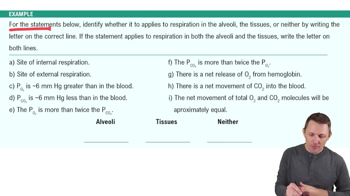
Respiration Example 3

Pleural Membranes

The pleural membranes are two layers of tissue that encase the lungs, consisting of the visceral pleura (attached to the lungs) and the parietal pleura (lining the chest wall). These membranes create a pleural cavity filled with pleural fluid, which reduces friction during breathing and helps maintain lung expansion.
Recommended video:
Guided course
3:49
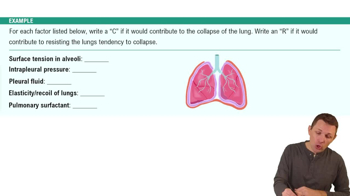
Pressure in the Lungs and Pleural Cavity Example 1