
Ch. 24 The Urinary System
Amerman - Human Anatomy & Physiology 2nd Edition
Amerman2nd EditionHuman Anatomy & PhysiologyISBN: 9780136873822Not the one you use?Change textbook
Chapter 24, Problem 5

Describe the structure of the filtration membrane.

Verified step by step guidance
1
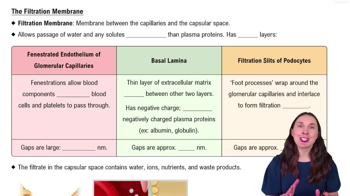
The filtration membrane is a specialized structure in the kidney's glomerulus that facilitates the filtration of blood. It consists of three main layers, each contributing to selective filtration.
The first layer is the fenestrated endothelium of the glomerular capillaries. This layer contains pores (fenestrations) that allow water, ions, and small molecules to pass through while preventing the passage of blood cells.
The second layer is the basement membrane, a dense and negatively charged extracellular matrix. It acts as a physical and charge barrier, preventing the passage of large proteins and molecules with a negative charge.
The third layer is the podocyte layer, which consists of specialized epithelial cells with foot-like extensions called pedicels. These pedicels interlock to form filtration slits, further restricting the passage of large molecules while allowing smaller substances to pass.
Together, these three layers ensure that the filtration membrane selectively filters blood, allowing water, ions, glucose, and small molecules to enter the nephron while retaining larger proteins and cells in the bloodstream.

Verified video answer for a similar problem:

This video solution was recommended by our tutors as helpful for the problem above.
Was this helpful?

Key Concepts

Here are the essential concepts you must grasp in order to answer the question correctly.

Filtration Membrane Structure

The filtration membrane is a specialized barrier in the kidneys, primarily composed of three layers: the fenestrated endothelium, the basement membrane, and the podocytes. This structure allows for selective filtration of blood, permitting water and small solutes to pass while retaining larger molecules and cells.
Recommended video:
4:30
The Filtration Membane

Fenestrated Endothelium

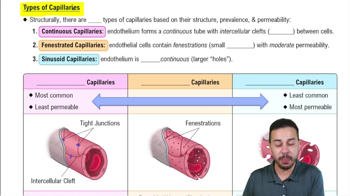
The fenestrated endothelium is the innermost layer of the filtration membrane, characterized by small pores (fenestrae) that enhance permeability. This layer facilitates the passage of water and solutes from the blood into the Bowman’s capsule while preventing the entry of larger blood cells and proteins.
Recommended video:
9:42
Types of Capillaries

Podocytes

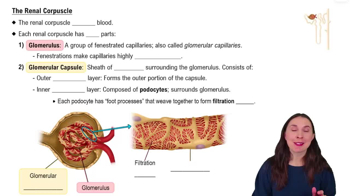
Podocytes are specialized epithelial cells that form the outer layer of the filtration membrane. They have foot-like extensions called pedicels that interdigitate, creating filtration slits. These slits play a crucial role in regulating the filtration process, ensuring that only appropriately sized molecules are filtered into the urine.
Recommended video:
4:52
The Renal Corpuscle
Related Practice
Textbook Question

Mark the following statements as true or false. If a statement is false, correct it to make a true statement.

d. Filtrate flows from the renal corpuscle to the distal tubule, the nephron loop, the proximal tubule, and into the collecting system.

635
views
Textbook Question

Mark the following statements as true or false. If a statement is false, correct it to make a true statement.

b. The distal tubule reabsorbs sodium ions and secretes potassium and hydrogen ions in response to ADH.

671
views
Textbook Question

Mark the following statements as true or false. If a statement is false, correct it to make a true statement.

c. The first capillary bed of the kidneys is the peritubular capillaries, which are fed by the afferent arteriole and drained by the efferent arteriole.

816
views
1
rank
Textbook Question

Cortical and juxtamedullary nephrons differ in the:

a. Lengths of their nephron loops

b. Structure of the capillaries surrounding them

c. Structure of their renal corpuscles

d. Both a and b are correct

e. Both b and c are correct

1519
views
1
rank
Textbook Question

Which of the following substances would pass through the filtration membrane to become part of the filtrate under normal circumstances? (Circle all that apply.)

a. Sodium ions

b. Albumin

c. Glucose

d. Erythrocytes

e. Leukocytes

f. Amino acids

g. Urea

842
views
Textbook Question

Mark the following statements as true or false. If a statement is false, correct it to make a true statement.

a. Sodium ions and glucose are cotransported into the proximal tubule cell by secondary active transport.

669
views