
Ch. 24 The Urinary System
Amerman - Human Anatomy & Physiology 2nd Edition
Amerman2nd EditionHuman Anatomy & PhysiologyISBN: 9780136873822Not the one you use?Change textbook
Chapter 24, Problem L3.B1

Explain how each of the drugs in question 1 from this section would lower blood pressure.

Verified step by step guidance
1
Identify the drugs mentioned in question 1 and classify them based on their mechanism of action (e.g., diuretics, beta-blockers, ACE inhibitors, calcium channel blockers, etc.). Each class of drugs works differently to lower blood pressure.
For diuretics: Explain how they reduce blood pressure by increasing the excretion of sodium and water from the kidneys, which decreases blood volume and, consequently, reduces blood pressure. Highlight the role of the kidneys in regulating blood pressure.
For beta-blockers: Describe how they lower blood pressure by blocking beta-adrenergic receptors, which reduces heart rate and the force of contraction, leading to a decrease in cardiac output. Connect this to the formula for blood pressure: BP = CO × TPR (where CO is cardiac output and TPR is total peripheral resistance).
For ACE inhibitors: Explain how they inhibit the angiotensin-converting enzyme, preventing the formation of angiotensin II, a potent vasoconstrictor. This leads to vasodilation and a reduction in total peripheral resistance, thereby lowering blood pressure.
For calcium channel blockers: Discuss how they prevent calcium ions from entering smooth muscle cells in blood vessel walls, leading to relaxation of the vessels (vasodilation) and a decrease in total peripheral resistance, which lowers blood pressure.

Verified video answer for a similar problem:

This video solution was recommended by our tutors as helpful for the problem above.
Was this helpful?

Key Concepts

Here are the essential concepts you must grasp in order to answer the question correctly.

Mechanism of Action

The mechanism of action refers to the specific biochemical interaction through which a drug produces its pharmacological effect. Understanding how each drug lowers blood pressure involves examining how it affects the cardiovascular system, such as by dilating blood vessels, reducing heart rate, or decreasing blood volume.
Recommended video:
03:53
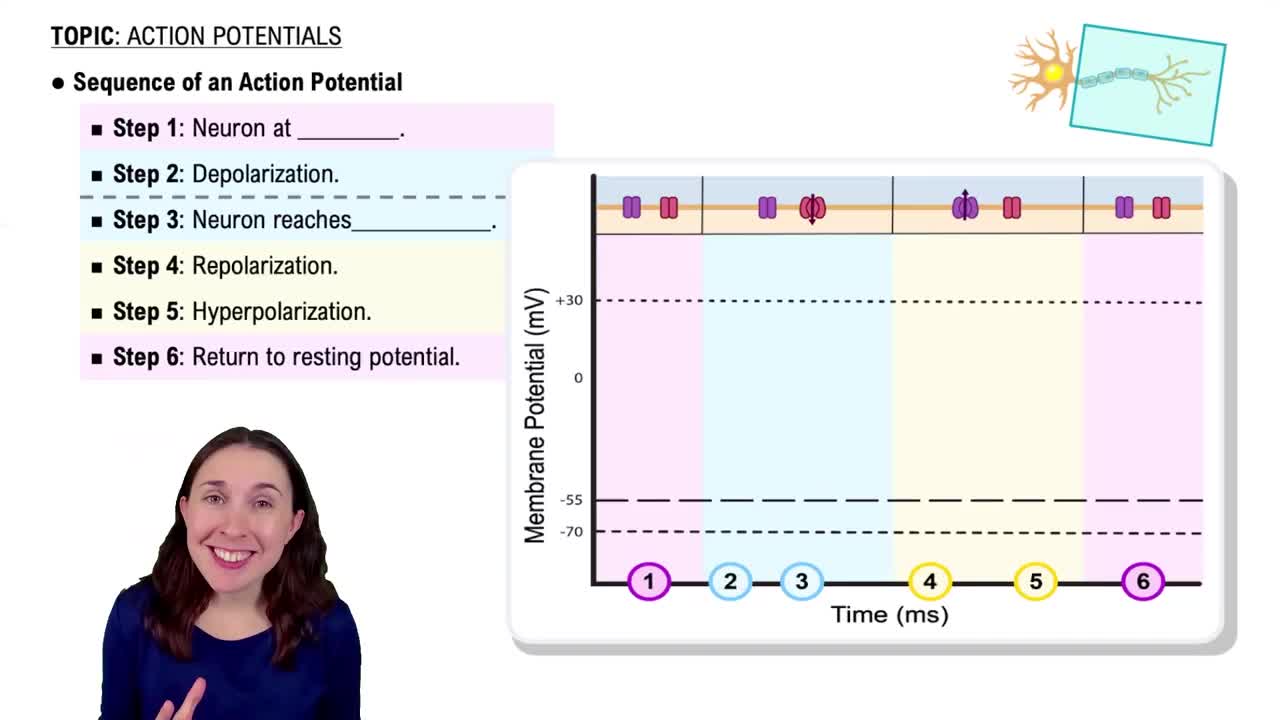
Action Potential

Types of Antihypertensive Drugs

Antihypertensive drugs are classified into several categories, including diuretics, ACE inhibitors, beta-blockers, and calcium channel blockers. Each class works differently to lower blood pressure, and recognizing these differences is crucial for understanding their specific effects and applications in treatment.
Recommended video:
01:06
Types of Phosphorylation

Physiological Impact on Blood Pressure

Blood pressure is influenced by various physiological factors, including cardiac output and systemic vascular resistance. A comprehensive understanding of how drugs alter these factors—such as by reducing heart rate or relaxing blood vessels—helps explain their role in managing hypertension effectively.
Recommended video:
Guided course
6:12
Partial Pressure
Related Practice
Textbook Question

Mr. Gupta has been diagnosed with nephrotic syndrome, which is characterized by the loss of plasma proteins such as albumin into the urine. What impact will this have on his colloid osmotic pressure? How will this affect the net filtration pressure in his capillary beds? What effect will this likely cause?

860
views
Textbook Question

Drugs that treat hypertension, or high blood pressure, have the following actions. Discuss the specific effect that each drug will have on the kidneys.

b. Blocking the receptor for angiotensin-II on blood vessels and in the renal tubule cells

614
views
Textbook Question

Deana is a 4-year-old girl with a rare genetic defect that causes the Na+/glucose symporters in the proximal tubule to reabsorb fewer glucose and sodium ions than normal. Predict the effects this defect will have on the composition and volume of Deana's urine. Explain why you would expect to see increased activity of the tubuloglomerular feedback and the renin-angiotensin-aldosterone system in Deana's kidneys.

705
views
Textbook Question

Mark the following statements as true or false. If a statement is false, correct it to make a true statement.

c. The first capillary bed of the kidneys is the peritubular capillaries, which are fed by the afferent arteriole and drained by the efferent arteriole.

816
views
1
rank
Textbook Question

Mark the following statements as true or false. If a statement is false, correct it to make a true statement.

b. Internally, the kidneys consist of an outer renal medulla, a middle renal pelvis, and an inner renal cortex.

853
views
1
rank
Textbook Question

Mark the following statements as true or false. If a statement is false, correct it to make a true statement.

a. The kidneys are retroperitoneal and covered by three layers of connective tissue.

803
views
1
rank