
Ch. 3 The Cell
Amerman - Human Anatomy & Physiology 2nd Edition
Amerman2nd EditionHuman Anatomy & PhysiologyISBN: 9780136873822Not the one you use?Change textbook
Chapter 3, Problem 19d

Mark the following statements about the cell cycle as true or false. If a statement is false, correct it to make a true statement.
The first three stages of the cell cycle are collectively called interphase.

Verified step by step guidance
1
Understand the cell cycle: The cell cycle consists of several stages, including interphase and the mitotic phase. Interphase is the period during which the cell grows, performs its normal functions, and prepares for division.
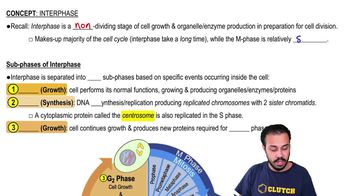
Break down interphase: Interphase is divided into three stages—G1 (Gap 1), S (Synthesis), and G2 (Gap 2). These stages collectively make up the majority of the cell cycle.
Evaluate the statement: The statement 'The first three stages of the cell cycle are collectively called interphase' is true because G1, S, and G2 are indeed the first three stages and are part of interphase.
Clarify the terminology: Ensure the student understands that interphase does not include the mitotic phase (M phase), which is the stage where the cell actually divides.
Reinforce understanding: Encourage the student to review diagrams of the cell cycle to visually confirm the division of interphase into G1, S, and G2 stages, and its distinction from the mitotic phase.

Verified video answer for a similar problem:

This video solution was recommended by our tutors as helpful for the problem above.
Was this helpful?

Key Concepts

Here are the essential concepts you must grasp in order to answer the question correctly.

Cell Cycle

The cell cycle is a series of phases that a cell goes through to grow and divide. It consists of interphase, where the cell prepares for division, and the mitotic phase, where actual division occurs. Understanding the cell cycle is crucial for grasping how cells replicate and maintain their functions.
Recommended video:
03:31
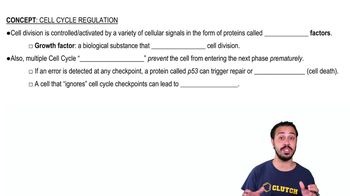
Cell Cycle Regulation

Interphase

Interphase is the longest phase of the cell cycle, comprising three stages: G1 (cell growth), S (DNA synthesis), and G2 (preparation for mitosis). During interphase, the cell undergoes significant growth and DNA replication, ensuring that each daughter cell receives a complete set of chromosomes. This phase is essential for proper cell function and division.
Recommended video:
08:05
Interphase

Mitosis

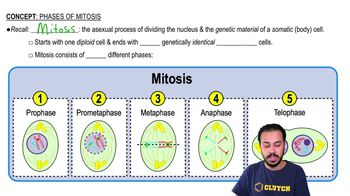
Mitosis is the process of cell division that results in two genetically identical daughter cells. It follows interphase and is divided into several stages: prophase, metaphase, anaphase, and telophase. Understanding mitosis is vital for comprehending how cells reproduce and how errors in this process can lead to diseases such as cancer.
Recommended video:
03:21
Phases of Mitosis