
Ch. 3 The Cell
Amerman - Human Anatomy & Physiology 2nd Edition
Amerman2nd EditionHuman Anatomy & PhysiologyISBN: 9780136873822Not the one you use?Change textbook
Chapter 3, Problem 5c

Mark the following statements about the plasma membrane as true or false. If a statement is false, correct it to make a true statement.
Membrane cholesterol is vital for cell-cell recognition.

Verified step by step guidance
1
Understand the role of cholesterol in the plasma membrane: Cholesterol is a lipid molecule that is embedded within the phospholipid bilayer of the plasma membrane. Its primary functions include maintaining membrane fluidity and stability, especially under varying temperature conditions.
Analyze the statement: The statement claims that membrane cholesterol is vital for cell-cell recognition. However, cell-cell recognition is primarily facilitated by glycoproteins and glycolipids, which are molecules with carbohydrate chains attached to proteins or lipids on the extracellular surface of the plasma membrane.
Determine the accuracy of the statement: Since cholesterol does not play a direct role in cell-cell recognition, the statement is false.
Correct the false statement: A corrected version of the statement would be: 'Membrane glycoproteins and glycolipids are vital for cell-cell recognition.'
Summarize the corrected understanding: Cholesterol is essential for maintaining the structural integrity and fluidity of the plasma membrane, but it is not directly involved in cell-cell recognition processes.

Verified video answer for a similar problem:

This video solution was recommended by our tutors as helpful for the problem above.
Was this helpful?

Key Concepts

Here are the essential concepts you must grasp in order to answer the question correctly.

Plasma Membrane Structure

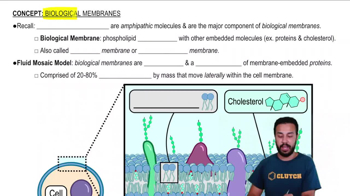
The plasma membrane is a phospholipid bilayer that surrounds and protects the cell, providing a barrier between the internal environment and the external surroundings. It contains various proteins, cholesterol, and carbohydrates that contribute to its fluidity and functionality, allowing selective permeability and communication with other cells.
Recommended video:
06:49
Biological Membranes

Role of Cholesterol in Membranes

Cholesterol is a lipid molecule that is interspersed within the phospholipid bilayer of the plasma membrane. It plays a crucial role in maintaining membrane fluidity, stability, and integrity, particularly in varying temperatures. However, cholesterol is not primarily responsible for cell-cell recognition, which is mainly facilitated by glycoproteins and glycolipids.
Recommended video:
06:49
Biological Membranes

Cell-Cell Recognition

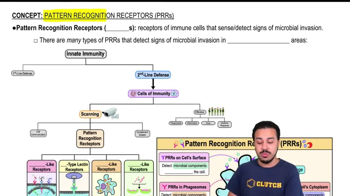
Cell-cell recognition is a biological process that allows cells to identify and interact with each other. This process is largely mediated by specific proteins and carbohydrates on the cell surface, such as glycoproteins and glycolipids, which serve as markers for cellular communication and signaling, rather than by cholesterol.
Recommended video:
4:24
Pattern Recognition Receptors
Related Practice
Textbook Question

Mark the following statements about the plasma membrane as true or false. If a statement is false, correct it to make a true statement.

Integral membrane proteins generally span the width of the plasma membrane, whereas peripheral proteins are found on only one side of the membrane.

778
views
Textbook Question

Mark the following statements about the plasma membrane as true or false. If a statement is false, correct it to make a true statement.

Membrane proteins often function as channels or carriers.

666
views
Textbook Question

Mark the following statements about the plasma membrane as true or false. If a statement is false, correct it to make a true statement.

The overall structure of the plasma membrane is a mosaic with the components locked tightly in place.

564
views
Textbook Question

Which of the following best describes the arrangement of the main component of the plasma membrane?

a. A monolayer of phospholipids with the phosphate heads facing the cytosol and the fatty acid tails facing the extracellular fluid

b. A bilayer of phospholipids with the phosphate heads facing the cytosol and extracellular fluid, and the fatty acid tails facing one another

c. A bilayer of phospholipids with the phosphate heads of one layer facing the fatty acid tails of the other

d. A bilayer of phospholipids with a layer of triglycerides sandwiched in the middle

846
views
Textbook Question

Mark the following statements about the plasma membrane as true or false. If a statement is false, correct it to make a true statement.

Cholesterol provides the plasma membrane with stability in the face of changing ion concentrations.

645
views
Textbook Question

What is the primary difference between active transport processes and passive transport processes?

650
views