Ch. 4 Histology
Amerman - Human Anatomy & Physiology 2nd Edition
Amerman2nd EditionHuman Anatomy & PhysiologyISBN: 9780136873822Not the one you use?Change textbook
Chapter 4, Problem 7c

Compare and contrast the following pairs of terms:
Holocrine secretion and merocrine secretion

Verified step by step guidance
1
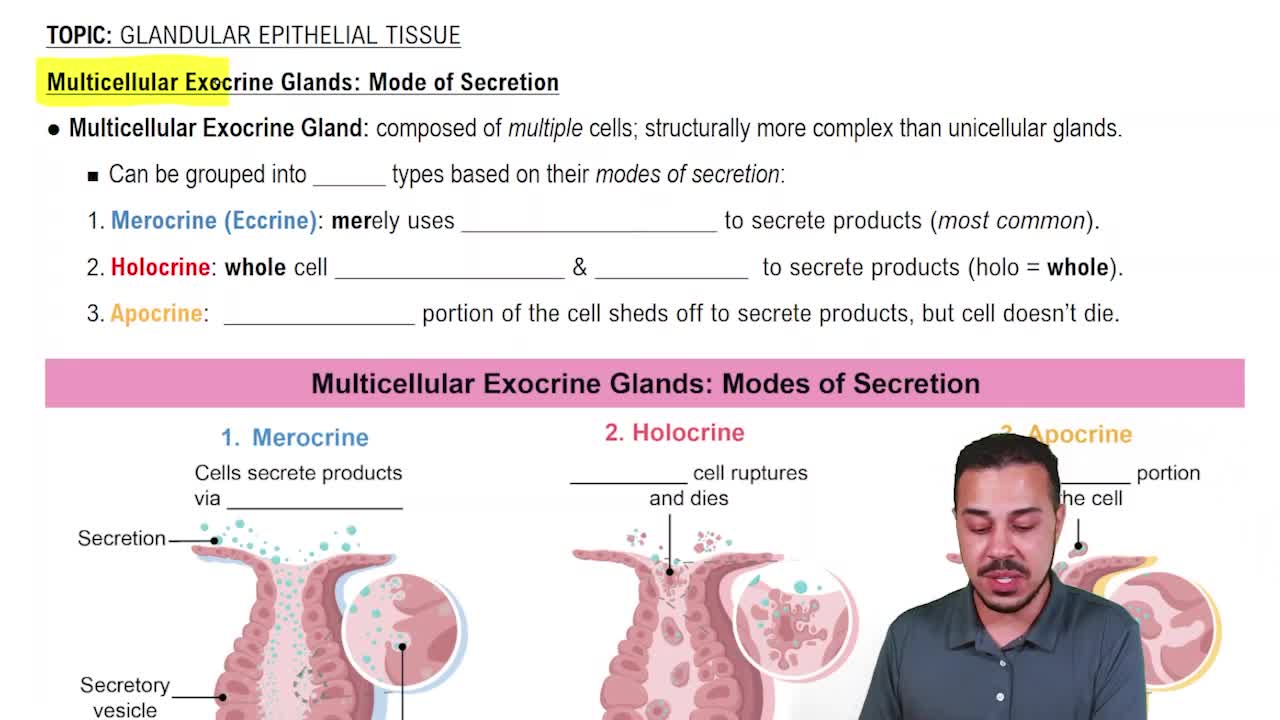
Define holocrine secretion: Holocrine secretion is a type of exocrine gland secretion where the entire cell disintegrates to release its contents. This process involves the accumulation of secretory products within the cell until the cell ruptures, releasing both the product and cellular debris into the duct. An example is sebaceous glands in the skin.
Define merocrine secretion: Merocrine secretion is another type of exocrine gland secretion where the secretory products are released via exocytosis. In this process, the cell remains intact and functional after secretion. An example is sweat glands (eccrine glands) in the skin.
Compare the mechanisms: Holocrine secretion involves the destruction of the entire cell, while merocrine secretion preserves the cell's structure and function. This makes holocrine secretion a more energy-intensive process due to the need for constant cell regeneration.
Contrast the cellular impact: In holocrine secretion, the cell dies as part of the secretion process, whereas in merocrine secretion, the cell remains alive and continues to produce secretions over time.
Provide examples for clarity: Holocrine secretion is exemplified by sebaceous glands, which produce oily secretions for the skin and hair. Merocrine secretion is exemplified by eccrine sweat glands, which produce watery sweat to regulate body temperature.

Verified video answer for a similar problem:

This video solution was recommended by our tutors as helpful for the problem above.
Was this helpful?

Key Concepts

Here are the essential concepts you must grasp in order to answer the question correctly.

Holocrine Secretion

Holocrine secretion is a type of exocrine secretion where the entire cell disintegrates to release its contents. This process involves the accumulation of secretory products within the cell, leading to cell death and the release of both the cell's cytoplasm and its secretory products. An example of holocrine secretion is seen in sebaceous glands, which produce sebum for skin lubrication.
Recommended video:
Guided course
05:35
Modes of Secretion: Merocrine, Holocrine & Apocrine

Merocrine Secretion

Merocrine secretion is a mode of exocrine secretion where cells release their products via exocytosis without any loss of cellular material. This process allows the cell to remain intact while continuously producing and secreting substances. Sweat glands are a classic example of merocrine secretion, as they release sweat through ducts without damaging the glandular cells.
Recommended video:
Guided course
05:35
Modes of Secretion: Merocrine, Holocrine & Apocrine

Exocrine Glands

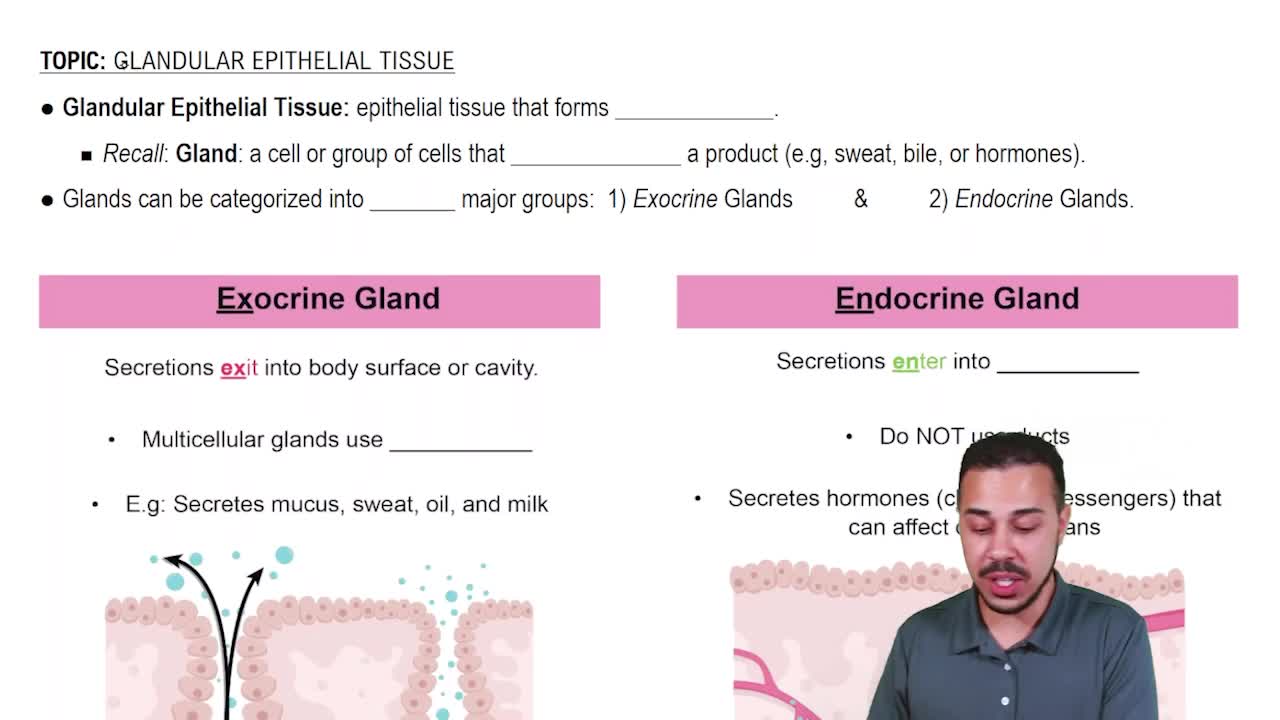
Exocrine glands are glands that secrete their products through ducts to the external environment or into body cavities. They can be classified based on their secretion methods, such as holocrine and merocrine. Understanding the differences in secretion types helps in comprehending how various glands function and their roles in physiological processes, such as thermoregulation and lubrication.
Recommended video:
Guided course
06:14
Exocrine vs. Endocrine Glands