Ch. 4 Histology
Amerman - Human Anatomy & Physiology 2nd Edition
Amerman2nd EditionHuman Anatomy & PhysiologyISBN: 9780136873822Not the one you use?Change textbook
Chapter 4, Problem 12

____are the cells of nervous tissue that send and receive messages, and ____ are the supporting cells of nervous tissue.
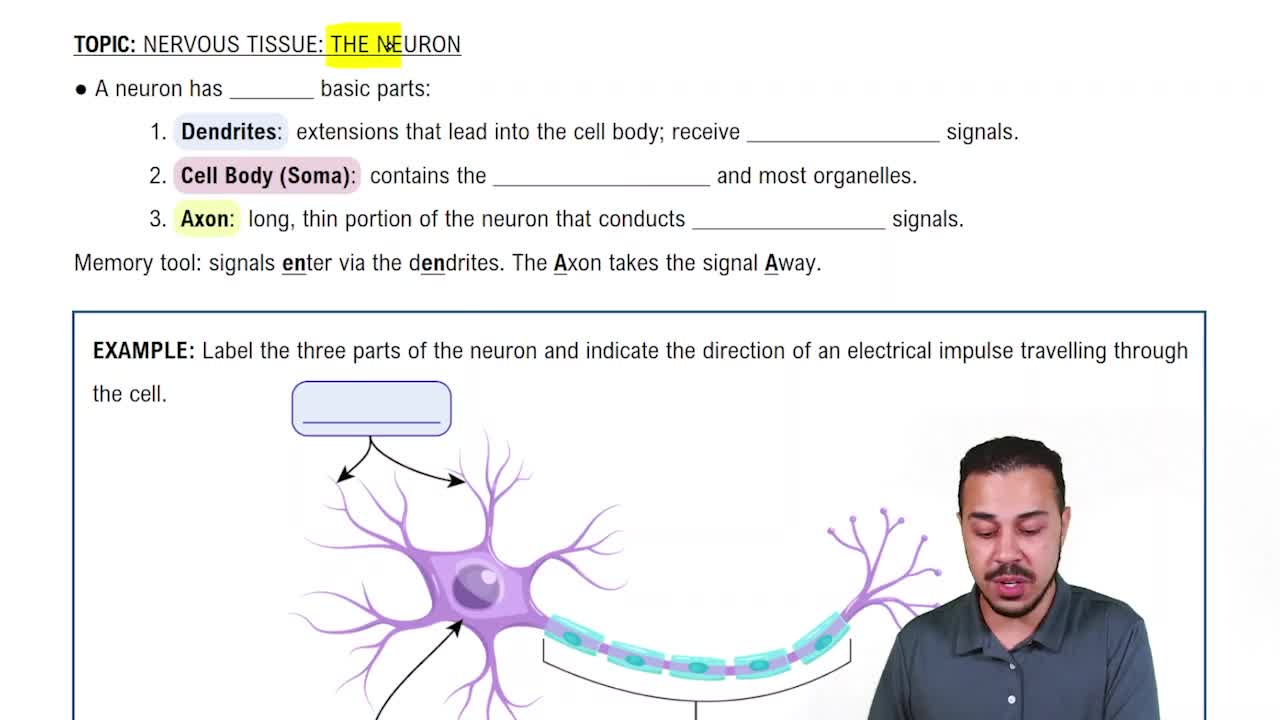
An ____ carries a nerve impulse toward a neuron cell body, and a(n) ____carries a nerve impulse away from a neuron cell body.

Verified step by step guidance
1
Step 1: Understand the structure of nervous tissue. Nervous tissue is composed of two main types of cells: neurons and neuroglia (also called glial cells). Neurons are responsible for sending and receiving messages, while neuroglia provide support and protection for neurons.
Step 2: Identify the role of neurons. Neurons are the functional units of the nervous system that transmit electrical signals. They consist of three main parts: the cell body (soma), dendrites, and axon.
Step 3: Define the function of dendrites. Dendrites are extensions of the neuron that carry nerve impulses *toward* the cell body. They receive signals from other neurons or sensory receptors.
Step 4: Define the function of the axon. The axon is a long projection of the neuron that carries nerve impulses *away* from the cell body to other neurons, muscles, or glands.
Step 5: Summarize the relationships. Neurons send and receive messages, neuroglia support neurons, dendrites carry impulses toward the cell body, and axons carry impulses away from the cell body.

Verified video answer for a similar problem:

This video solution was recommended by our tutors as helpful for the problem above.
Was this helpful?

Key Concepts

Here are the essential concepts you must grasp in order to answer the question correctly.

Neurons

Neurons are the fundamental cells of the nervous system responsible for transmitting information throughout the body. They send and receive electrical signals, known as nerve impulses, which facilitate communication between different parts of the body and the brain. Neurons consist of three main parts: the cell body, dendrites, and axon, each playing a crucial role in the transmission of signals.
Recommended video:

Glial Cells

Glial cells, or neuroglia, are the supporting cells of nervous tissue that provide structural and functional support to neurons. They play various roles, including maintaining homeostasis, forming myelin, and providing protection and support for neurons. Unlike neurons, glial cells do not transmit nerve impulses but are essential for the overall health and functionality of the nervous system.
Recommended video:
05:33
Cell Junctions

Axon and Dendrite

The axon and dendrite are two critical components of a neuron that facilitate the flow of nerve impulses. The dendrite receives signals from other neurons and carries them toward the cell body, while the axon transmits impulses away from the cell body to other neurons or muscles. This directional flow of information is vital for effective communication within the nervous system.
Recommended video:
Related Practice
Textbook Question

Each of the following statements is false. Correct each to make a true statement.

Mucous membranes are composed of mesothelium and the underlying loose connective tissue.

929
views

Textbook Question

Which of the following statements about muscle tissue is false?

a. Smooth muscle tissue is involuntary, and the cells are nonstriated.

b. Cardiac muscle tissue is involuntary, and the cells are striated.

c. Skeletal muscle fibers are joined by intercalated discs.

d. Skeletal muscle fibers are long and cylindrical striated cells.

1114
views
Textbook Question

Match the following types of connective tissue with their correct location(s). 

Hyaline cartilage           

Elastic cartilage           

Smooth muscle           

Dense irregular connective tissue           

Fibrocartilage

Cardiac muscle

Dense regular elastic tissue

Reticular connective tissue 

a. Dermis, surrounding joints, organs

b. Most hollow organs, eye, skin

c. Large arteries, certain ligaments

d. Ear and epiglottis

e. Lymph nodes, spleen, liver

f. Freely moveable joints

g. Intervertebral discs, knee joint

h. Heart

1230
views
Textbook Question

Mark the following statements as true or false. If a statement is false, correct it to make a true statement.

The ECM of bone tissue consists exclusively of calcium phosphate crystals.

671
views
Textbook Question

Each of the following statements is false. Correct each to make a true statement.

Mesothelial cells secrete mucus.

798
views
Textbook Question

Each of the following statements is false. Correct each to make a true statement.

Synoviocytes are the secretory cells of mucosae.

743
views