Ch. 4 Histology
Amerman - Human Anatomy & Physiology 2nd Edition
Amerman2nd EditionHuman Anatomy & PhysiologyISBN: 9780136873822Not the one you use?Change textbook
Chapter 4, Problem 2

State whether each of the following describes epithelial, connective, muscle, or nervous tissue.


a. ____ECM is often the primary element. 
b. ____Consists of excitable cells that are specialized for contraction. 
c. ____Sheets of tightly packed cells with little ECM. 
d. ____Makes up the majority of the brain and spinal cord. 
e. ____Cells may be smooth or striated. 
f. ____Binds, connects, supports, and transports substances throughout the body.

Verified step by step guidance
1
Step 1: Understand the four main tissue types in the human body: epithelial, connective, muscle, and nervous tissue. Each has distinct characteristics and functions.
Step 2: For part (a), identify which tissue type has extracellular matrix (ECM) as its primary element. Recall that connective tissue is characterized by a large amount of ECM, which provides structural and functional support.
Step 3: For part (b), determine which tissue type consists of excitable cells specialized for contraction. Muscle tissue is responsible for movement and is composed of excitable cells that contract in response to stimuli.
Step 4: For part (c), identify the tissue type that forms sheets of tightly packed cells with little ECM. Epithelial tissue fits this description, as it forms protective layers and linings with minimal ECM.
Step 5: For parts (d), (e), and (f), match the descriptions to the appropriate tissue types: (d) Nervous tissue makes up the brain and spinal cord, (e) Muscle tissue cells can be smooth or striated, and (f) Connective tissue binds, supports, and transports substances throughout the body.

Verified video answer for a similar problem:

This video solution was recommended by our tutors as helpful for the problem above.
Was this helpful?

Key Concepts

Here are the essential concepts you must grasp in order to answer the question correctly.

Epithelial Tissue

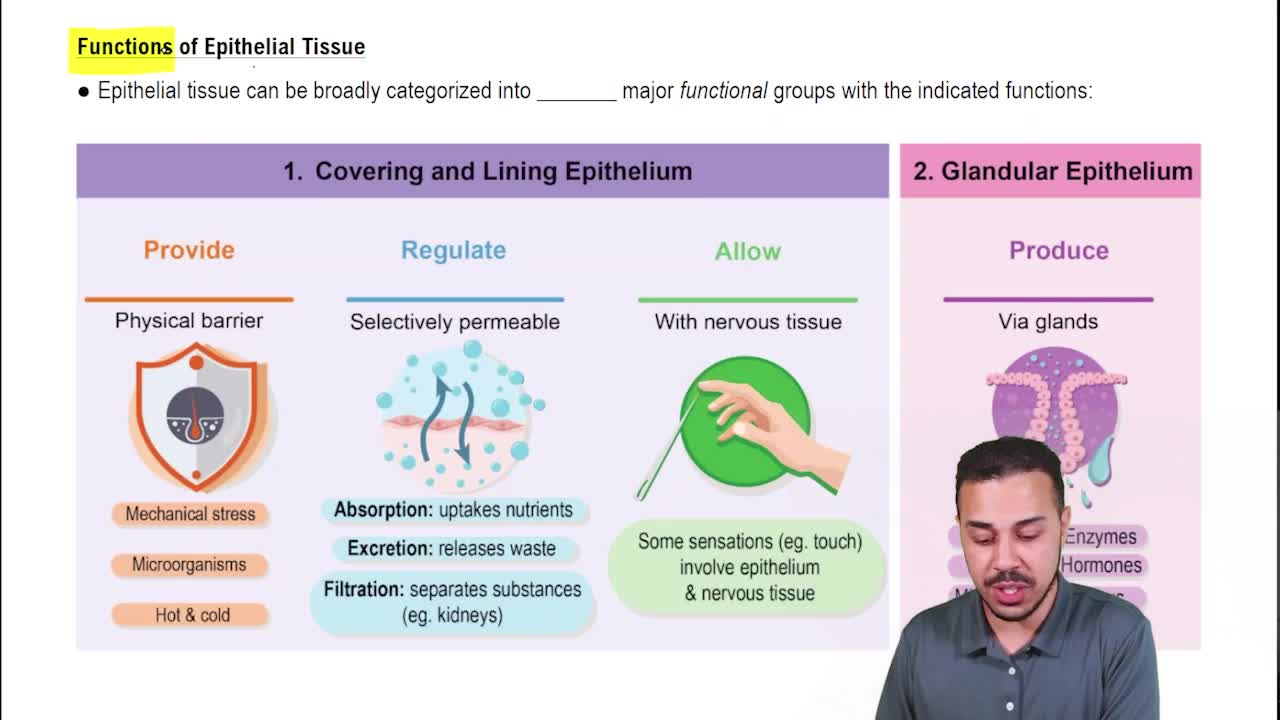
Epithelial tissue consists of sheets of tightly packed cells with minimal extracellular matrix (ECM). It serves as a protective barrier and is involved in absorption, secretion, and sensation. This type of tissue lines surfaces and cavities throughout the body, including the skin and the lining of organs.
Recommended video:
Guided course
07:25
Functions of Epithelial Tissue

Muscle Tissue

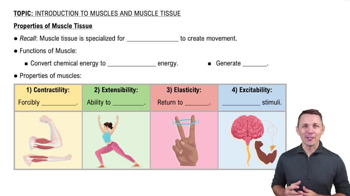
Muscle tissue is composed of excitable cells that are specialized for contraction, enabling movement. There are three types of muscle tissue: skeletal, cardiac, and smooth, each with distinct structures and functions. Skeletal muscle is striated and under voluntary control, while smooth muscle is non-striated and involuntary.
Recommended video:
Guided course
4:36
Properties of Muscle Tissue

Nervous Tissue

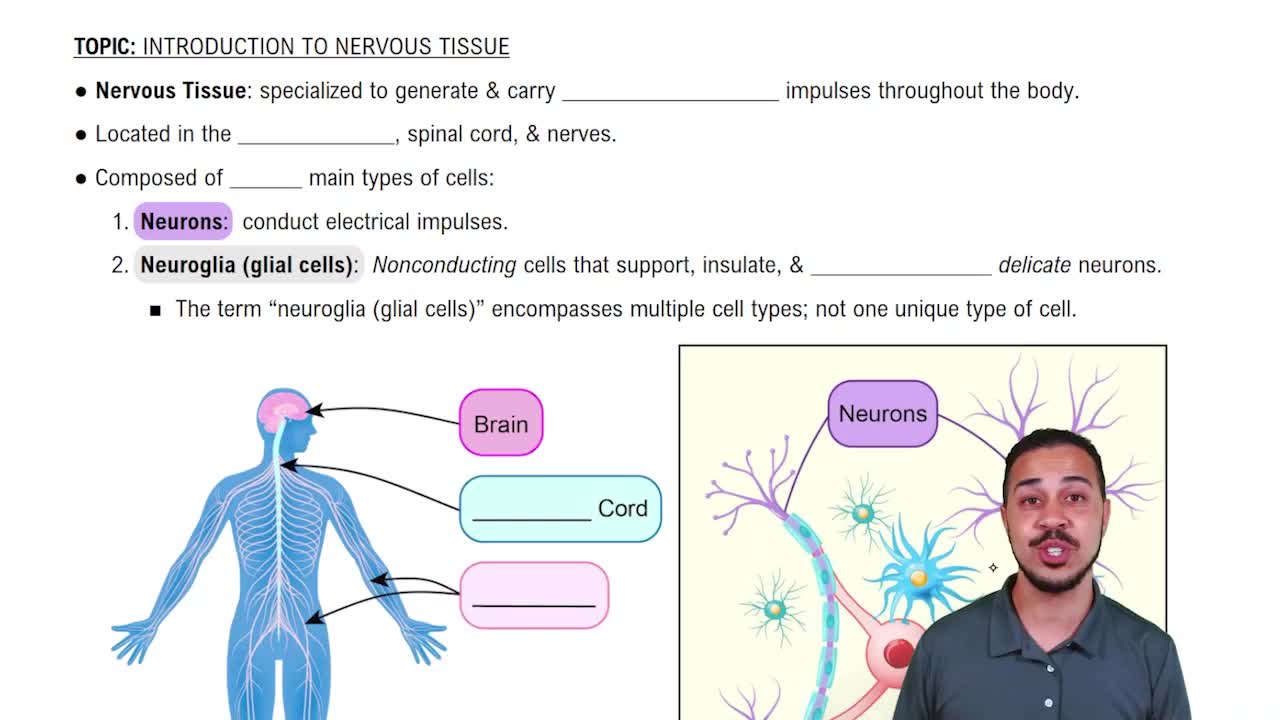
Nervous tissue makes up the majority of the brain and spinal cord and is responsible for transmitting electrical signals throughout the body. It consists of neurons, which are the excitable cells that carry impulses, and glial cells, which support and protect neurons. This tissue is crucial for coordinating bodily functions and responses.
Recommended video:
Guided course
04:36
Intro to Nervous Tissue