Ch. 6 Bones and Bone Tissue
Amerman - Human Anatomy & Physiology 2nd Edition
Amerman2nd EditionHuman Anatomy & PhysiologyISBN: 9780136873822Not the one you use?Change textbook
Chapter 6, Problem 17

Correctly order the following steps of fracture repair, placing a 1 by the first step, a 2 by the second step, and so on.
Osteoblasts in the periosteum lay down a bone callus of primary bone.
Damaged blood vessels bleed and fill the gap between the bone fragments with a hematoma.
The bone callus is remodeled and replaced with secondary bone.
Fibroblasts, chondroblasts, and blood vessels enter the clot, and the soft callus begins to bridge the gap between bone fragments.

Verified step by step guidance
1
Step 1: Begin by identifying the initial response to a fracture, which involves damaged blood vessels bleeding and filling the gap between the bone fragments with a hematoma. This is the body's immediate reaction to injury.
Step 2: Next, fibroblasts, chondroblasts, and blood vessels enter the clot formed by the hematoma. These cells work together to form a soft callus, which begins to bridge the gap between the bone fragments.
Step 3: Following the formation of the soft callus, osteoblasts in the periosteum lay down a bone callus composed of primary bone. This step strengthens the fracture site.
Step 4: Finally, the bone callus undergoes remodeling and is replaced with secondary bone. This process restores the bone's original structure and function.

Verified video answer for a similar problem:

This video solution was recommended by our tutors as helpful for the problem above.
Was this helpful?

Key Concepts

Here are the essential concepts you must grasp in order to answer the question correctly.

Fracture Repair Stages

Fracture repair occurs in a series of stages: inflammation, soft callus formation, hard callus formation, and remodeling. Initially, a hematoma forms at the fracture site, followed by the development of a soft callus made of cartilage. This is then replaced by a hard callus of primary bone, which is later remodeled into secondary bone, restoring the bone's original structure and strength.
Recommended video:
03:20
DNA Repair

Role of Osteoblasts

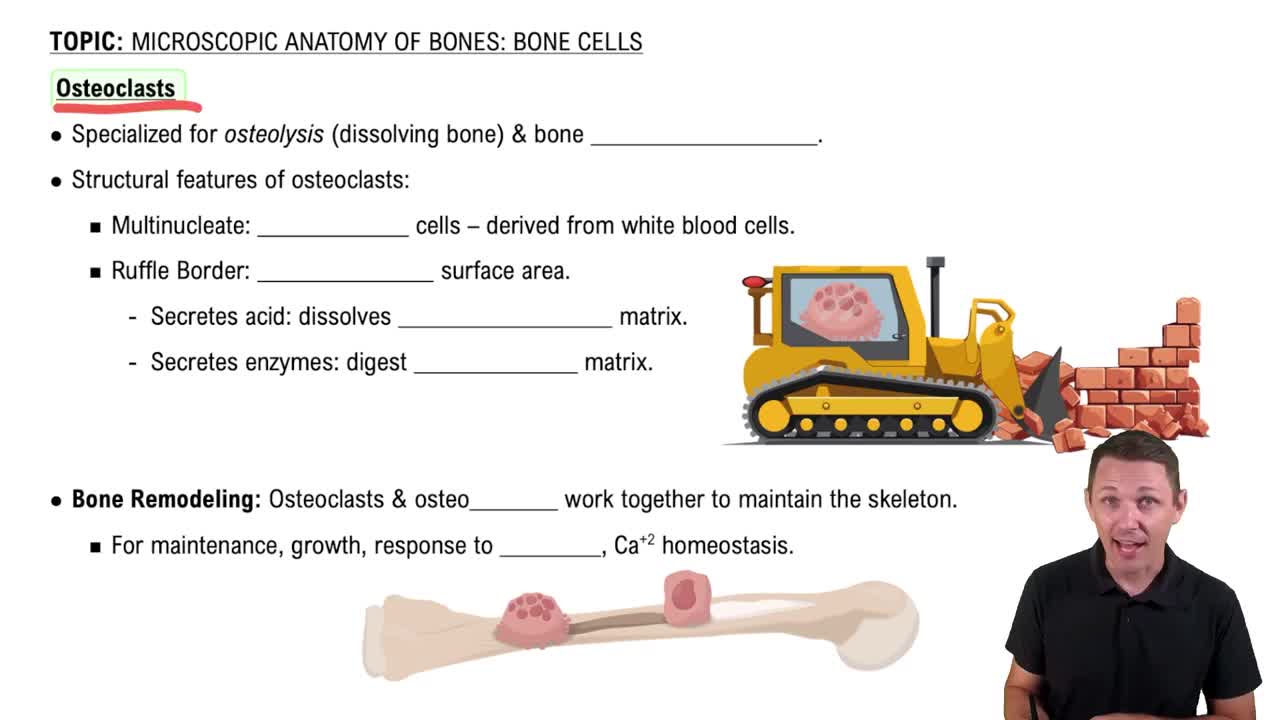
Osteoblasts are specialized cells responsible for bone formation. During the fracture repair process, they play a crucial role in laying down new bone material, forming a hard callus that stabilizes the fracture. Their activity is essential for the transition from the soft callus to the hard callus stage, ultimately leading to the restoration of bone integrity.
Recommended video:

Hematoma Formation

Hematoma formation is the initial response to a bone fracture, where damaged blood vessels bleed into the fracture site, creating a blood clot. This hematoma serves as a scaffold for the migration of cells involved in healing, including fibroblasts and osteoblasts. It is critical for initiating the inflammatory response and setting the stage for subsequent healing processes.
Recommended video:
9:43
Platelet Plug Formation