Ch. 7 The Skeletal System
Amerman - Human Anatomy & Physiology 2nd Edition
Amerman2nd EditionHuman Anatomy & PhysiologyISBN: 9780136873822Not the one you use?Change textbook
Chapter 7, Problem L3.2

Mrs. Dent presents to the clinic with back pain. During the exam, you notice that she has severe kyphosis, and you suspect a vertebral fracture. What specific part of her vertebra is likely to be fractured, considering her deformity? Explain.

Verified step by step guidance
1
Kyphosis is an excessive outward curvature of the thoracic spine, often leading to a hunched posture. This condition increases stress on the vertebrae, particularly in the thoracic region.
The vertebral body is the most likely part of the vertebra to be fractured in cases of kyphosis. This is because the vertebral body bears the majority of the weight and is subjected to compressive forces, especially in individuals with weakened bones, such as those with osteoporosis.
Osteoporosis is a common underlying condition that predisposes individuals to vertebral fractures. It leads to decreased bone density and structural integrity, making the vertebral body more susceptible to compression fractures.
Compression fractures of the vertebral body can exacerbate kyphosis, creating a cycle of worsening deformity and increased risk of further fractures. This is due to the collapse of the anterior portion of the vertebral body, which contributes to the forward curvature of the spine.
To confirm the diagnosis, imaging studies such as X-rays, CT scans, or MRI can be used to visualize the fracture and assess the extent of kyphosis. These tools also help identify any underlying conditions, such as osteoporosis, that may need to be addressed.

Verified video answer for a similar problem:

This video solution was recommended by our tutors as helpful for the problem above.
Was this helpful?

Key Concepts

Here are the essential concepts you must grasp in order to answer the question correctly.

Kyphosis

Kyphosis is a spinal condition characterized by an excessive outward curvature of the thoracic spine, leading to a hunchback appearance. It can result from various factors, including degenerative diseases, osteoporosis, or trauma. Understanding kyphosis is crucial in assessing potential complications, such as vertebral fractures, particularly in older adults.

Vertebral Fracture

A vertebral fracture occurs when one of the bones in the spine (vertebrae) breaks, often due to trauma or conditions like osteoporosis. In patients with kyphosis, the vertebrae are more susceptible to fractures due to altered biomechanics and increased stress on the vertebral bodies. Identifying the specific type of fracture is essential for appropriate management and treatment.
Recommended video:
Guided course
6:29
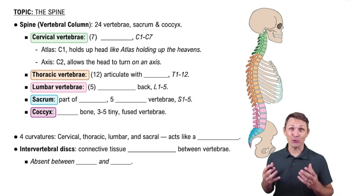
Spine (Vertebral Column)

Vertebral Body

The vertebral body is the large, cylindrical part of a vertebra that bears weight and provides structural support to the spine. In cases of kyphosis, the anterior portion of the vertebral body is often compromised, leading to fractures. Recognizing the role of the vertebral body in spinal stability helps in understanding the implications of fractures in patients with spinal deformities.
Recommended video:
Guided course
3:20
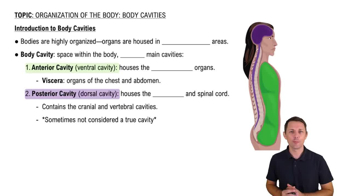
Introduction to Body Cavities
Related Practice
Textbook Question

Mark the following statements as true or false. If a statement is false, correct it to make a true statement.


c. The sella turcica of the sphenoid bone houses the pituitary gland.

1221
views

Textbook Question

Predict where each of the following structures is located, based on your knowledge of skeletal anatomy and anatomical terms (your answers should be along the lines of 'lateral crural region' or 'posterior cervical region').


a. Frontal lobe of brain

b. Suprahyoid muscle

c. Ulnar artery

d. Tibial nerve

e. Intercostal muscle

f. External iliac artery

967
views
2
rank
Textbook Question

Ms. Hendrix suffered a severe hip fracture that required hip replacement surgery. After an extended recovery period, she is undergoing physical therapy to regain strength and mobility.

Which bone is involved in a hip fracture, and what part of the bone is likely to be fractured?

781
views
Textbook Question

Mark the following statements as true or false. If a statement is false, correct it to make a true statement.


b. The cribriform plate is a component of the ethmoid bone.

912
views
Textbook Question

Mark the following statements as true or false. If a statement is false, correct it to make a true statement.


a. The four paranasal sinuses are the frontal, parietal, sphenoidal, and mandibular sinuses.

1001
views
Textbook Question

A deviated septum results when the nasal septum is shifted to one side or the other. What bones might be involved in this condition? Why might this make breathing difficult?

1253
views
1
rank