The inferior portion of the sternum is the_____ . The superior portion of the sternum is the_____, and it articulates with the______ and the first rib.
Ch. 7 The Skeletal System
Chapter 7, Problem 9
Transverse foramina are a characteristic of which kind of vertebra?
a. Thoracic
b. Lumbar
c. Sacral
d. Cervical
Verified step by step guidance1
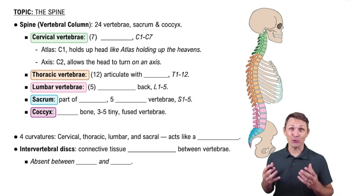
Understand the anatomy of the vertebrae: The vertebral column is divided into different regions—cervical, thoracic, lumbar, sacral, and coccygeal. Each region has unique characteristics that distinguish its vertebrae.
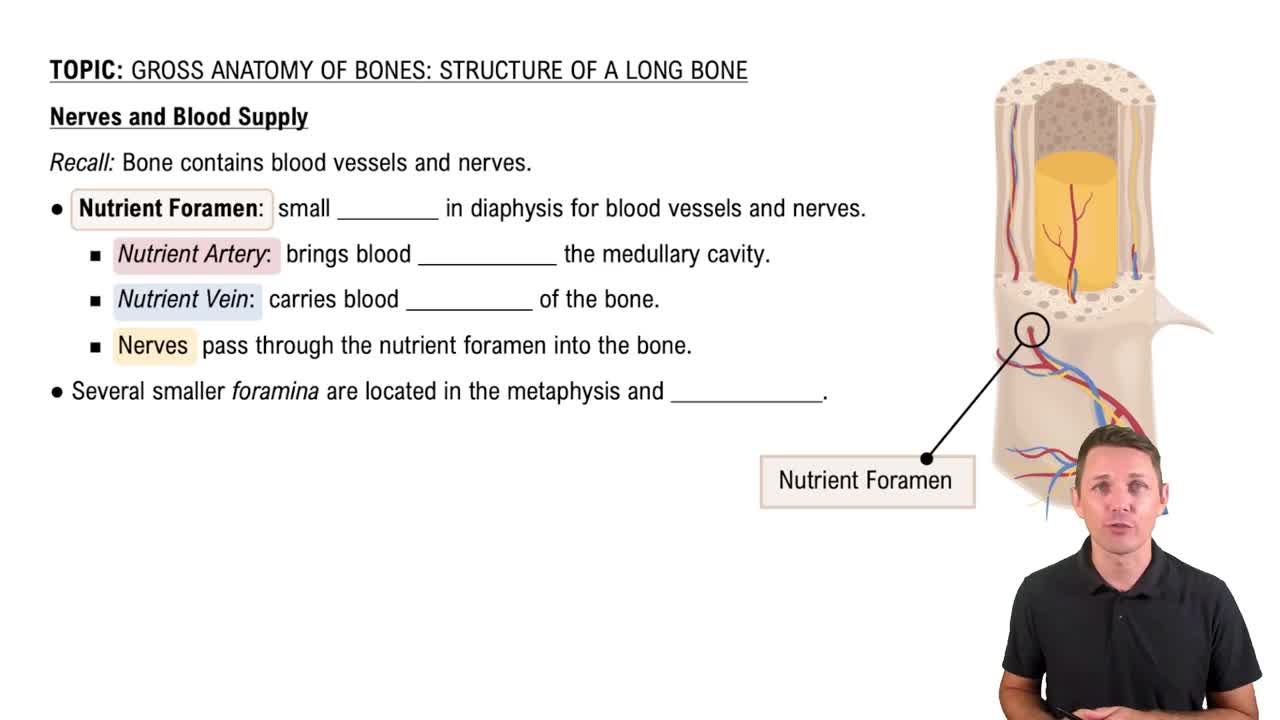
Learn about transverse foramina: Transverse foramina are openings found in the transverse processes of certain vertebrae. These foramina allow the passage of the vertebral arteries, veins, and associated nerves.
Identify the vertebrae with transverse foramina: Transverse foramina are a defining feature of cervical vertebrae. These foramina are present in all cervical vertebrae except for the seventh (C7), where they may be smaller or absent.
Eliminate other options: Thoracic vertebrae are characterized by facets for rib articulation, lumbar vertebrae are large and robust to support weight, and sacral vertebrae are fused to form the sacrum. None of these have transverse foramina.
Conclude that the correct answer is cervical vertebrae, as they are the only type of vertebrae with transverse foramina.

Verified video answer for a similar problem:
This video solution was recommended by our tutors as helpful for the problem above.
Was this helpful?
Key Concepts
Here are the essential concepts you must grasp in order to answer the question correctly.
Transverse Foramina
Transverse foramina are small openings located in the transverse processes of certain vertebrae. They serve as passageways for the vertebral arteries and veins, which supply blood to the brain. This anatomical feature is primarily found in cervical vertebrae, distinguishing them from other types of vertebrae.
Recommended video:
Guided course
Nerves and Blood Supply
Cervical Vertebrae
Cervical vertebrae are the seven vertebrae located in the neck region of the spine, labeled C1 to C7. They are characterized by their smaller size and unique features, such as the presence of transverse foramina. These vertebrae support the head and allow for a wide range of motion, including rotation and flexion.
Recommended video:
Guided course
Spine (Vertebral Column)
Vertebral Column Anatomy
The vertebral column, or spine, is composed of 33 vertebrae divided into five regions: cervical, thoracic, lumbar, sacral, and coccygeal. Each region has distinct characteristics and functions, with cervical vertebrae being specialized for mobility and protection of the spinal cord. Understanding the anatomy of the vertebral column is essential for identifying the specific features of different vertebrae.
Recommended video:
Guided course
Spine (Vertebral Column)
Related Practice
Textbook Question
867
views
Textbook Question
Which of the following portions of the scapula articulates with the clavicle?
a. Coracoid process
b. Acromion
c. Spine
d. Glenoid cavity
1096
views
1
rank
Textbook Question
Mark the following statements as true or false. If a statement is false, correct it to make a true statement.
b. A vertebral disc is composed of an inner anulus fibrosus and an outer nucleus pulposus.
855
views
Textbook Question
How do true, false, and floating ribs differ from one another?
1544
views
Textbook Question
Mark the following statements as true or false. If a statement is false, correct it to make a true statement.
c. The posterior projection from a vertebra is the spinous process.
805
views
Textbook Question
Mark the following statements as true or false. If a statement is false, correct it to make a true statement.
d. The sacral, coccygeal, and cervical vertebrae are fused in an adult.
891
views