
Ch. 9 The Muscular System
Amerman - Human Anatomy & Physiology 2nd Edition
Amerman2nd EditionHuman Anatomy & PhysiologyISBN: 9780136873822Not the one you use?Change textbook
Chapter 9, Problem 4

The action of the biceps brachii muscle on the hinge joint of the elbow is an example of which kind of lever system?
a. First class
b. Second class
c. Third class
d. Fourth class

Verified step by step guidance
1
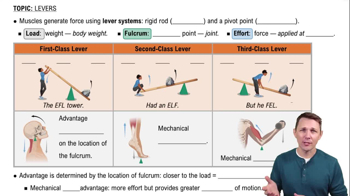
Understand the three types of lever systems in the human body: First-class levers have the fulcrum between the effort and the load, second-class levers have the load between the effort and the fulcrum, and third-class levers have the effort between the load and the fulcrum.
Identify the components of the lever system in the action of the biceps brachii muscle at the elbow joint: The fulcrum is the hinge joint of the elbow, the load is the weight being lifted (e.g., the forearm or an object in the hand), and the effort is the contraction of the biceps brachii muscle.
Determine the position of the effort relative to the fulcrum and the load: In this case, the effort (biceps brachii contraction) is applied between the fulcrum (elbow joint) and the load (forearm or object being lifted).
Compare this arrangement to the definitions of the lever systems: Since the effort is between the fulcrum and the load, this matches the characteristics of a third-class lever system.
Conclude that the action of the biceps brachii muscle on the hinge joint of the elbow is an example of a third-class lever system.

Verified video answer for a similar problem:

This video solution was recommended by our tutors as helpful for the problem above.
Was this helpful?

Key Concepts

Here are the essential concepts you must grasp in order to answer the question correctly.

Lever Systems

A lever system consists of a rigid bar (the lever) that pivots around a fixed point called the fulcrum. In biomechanics, levers are classified into three types based on the relative positions of the effort, load, and fulcrum. Understanding these classifications helps in analyzing how muscles and joints work together to produce movement.
Recommended video:
Guided course
8:14
Lever Systems

Types of Levers

There are three classes of levers: first class, second class, and third class. In a first-class lever, the fulcrum is between the effort and the load (e.g., a seesaw). In a second-class lever, the load is between the fulcrum and the effort (e.g., a wheelbarrow). In a third-class lever, the effort is applied between the fulcrum and the load (e.g., the biceps brachii at the elbow).
Recommended video:
Guided course
8:14
Lever Systems

Biceps Brachii and Elbow Joint

The biceps brachii muscle acts on the elbow joint, which is a hinge joint allowing flexion and extension. When the biceps contracts, it applies force to the forearm, lifting the load (e.g., weight in the hand). This action exemplifies a third-class lever system, where the effort (muscle contraction) is applied between the fulcrum (elbow joint) and the load (weight in hand).
Recommended video:
08:25
Structural Joint Classifications
Related Practice
Textbook Question

Mr. Bell presents with the inability to move certain muscles on one side of his face. You ask him to make various facial expressions and find that on his right side he is unable to purse his lips, pull in his cheeks, elevate his upper lip, and smirk. What muscles is Mr. Bell unable to contract?

558
views
Textbook Question

Mark the following statements as true or false. If the statement is false, correct it to make a true statement.

The main action of the zygomaticus major and minor muscles is to pull the corners of the mouth up to produce smiling.

782
views
Textbook Question

Ms. Cho presents with muscle pain in the area around her anterior neck and superior chest. She explains that she has had a respiratory infection over the past 2 weeks that made it hard for her to breathe. What is likely causing her muscle soreness? (Hint: Remember that the origin and insertion of some muscles can switch and that one likely has to breathe more deeply with a respiratory infection.)

812
views
Textbook Question

Which function is being fulfilled by a muscle that holds a bone steady during movement?

a. Antagonist

b. Synergist

c. Supinator

d. Fixator

1202
views
Textbook Question

Ms. Hendrix suffered a severe hip fracture that required hip replacement surgery. After an extended recovery period, she is undergoing physical therapy to regain strength and mobility.

Which actions could Ms. Hendrix perform to strengthen these muscles?

701
views
Textbook Question

Mark the following statements as true or false. If the statement is false, correct it to make a true statement.

The orbicularis oris muscle is located around the eye.

908
views