

Mr. Yao is a patient with kidney disease who presents to your clinic for monitoring. You notice on his chart that his GFR was estimated through inulin administration to be about 35 ml/min. What does this tell you about the health of his kidneys? Mr. Yao is taking a medication that is normally excreted from the body in the urine. You order blood work and find that the concentration of this medication in his plasma is much higher than normal. How does his decreased GFR explain the elevated level of medication in his plasma?
Drugs that treat hypertension, or high blood pressure, have the following actions. Discuss the specific effect that each drug will have on the kidneys.
b. Blocking the receptor for angiotensin-II on blood vessels and in the renal tubule cells
Verified step by step guidance
Verified video answer for a similar problem:
Key Concepts
Angiotensin II Receptor Blockade
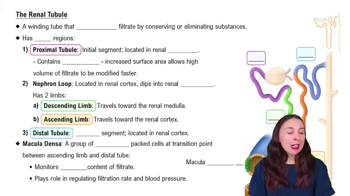
Renal Tubule Function
Hypertension and Kidney Health
Explain how each of the drugs in question 1 from this section would lower blood pressure.
Deana is a 4-year-old girl with a rare genetic defect that causes the Na+/glucose symporters in the proximal tubule to reabsorb fewer glucose and sodium ions than normal. Predict the effects this defect will have on the composition and volume of Deana's urine. Explain why you would expect to see increased activity of the tubuloglomerular feedback and the renin-angiotensin-aldosterone system in Deana's kidneys.
Mark the following statements as true or false. If a statement is false, correct it to make a true statement.
c. The first capillary bed of the kidneys is the peritubular capillaries, which are fed by the afferent arteriole and drained by the efferent arteriole.
Mark the following statements as true or false. If a statement is false, correct it to make a true statement.
b. Internally, the kidneys consist of an outer renal medulla, a middle renal pelvis, and an inner renal cortex.
Mark the following statements as true or false. If a statement is false, correct it to make a true statement.
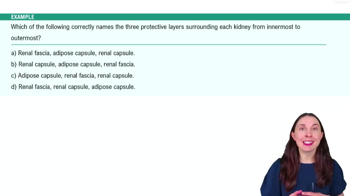
a. The kidneys are retroperitoneal and covered by three layers of connective tissue.
