
Ch. 10 The Muscular System
Hoehn - Marieb Human Anatomy & Physiology, 12th edition
Hoehn, Haynes, Abbott12th EditionMarieb Human Anatomy & PhysiologyISBN: 9780138242732Not the one you use?Change textbook
Chapter 10, Problem 24

Assume you have a 10-lb weight in your right hand. Explain why it is easier to flex the right elbow when your forearm is supinated than when it is pronated.

Verified step by step guidance
1
Step 1: Understand the anatomy involved in elbow flexion, focusing on the primary muscles responsible, especially the biceps brachii and brachialis muscles.
Step 2: Recognize that the biceps brachii is a strong flexor of the elbow and also a powerful supinator of the forearm, meaning it works best when the forearm is supinated.
Step 3: Note that when the forearm is supinated, the biceps brachii has a mechanical advantage because its tendon is optimally positioned to generate force and flex the elbow efficiently.
Step 4: When the forearm is pronated, the biceps brachii tendon is twisted and less able to exert force effectively, so the brachialis muscle, which is not affected by forearm position, becomes the primary flexor but is generally less powerful than the biceps in this position.
Step 5: Conclude that because the biceps brachii contributes more force during supination, it is easier to flex the elbow with the forearm supinated than pronated when holding a 10-lb weight.

Verified video answer for a similar problem:

This video solution was recommended by our tutors as helpful for the problem above.
Video duration:
3m
Was this helpful?

Key Concepts

Here are the essential concepts you must grasp in order to answer the question correctly.

Forearm Supination and Pronation

Supination and pronation refer to the rotational movements of the forearm. Supination turns the palm upward or forward, while pronation turns it downward or backward. These positions affect the alignment and function of muscles involved in elbow flexion.
Recommended video:
Guided course
5:30
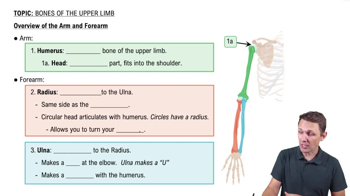
Overview of the Arm and Forearm

Muscle Mechanics of Elbow Flexion

Elbow flexion primarily involves the biceps brachii and brachialis muscles. The biceps brachii is more effective when the forearm is supinated because its tendon attaches to the radius, which rotates during supination, enhancing its leverage.
Recommended video:
Guided course
5:41
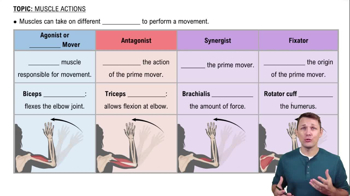
Muscle Actions

Biomechanical Advantage and Lever Systems

Muscle force effectiveness depends on the lever arm length and joint position. When the forearm is supinated, the biceps brachii has a better mechanical advantage, increasing torque and making it easier to lift weights compared to the pronated position.
Recommended video:
Guided course
8:14
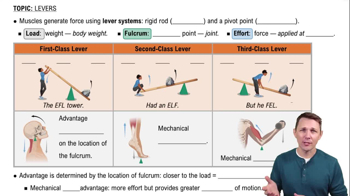
Lever Systems
Related Practice
Textbook Question

Mr. Ahmadi, an out-of-shape 45-year-old man, was advised by his physician to lose weight and to exercise on a regular basis. He followed his diet faithfully and began to jog daily. One day, while on his morning jog, he heard a snapping sound that was immediately followed by a severe pain in his right lower calf. When his leg was examined, a gap was seen between his swollen upper calf region and his heel, and he was unable to plantar flex that ankle. What do you think happened? Why was the upper part of his calf swollen?

1049
views
Textbook Question

Name two muscles in each of the following compartments or regions:

a. thenar eminence (ball of thumb)

b. posterior compartment of forearm

c. anterior compartment of forearm—deep muscle group

d. anterior muscle group in the arm

e. muscles of mastication

982
views
Textbook Question

As Kendra's coach watched her sail over the high jump bar, he contracted his right orbicularis oculi muscle, raised his arm, and contracted his opponens pollicis. Was he pleased or displeased with her performance? How do you know?

856
views
Textbook Question

When Mrs. O'Brien returned to her doctor for a follow-up visit after childbirth, she complained that she was incontinent (having problems controlling her urine flow) when she sneezed. The physician asked his nurse to give Mrs. O'Brien instructions on how to perform exercises to strengthen the muscles of the pelvic floor. To which muscles was he referring?

1043
views
Textbook Question

What class of lever system do the following activities describe?

a. The soleus muscle plantar flexes the foot.

b. The triceps brachii is strained while doing pushups.

1204
views