Differentiate between the arrangement of elements (load, fulcrum, and effort) in first-, second-, and third-class levers.
Ch. 10 The Muscular System
Hoehn, Haynes, Abbott12th EditionMarieb Human Anatomy & PhysiologyISBN: 9780138242732Not the one you use?Change textbook
Chapter 10, Problem 15
Name and describe the action of muscles used to shake your head no; to nod yes.
Verified step by step guidance1
Identify the primary muscle responsible for shaking your head 'no'. This action involves rotating the head from side to side, which is mainly performed by the sternocleidomastoid muscles located on each side of the neck.
Describe the action of the sternocleidomastoid muscles: when one sternocleidomastoid contracts, it rotates the head to the opposite side, enabling the 'no' motion. When both contract together, they flex the neck.
Identify the muscles responsible for nodding your head 'yes'. This movement is primarily a flexion and extension of the neck, involving the muscles at the back and front of the neck.
Describe the action of the muscles used to nod 'yes': the primary muscles involved are the sternocleidomastoid (for flexion) and the splenius capitis and semispinalis capitis muscles (for extension), which allow the head to move up and down.
Summarize by linking each muscle to its specific action: sternocleidomastoid for head rotation ('no'), and a combination of sternocleidomastoid and posterior neck muscles for head flexion and extension ('yes').

Verified video answer for a similar problem:
This video solution was recommended by our tutors as helpful for the problem above.
Video duration:
2mWas this helpful?
Key Concepts
Here are the essential concepts you must grasp in order to answer the question correctly.
Muscle Actions in Head Movements
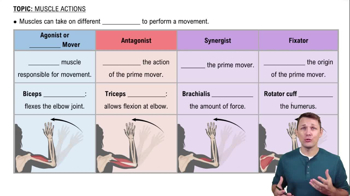
Muscle actions refer to the specific movements muscles produce when they contract. In head movements, muscles either rotate, flex, or extend the head. Understanding these actions helps identify which muscles are responsible for shaking the head 'no' or nodding 'yes'.
Recommended video:
Guided course
Muscle Actions
Muscles Involved in Shaking Head 'No'
Shaking the head 'no' involves lateral rotation of the head, primarily controlled by the sternocleidomastoid muscles. These muscles contract on one side to rotate the head to the opposite side, enabling the side-to-side 'no' motion.
Recommended video:
Guided course
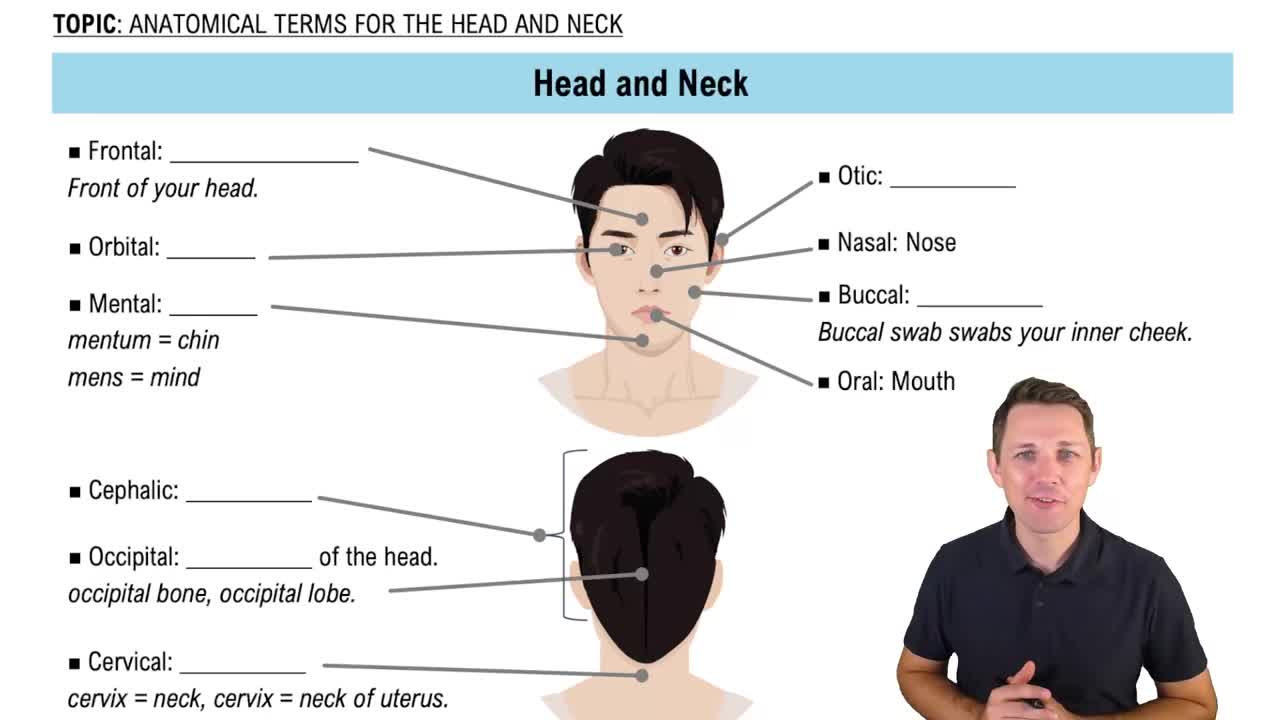
The Head and Neck
Muscles Involved in Nodding Head 'Yes'
Nodding the head 'yes' involves flexion and extension at the atlanto-occipital joint. The primary muscles responsible are the sternocleidomastoid and the splenius capitis, which work together to flex and extend the head forward and backward.
Recommended video:
Guided course
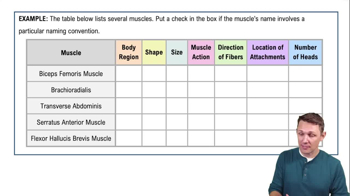
Muscle Naming Example 1
Related Practice
Textbook Question
1050
views
Textbook Question
Which criterion (or criteria) is/are used in naming the gluteus medius?
a. Relative size
b. Muscle location
c. Muscle shape
d. Action
e. Number of origins
1070
views
Textbook Question
Which muscles act to propel food down the length of the pharynx to the esophagus?
974
views
Textbook Question
Name four criteria used in naming muscles, and provide an example (other than those used in the text) that illustrates each criterion.
1410
views
Textbook Question
a. Name two forearm muscles that are powerful extensors and abductors of the hand.
b. Name the sole forearm muscle that can flex the distal interphalangeal joints.
1113
views
Textbook Question
Which of the following is a large, deep muscle that protracts the scapula during punching?
a. Serratus anterior
b. Rhomboids
c. Levator scapulae
d. Subscapularis
1031
views